

Not too long ago, I discovered something on social media that I had previously been unaware of.
I’m sure it wouldn’t seem like a big deal to some people, but I’d be lying if I said it didn’t bother me.
I mean, I’m going out on a limb here by revealing this and opening myself up to a lot of criticism.
I’m willing to accept whatever comes from sharing it because I believe people need to know about it.
The best way I can explain it is by using the internet as an example.
The internet has existed long enough for most of us to understand that there are risks involved in using it. One of the most frequently discussed topics is protecting your personal information. We all know how important it is to pay attention to where we shop, which websites we visit, and which platforms we trust with our data.
The people who understand these risks best often learn the hard way. Many have experienced identity theft or credit card fraud.
It usually begins with unauthorized purchases appearing on an account. Charges show up that the account holder never made.
Unfortunately, this type of crime has become so common that most banks have streamlined the process. Today, you can often report fraud, freeze your cards, request an investigation, and begin replacing your cards and account numbers without ever stepping inside a branch.
Sometimes, depending on the institution and the circumstances, the bank may decide not to close the compromised account immediately.
Instead, it continues monitoring activity.
The goal is to gather information that may help identify the person responsible.
Even when your money is protected, the experience can still be deeply unsettling. There is something disturbing about watching someone violate your financial security from behind a screen.
You never see it coming. You never see the person responsible, yet unauthorized transactions continue appearing one after another, reminding you that someone, somewhere, has gained access to something that belongs to you.
It creates a profound sense of vulnerability.
In some cases, it almost feels as though you’ve become bait while investigators quietly monitor the activity in hopes of identifying the offender.
Although people have been warned about these risks for years, they continue to happen every day.
Most of us eventually learn that protecting our online data matters.
We learn to use trusted websites.
We learn to avoid suspicious links.
We learn to be cautious about where we enter our information.
There are other forms of intrusion that are just as invasive, yet almost nobody is talking about them.
Why?
I think it’s important to share what I recently uncovered.
Are you aware that every time you use social media, you’re not only sharing information with the platform itself but also helping shape data that marketers, advertisers, and content creators use to understand audiences?
Yes, I realize this is different from financial fraud. It isn’t about someone stealing your money.
Every time you open a social media app and casually scroll through your feed, you’re interacting with an ecosystem designed to learn about your interests, habits, preferences, and behavior.
Within sixty seconds of opening most platforms, you’ll probably encounter a sponsored advertisement, an influencer recommendation, an affiliate promotion, or branded content presented as something else.
None of that is accidental.
If you don’t believe me, try a simple experiment.
Find someone else in your home or workplace. Stand beside one another and open the same social media platform at the same time.
Slowly scroll through your feeds together.
Pay attention to everything you see. Advertisements. Influencers. Short videos. Local businesses. Recommended posts.
Even if you live in the same area, share friends, visit many of the same places, and have similar interests, your feeds will still be remarkably different.
Much of what appears is influenced by your online behavior.
What you watch.
What you search.
What you click.
How long do you pause on a post.
Even slowing down to read something without clicking can become another behavioral signal.
These interactions help platforms personalize what you see over time.
All of your clicks, in app navigation, conversations, interactions, and online behavior contribute to a digital profile that platforms use to better understand your interests. While that information is not publicly accessible in the way a social media profile is, it is collected, categorized, and used in ways most people rarely think about.
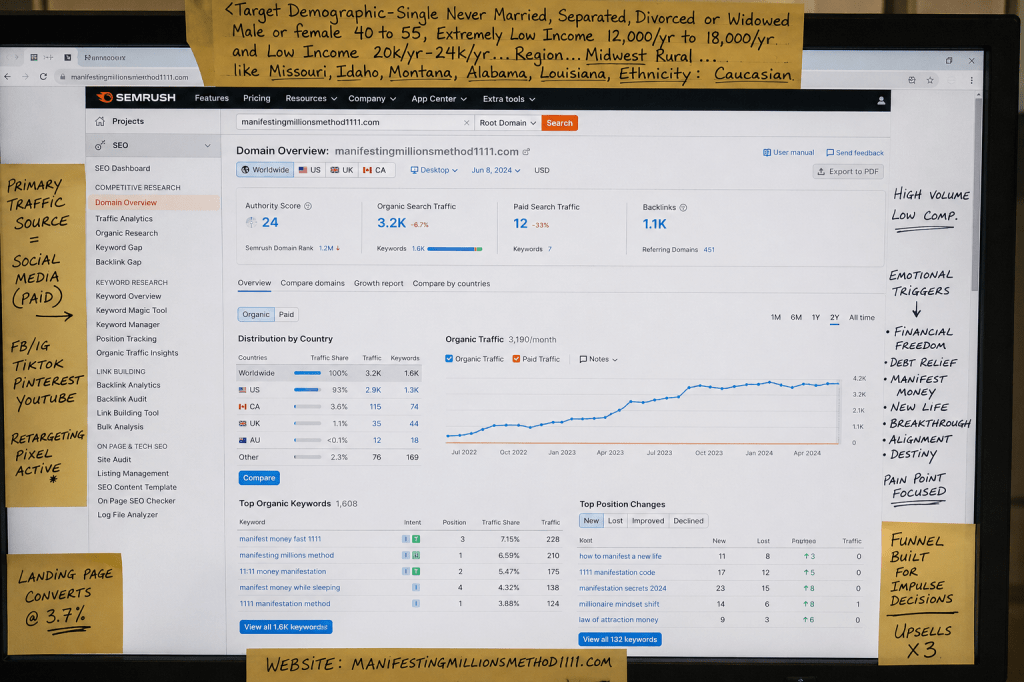
That data can become part of broader audience segments used by advertisers, marketers, and businesses. Search engine optimization, audience targeting, and advertising tools help identify groups of people who share similar interests, behaviors, demographics, or purchasing habits. The goal is simple. Create content that captures the attention of people who are most likely to engage with it.
For many creators, the objective is to generate views, build an audience, earn affiliate commissions, sell products, or eventually qualify for monetization.
Artificial intelligence has accelerated this process.
Instead of manually planning every post, marketers can now analyze audience data, generate dozens of content ideas, write captions, create graphics, produce videos, schedule uploads, and optimize publishing times with very little human effort.
Imagine creating twenty, thirty, or even fifty pieces of content in a single afternoon.
Each post serves a different purpose.
Some are designed to build awareness.
Some are meant to establish credibility.
Some educate.
Some entertain.
Others exist solely to move someone one step closer to making a purchase.
The entire campaign can then be scheduled to publish automatically over days or weeks, often timed to coincide with periods when the intended audience is most active online.
If you work a traditional schedule, you probably check social media before work, during lunch, after dinner, and again before going to bed.
Modern marketing platforms can identify patterns like these across large audiences and help determine when content is most likely to receive attention.
None of this is inherently unethical.
In fact, it’s remarkably effective.
The concern arises when people fail to recognize just how sophisticated these systems have become.
What appears to be a spontaneous recommendation or a casual post is often part of a carefully planned marketing strategy.
By the time a post reaches your feed, it has likely been researched, tested, optimized, and scheduled long before you ever see it.
Some posts offer genuinely useful information.
Some provide free downloads in exchange for an email address.
Some encourage viewers to comment with a specific word to receive a guide, checklist, or resource through direct message.
Some invite you to join a webinar, masterclass, or private community.
Each interaction helps measure engagement and can trigger additional automated follow up messages.
Again, automation itself isn’t the problem.
The problem begins when the relationship becomes less about helping people and more about guiding them through an increasingly complex sales funnel without them fully realizing that’s what’s happening.
Not every creator operates this way.
Many genuinely care about educating their audience and recommending products they truly believe in.
Others, however, build content almost entirely around conversion.
The educational content becomes the bait.
The trust becomes the currency.
The sale becomes the destination.
That distinction matters.
Imagine a typical content campaign.
It rarely consists of a single post.
Instead, it may include dozens of pieces of content, each serving a specific purpose within a larger strategy.
One post introduces a problem.
Another builds credibility.
Another tells a personal story.
Another offers a free download.
Another invites comments.
Another encourages viewers to subscribe.
Another promotes a product.
Viewed individually, each post appears harmless.
Viewed together, they reveal a carefully designed system.
Some content exists to build trust.
Some are intended to be educated.
Some are purely entertaining.
Some create curiosity.
Some are designed to encourage engagement because every like, comment, share, save, or click provides additional information about what captures your attention.
One person downloads a free checklist.
Another signs up for a newsletter.
Someone else comments a single word to receive a guide through direct message.
To the user, these interactions often feel unrelated.
Behind the scenes, they can become part of a larger automated marketing sequence.
An email may arrive the following day.
A follow up message appears a few days later.
Another recommendation follows.
Eventually, a product or service is introduced.
Again, none of this is automatically unethical.
Marketing has always involved building relationships before making an offer.
The question is whether the audience understands that’s what is happening.
Transparency matters.
People deserve to know when they’re entering a sales funnel instead of believing they’re simply receiving unbiased advice.
This becomes especially important when the content centers on subjects people care deeply about.
Financial hardship.
Personal safety.
Parenting.
Mental health.
Emergency preparedness.
Disaster readiness.
Career changes.
Education.
These are areas where people often arrive, feeling uncertain, overwhelmed, or desperate for answers.
That makes trust incredibly valuable.
It also makes trust incredibly easy to misuse.
Some creators recognize this responsibility.
Others recognize an opportunity.
Those are not always the same thing.
One creator asks, “How can I genuinely help someone solve this problem?”
Another asks, “How can I turn this problem into a conversion?”
From the outside, those two approaches can look almost identical.
Both may produce polished videos.
Both may sound compassionate.
Both may recommend similar products.
The difference often isn’t visible until you follow the trail.
Does every conversation eventually lead to a purchase?
Does every solution require another download?
Another subscription?
Another course?
Another affiliate link?
If so, it’s worth asking whether education is the mission or simply the method.
That doesn’t mean affiliate marketing is inherently wrong.
Far from it.
Affiliate marketing can be an honest way for creators to support their work while recommending products they genuinely use and believe in.
The issue isn’t the existence of affiliate links.
The issue is whether financial incentives begin influencing the recommendations themselves.
That’s where trust starts to erode.

And once trust erodes, it’s difficult to rebuild.
Audiences may not notice immediately.
At first, everything still feels helpful.
The advice still sounds reasonable.
The tone still feels supportive.
But over time, patterns emerge.
Recommendations begin to feel repetitive.
Solutions start to look suspiciously similar.
Every path seems to lead to the same destination.
That’s when people begin to question what they’re seeing.
Not just the content itself, but the intent behind it.
And intent definitely matters.
Because content isn’t just information.
It shapes decisions. It influences behavior.
It affects how people spend their time, their money, and their attention.
When someone is in a vulnerable position, those influences carry even more weight.
That’s why clarity is so important.
Clear intentions and disclosures.
Clear boundaries between education and promotion.
When those lines are visible, people can make informed choices.
They can decide what to trust.
They can decide what to ignore.
They can engage on their own terms.
Without clarity, the relationship becomes one-sided.
The creator understands the system.
The audience does not.
And that imbalance is where problems begin.
Because influence without transparency is manipulation.
If they are already aware of how it may appear, they’ll attempt to frame it as transparency.
And while not every creator crosses that line, the structure of modern content platforms makes it easier than ever to do so.
Algorithms reward engagements.
Engagements drive an emotional response.
Those emotional responses drive clicks, shares, and conversions.
It becomes a cycle that shifts priorities over time behind the scenes.
Helping people becomes secondary.
Keeping them engaged becomes the goal.
And once that shift happens, everything else follows.
Content becomes optimized, not for truth, but for performance.
Advice becomes tailored, not for accuracy, but for appeal.
Trust becomes a tool rather than a responsibility.
That’s why awareness matters.
This awareness is intended to heighten discernment.
To remind people that behind every piece of content, there is a creator making choices.
What to include.
What to leave out.
What to emphasize.
What to promote.
Understanding that doesn’t mean rejecting everything.
It simply means paying attention.
Asking questions.
Looking beyond the surface.
Because the more you understand how these systems work, the easier it becomes to navigate them without losing your autonomy.
And that, ultimately, is the goal.
Now, before anyone misunderstands me, this isn’t an argument against creators making money.
People deserve to be compensated for their knowledge, their time, and the value they provide.
Writers should be paid.
Teachers should be paid.
Researchers should be paid.
Developers should be paid.
Content creators should be paid.
There is nothing inherently wrong with earning an income through honest work.
The concern isn’t monetization.
The concern is what happens when monetization quietly becomes the purpose instead of the result.
There is a difference.
One creator begins with the question, “What information would genuinely help someone today?”
Another begins with, “What content is most likely to convert?”
Those starting points may produce content that looks almost identical on the surface.
Underneath, however, they’re driven by entirely different motivations.
The first measures success by whether people leave better informed.
The second measures success by whether people click.
One builds trust because the information has value.
The other builds information because trust has value.
That distinction is easy to overlook, yet it changes everything.
It also explains why so much content has begun to feel strangely familiar.
You’ve probably noticed it yourself.
Different creators.
Different voices.
Different branding.
Yet somehow they’re all saying the same things.
Using the same hooks.
Making the same promises.
Recommending the same products.
Offering the same free guides.
Following the same content formulas.
That’s not because hundreds of creators suddenly became original thinkers who reached identical conclusions.
It’s because many of them are learning from the same courses.
Using the same AI tools.
Following the same marketing frameworks.
Studying the same analytics.
Optimizing for the same algorithms.
The result is an internet that increasingly rewards predictability over originality.
Content begins to sound manufactured.
Not because it lacks effort.
Because it lacks perspective.
When everyone is chasing the same metrics, creativity slowly gives way to conformity.
The algorithm doesn’t ask whether something is meaningful.
It asks whether people engage with it.
Those aren’t always the same thing.
That realization changed the way I look at social media.
It forced me to ask a different question.
Instead of asking whether something is popular, I started asking why it’s popular.
Instead of asking whether someone is successful, I started asking what system helped create that success.
Sometimes the answer is talent.
Sometimes it’s consistency.
Sometimes it’s expertise.
And sometimes it’s simply a deep understanding of how to capture and redirect attention.
Attention has become one of the most valuable currencies in the digital world.
Where attention goes, influence follows.
Where influence grows, money often follows.
The question each of us has to answer is simple.
Who is directing my attention?
And more importantly…
Why?
That question sits at the heart of everything I create. Everything I write.
Not because I believe I’m immune to these systems, because Im not.
I use technology.
I use AI.
I study marketing.
I understand automation.
Those tools aren’t the enemy.
There’s no vendetta they harbor.
Like any tool, their value depends on the intention of the person using them.
A hammer can build a home.
The same hammer can break a window.
Technology works much the same way.
Artificial intelligence can help someone organize information, discover patterns, summarize years of research, or make knowledge more accessible than ever before.
It can also be used to manufacture trust that hasn’t been earned.
To imitate expertise that doesn’t exist.
To produce endless amounts of content without adding anything of substance.
That’s the crossroads we’re approaching.
Not one where humans compete against AI.
One where authenticity competes against optimization.
One where discernment competes against convenience.
One where truth competes against performance.
I don’t believe the solution is abandoning technology.
I believe the solution is becoming more intentional about how we use it.
Technology should strengthen our ability to think. It’s not meant to replace it.
It should expand our understanding, not narrow it.
It should help us ask better questions.
Not just deliver faster answers.
That’s the standard I’m trying to hold myself to.
If I recommend something, I want it to be because I’ve taken the time to examine it.
If I share an idea, I want it to challenge people to think, not simply persuade them to agree.
If I earn money from something, I want people to know exactly how and why.
Transparency shouldn’t be a marketing strategy.
It should be a principle.
I don’t expect everyone to agree with my conclusions.
In fact, I hope they don’t accept them blindly.
Question them. Research them. Challenge them.
Look for evidence that proves me wrong.
That’s how real understanding develops.
Not through blind agreement.
Instead, through thoughtful examination.
If this article accomplishes anything, I hope it encourages people to become more conscious consumers of information.
Pause before clicking. sharing. Before assuming that popularity equals credibility.
Ask who benefits and what is being sold.
Would their recommendation would still exist if there were no commissions attached to it?
They answer will always be Yes.
Being able to spot the truth from the falsehood is a skill.
A skill that is increasingly valuable in a world where artificial intelligence can produce persuasive content faster than any human ever could.
The future doesn’t belong to the people who consume the most information.
It belongs to the people who learn to recognize the difference between information and influence.
It also belongs to those who have developed wisdom from what they’ve learned.
The information tells you what happened.
The influence tells you what to do about it.
The wisdom teaches you how to decide for yourself.
If we lose that distinction, we won’t just misunderstand the internet.
We’ll misunderstand each other.
And that’s a price no algorithm should ever be allowed to decide.
Maybe the answer isn’t to become more skeptical of everything.
Maybe the answer is to become more intentional.
To slow down and, more importantly,
think before reacting.
To recognize that attention is one of the few resources we can never earn back once it’s spent.
Every notification asks for it.
Every headline competes for it.
Every advertisement purchases it.
Every creator hopes to capture it.
Some will honor it.
Some will exploit it.
Knowing the difference has become part of being digitally literate.
Perhaps that’s the real lesson here.
Not that algorithms exist.
Not that automation is advancing.
Not that artificial intelligence is changing the internet.
We already know those things.
The real lesson is that we still have a choice.
We choose what deserves our trust.
We choose whose voices we amplify.
We choose which ideas we carry forward.
Most importantly, we choose whether we become passive participants in these systems or conscious participants.
Technology will continue to evolve.
Marketing will become more sophisticated.
Artificial intelligence will become more convincing.
Automation will become more seamless.
None of those things are likely to change.
What can change is us.
Our awareness.
Our discernment.
Our willingness to ask one more question before accepting the first answer.
That isn’t fear.
That’s responsibility.
Maybe that’s what being prepared really means.
Preparedness isn’t only about storing supplies.
It isn’t only about emergency kits, generators, or backup plans.
Preparedness begins with awareness.
Understanding the systems that shape our decisions before those decisions quietly begins shaping us.
The first thing any system hopes to influence doesn’t begin at your wallet.
It’s to get your attention because your attention shapes your habits.
Your habits shape your decisions.
Your decisions shape your future.
Protecting that may be one of the most practical forms of preparedness there is.
If this article causes you to pause the next time you scroll, question the next recommendation you receive, or look a little deeper before accepting someone’s advice, then it has served its purpose.
Not because I want it to lead you into trusting me.
I hope you become the kind of person who doesn’t need to look outwardly for trust
I hope you become someone who asks better questions, seeks better evidence, and arrives at better conclusions because you chose to think critically for yourself.
That’s worth more than any affiliate commission.
More than any viral post.
More than any algorithm could ever calculate.
Because in a world increasingly designed to influence how we think, the most valuable thing we can protect may be our ability to think independently.
That is what I write these blog posts for. That has always been what I use this soapbox for.
I’m not telling you what to believe.
Inviting you to look beneath the surface.
To question what appears obvious.
To examine what others overlook.
To Xpose what matters.
And to burn away everything that doesn’t.
 The Xcerpts by Xposed™