Broke & Bougie Budgeting

Being Financially Responsible doesnt mean you have to deprive yourself of the things you enjoy.The two can actually coexist.

Just so you all know, budgeting your money isn’t just something reserved for older generations anymore. 

In fact, even you, can starf budgeting today, and you don’t need to sacrifice anything start.

There are several perks that come with budgeting, too.

The best part is that those perks show up a lot sooner than you’d probably expect.

Unlike a job, you don’t have to work for a company three to six months before you’re eligible to enjoy the benefits.

After you first get hired, you enter that probationary period of employment purgatory. You’re working, showing up consistently, proving your reliability, and putting in the hours, but you’re still waiting to become eligible for the benefits that come with the job.
Health insurance, paid time off, retirement benefits, and other employment perks often require you to work for a certain period before you qualify. In other words, your consistency and performance become the prerequisite for unlocking the additional benefits attached to your employment.
You’re technically in, but you haven’t unlocked everything yet.

Budgeting has perks too.
The difference is, nobody hands them to you.
They come from you.
You’re the one managing the money. You’re the one negotiating with yourself. You’re the one deciding where every dollar goes.
So you’re also the one who gets to decide what the rewards look like.
Maybe it’s finally booking the pedicure you’ve been putting off for years.
Maybe it’s giving yourself guilt free spending money every month because you intentionally built it into the plan.
Maybe it’s watching your emergency fund grow until a flat tire, unexpected bill, or minor crisis no longer sends your entire financial life into panic mode.
Those are the perks of budgeting.
They aren’t employee benefits waiting for someone else to approve you.
They’re benefits you create for yourself by deciding what matters, assigning your money a purpose, and actually following through.
And unlike most workplace benefits, there’s no probationary period.
You don’t have to wait six months.
You don’t have to prove yourself to a manager.
You can start unlocking the benefits almost immediately.


In fact, if you started budgeting today, you’d be surprised how much you could learn about your spending habits in just 30 days.
After reviewing only one month’s worth of expenses, you can begin diagnosing your own financial patterns without ever sitting down with a financial advisor.


You’ll quickly identify the areas that need adjusting.


Then, you simply adjust your budget accordingly.


Where there’s a little excess in one category, you trim it back and reallocate those dollars somewhere they’ll serve you better.


For example, maybe you signed up for HBO because you wanted to binge watch The Sopranos during one snowy weekend.

The weekend came and went.

Life moved on.

Six months later, you’re still paying $14.99 every month.
You see the charge come up through a text alert to your phone.

You automatically dismissed it as a subscription or app.


And then you disregard it.

You don’t confirm which one it is. 
No deeper analysis.

It gives your money a map instead of letting it wander aimlessly.

It doesn’t control your life.


There is no realization that you’ve spent nearly $90 on something you completely forgot you were paying for.
That’s exactly what budgeting helps you uncover.
Not because a $14.99 subscription is enough to collapse your life.


It’s the 120 days you’ve been paying it. 


How much money do you have available today?
Which bills are absolutely essential and must be paid first?
What financial damage needs immediate attention?
What expenses can be delayed, reduced, or eliminated?
What items could you sell to generate quick cash?
What opportunities do you have to earn additional income immediately?
What is your action plan for tomorrow, next week, and beyond?

Back to Back. 

6 months worth of  $14.99 charges you’ve paid, that went into the void.

These forgotten charges absolutely can add up and be a major contributing factor to your consistent struggle to pay your bills on time.

You figure out how to navigate one financial emergency after another.
That’s admirable in a sense. 
But it’s also exhausting.
Living in a constant state of reaction doesn’t just drain your bank account. It drains your nervous system.
You never truly relax because you’re already anticipating the next consequence before the current one has even been resolved.
The frustrating part is that much of that cycle is predictable.
Not every emergency can be prevented, but many of the financial crises we experience aren’t random at all.

This doesn’t necessarily mean you’re irresponsible.

Life happens.

Things slip through the cracks.

You fully intended to cancel that subscription. You meant to make the phone call. You meant to log in and update it.

So you finally cancel it.

Unfortunately, not before paying for another month of something you haven’t used or benefited from.

We’re not pointing this out to make you feel bad.

Quite the opposite.

We’re writing this because we’ve been there too.

For a long time, we believed budgeting was for…well… a certain caliber of people.

We shrugged it off.

I’ll make it back.”

“It’s only a few dollars.”

“I’m not about to sit in my house like some old hobbit guarding a vault full of money that I accumulated by denying myself every ounce of joy for the last thirty years.”

That’s never been the goal.

And it’s certainly not who I am.

As I write this, I have about ten dollars in cash in my wallet. If the banking industry collapsed tomorrow, I’d be in trouble because nearly all of my money exists as digital currency.

I’m nowhere near where I ultimately want to be financially.

Neither are many people in my generation.

That’s exactly why I believe this budgeting conversation needs to happen.

We don’t overcome financial hardship by pretending it doesn’t exist.

We overcome it by getting out of our own way and becoming more intentional with what we already have.

Now, maybe none of this describes you.

Maybe you don’t splurge.

Maybe you don’t online shop.

Maybe every dollar you spend goes toward necessities, bills, groceries, and keeping the lights on.

You don’t need anyone to tell you where your money is going because you already know.

The problem isn’t that you’re careless.

The problem is that there’s simply not much leftover.

Even then, there is still a version of budgeting that can benefit you.

Instead of tracking unnecessary spending, your focus becomes optimization.

You review your monthly expenses and ask yourself where small adjustments could create a little breathing room.

Could you switch to the ad-supported version of your streaming service?

Could you negotiate a better internet plan?

Could you reexamine your cell phone plan and eliminate features you no longer use?

Could you enroll in your utility company’s budget billing program, where available, to spread seasonal spikes into predictable monthly payments?

Most of the utility companies offer these programs after you’ve established a good payment history. Some require recent bank statements or pay stubs to qualify.

Here in the Washington, DC metropolitan area, where electricity costs have climbed dramatically in recent years, largely because of increasing energy demand, those kinds of programs can make a meaningful difference in managing a household budget.

The point is this.

There isn’t just one kind of budget.

There are dozens.

The best budget isn’t the one someone else tells you to use.

It’s the one built around your actual life, your real goals, and the financial reality you’re living in right now. Not the life a spreadsheet assumes you have. The life you actually have.

That’s just one example of how a budget can free up money that was quietly disappearing anyway.

Money that wasn’t truly improving your life. Money that can instead be set aside for the moments you never see coming.

Or…

The moments you intentionally want to enjoy.

Take something as simple as a pedicure.

For years, I was a regular at the nail salon before I had my youngest three kids.

After my two boys came along, there’s no way in hell I could have imagined bringing those extremely hyper little boys into a quiet establishment.

I laugh about it now when I think back to some of the things they had divulged to complete strangers in the past.

They loved announcing my business to anyone who would listen.

Now that they are teenagers and the only little one I hsve is my 5 year old girl, I do hope to take her one day soon.

Maybe her and I could start a mommy and daughter tradition, like I used to have with my oldest daughter when she was little.

The truth is, I haven’t had a professional pedicure since around 2010.

Not because I physically couldn’t.

Because I couldn’t justify it.

I know how to give myself one.

I worked at a spa for years.

I cut my own hair.

I color my own hair.

In fact, whenever something can be done at home to save money, I usually choose that option.

Somewhere along the way, I stopped allowing myself to be pampered because I convinced myself it wasn’t necessary.

But what kind of life is that?

Financial responsibility shouldn’t require you to eliminate every small pleasure that helps you decompress.

That’s one of the biggest advantages of having a budget.

It gives you permission to enjoy those moments because you planned for them.

Instead of feeling guilty afterward, you know the money was already set aside.

That’s the difference. It’s not splurging on myself.  I’m quick to dismiss anything I might want to do for myself sim

mply because I can do it myself.

A budget is not something that is designed to remind you of what you cant do.

In fact, it’s actually there to let you say “yes” without regret.

Have you had the same thing communicated to you about budgeting? Did it influence your opinion and led to you developing a negative perspective of managing money?

How Did We Allow Our Perception of Budgeting, Something So Conscientious, Proactive, and Practical, to Become So Warped That We Started Seeing It as a Sign of Failure?

Why Have We Developed This Impression?

Where Did This Idea Come From?

Why Were So Many of Us Set Up to Struggle Financially as Adults?

More Importantly, How Do We Get Out?

The moment we’re old enough to get our first job and earn our own paycheck is usually when something shifts inside us that changes our opinion of budgeting.


Once you’re no longer a financial burden to your parents, they naturally become less involved in how you spend your money.

You’re working more, home less, and gradually spending less time around your family.

With that comes something many of us have never really had before.


Financial freedom.
For some, that freedom comes with responsibilities, like paying rent if you’re still living at home but no longer in school.

As long as you pay what you’re expected to pay, most parents aren’t overly concerned with what you do with the rest of your paycheck.
That’s often where financial irresponsibility quietly makes its entrance.
Not because you’re reckless.
Because nobody has ever shown you a better system.
Little by little, a pattern develops.
Fast food becomes a convenience instead of an occasional treat.
Online shopping becomes entertainment.
A “want” slowly disguises itself as a “need.”
After years of repeating those same habits, they become normal. By the time your direct deposit hits, you’ve already mentally spent most of it. You open the bookmarked tabs on your phone, revisit the shopping carts you’ve been patiently waiting to check out, and give yourself permission to spend the money because, after all…


“I worked hard for it.”
Then, the chain reaction begins.
Maybe it’s a disconnect notice.
A dead car battery.
A flat tire.
The phone you’re only two months away from paying off slips out of your back pocket and spends two minutes submerged in the bathtub before you find it.
Your everyday glasses break, and your insurance doesn’t cover a replacement.
The inconvenience might change each time, but the pattern remains the same.
The pattern doesn’t.
After a while, you become so accustomed to living this way that you build an entire survival system around it.

You become incredibly good at reacting to emergencies instead of preventing them.


The Broke & Bougie Budgeting Worlsheets are designed for the kind of individual that I just described above. The kind of person who isn’t irresponsible but simply tries to survive while juggling everyday life. Sometimes, all it takes is one unexpected expense to send everything into chaos.

These worksheets are meant to help prevent that from happening again.


Inside, you’ll find several worksheets, each serving a different purpose depending on where you are financially.

You know who to call, which bill can wait, which payment can be pushed back a few days, and how to stretch what little you have left.


You have been operating in survival mode for so long that you’ve learned how to become incredibly resourceful.

Unfortunately, these conversations don’t happen until the damage has already been done.
For many, you might associate budgeting with restrictions.

You aren’t prone to a string of bad luck. Nobody has cursed you either. You’re just unintentionally creating conditions where chaos has more opportunities to show up. You’ve simply just lost sight of where your money goes.  Years ago. Sure, you aren’t at that advanced stage of recklessness that has you gambling all your money away in five minutes. But, you definitely do need some help.

That’s exactly what a budget is designed to help you find.

You know that one saying about getting your life in order?

The one that goes like…

“I’m just trying to get my ducks in a row”
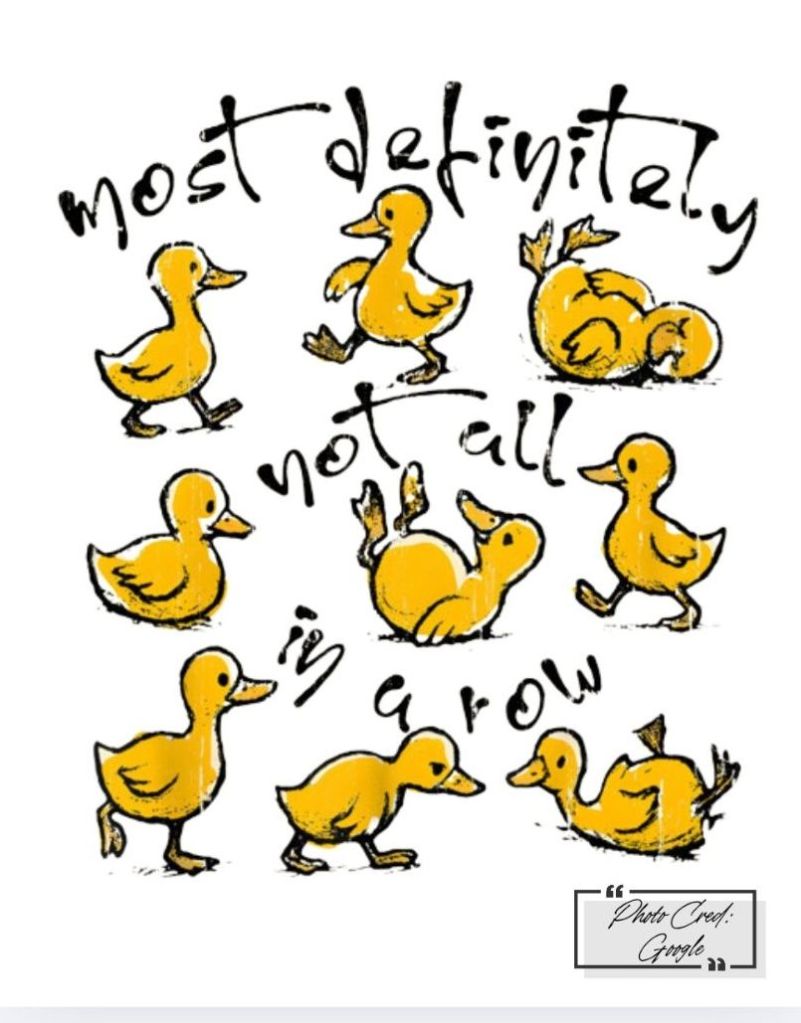
We all have heard it.

So much in fact,  there’s dozens of comics that discuss these ducks and their long-standing inability to act right.
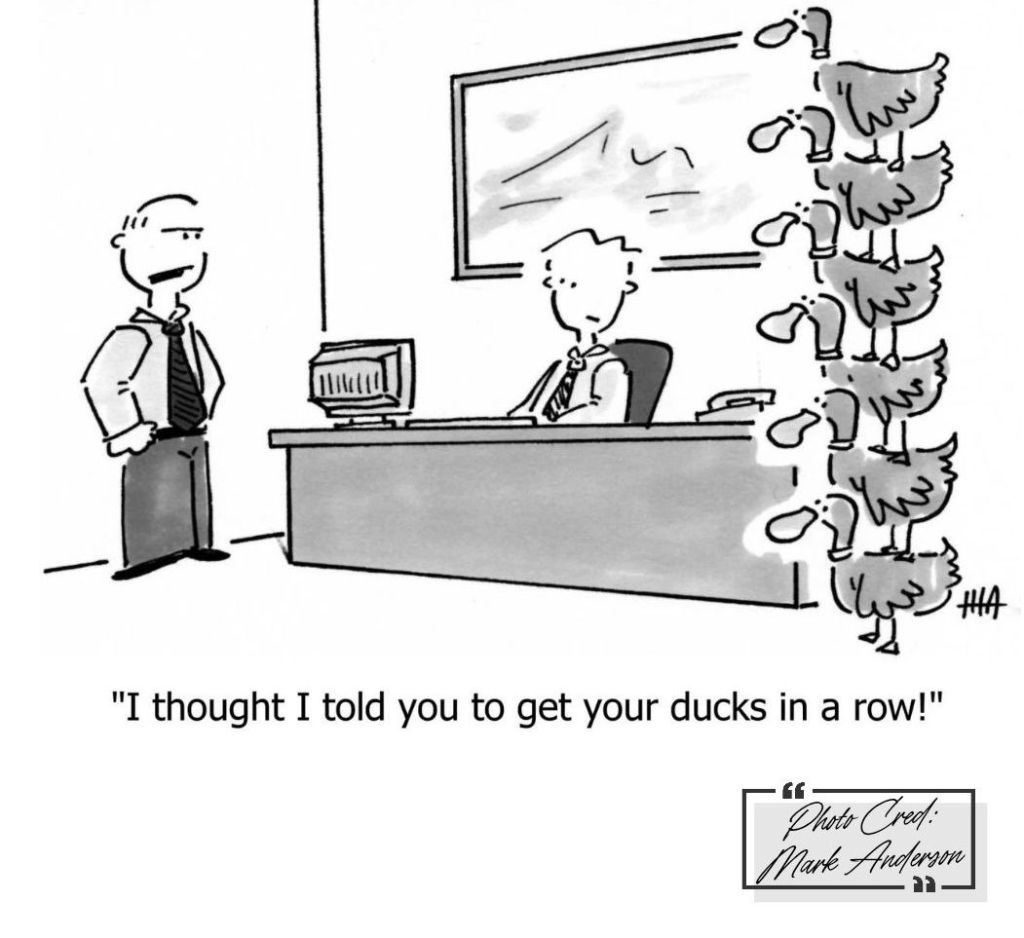
The ducks in question for this Broke  & Bougie Budgeting Strategy article I don’t have to lease from anyone.

I have a decent size group of ducks already in my possession that already are long overdue for some disciplinary action.

My ducks are infamous for bumping heads and refusing to follow any directions.

Thats how we got this brilliant idea to keep them from straying too far and also keep them safe.

This ingenious piece of technology  is intended to not only keep track of them but also.collectively provide better care for them in the long run.

Your ducks are long overdue for some attention.

You’ve spent years chasing those ducks in every direction, trying to convince them to cooperate.

But really, your invention is suitable for anybodys ducks, no matter the size or degree of aggression.

We all know how they respond when you attempt to contain them.

You knew this already so your approach  would need to be more than just a tracking system.

And then the day comes and you get the delivery.

The prototype of your invention has arrived,  finally.  

You sent your sketches and all the schematics weeks ago, over to a contact overseas, so they made a physical copy of your invention.  

Your prototype.

You pull out a small cylindrical box.
Inside is a tiny digital screen and nine miniature tracking bands.
Think somewhere between an AirTag, a house arrest ankle monitor, and one of those wildlife tracking collars scientists use to monitor endangered animals.
This is only the mechanism fot tracking.

As i said before, its only one piece of the puzzle.
The first phase is the gps system inside the box.

Instead of trying to manually control your ducks & fuss with them, the gps allows you to track them from afar.

At this point, those ducks have spent years wandering off in every direction.

You couldn’t even begin to guess where they go.
Anywhere except where you need them.


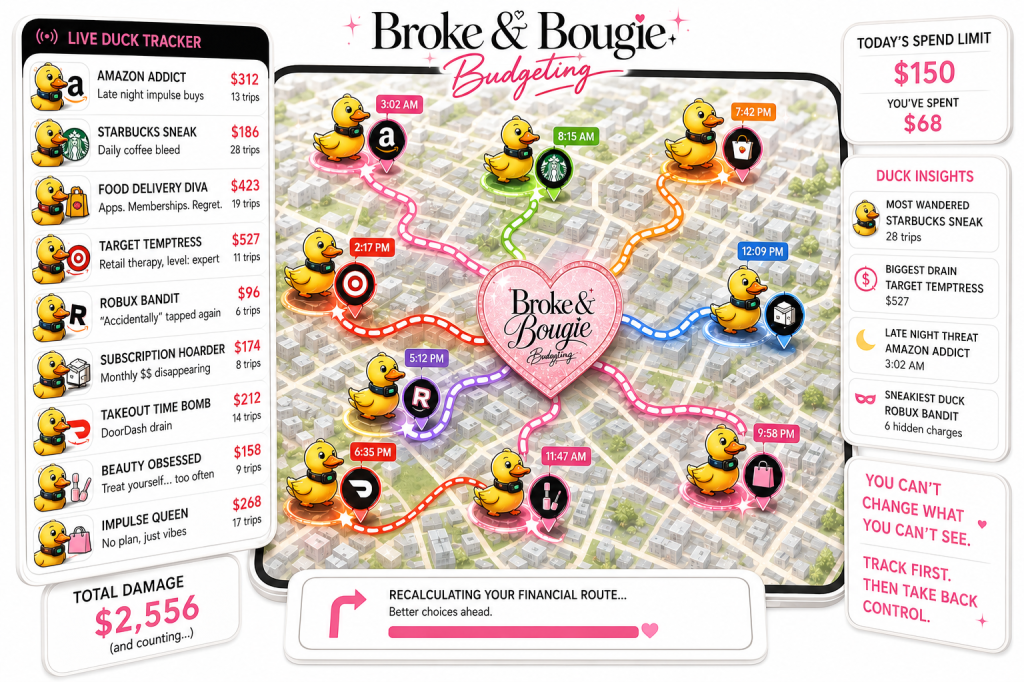
Now imagine each duck represents one of your spending habits.


One duck has a tendency to sneak onto Amazon at three in the morning and purchase unnecessary things just because they are on sale.
Another duck can’t waddle past Starbucks without somehow turning a single coffee into an almost twenty-dollar purchase.
One has developed an unhealthy relationship with food delivery apps and quietly signed you up for multiple monthly memberships that you barely even use.
Another has a Target addiction that has never once resulted in a receipt under $100.
One is secretly buying Robux six times a month because someone “accidentally” tapped the purchase button mid-game.


Individually, none of these ducks’ behaviors scream bankruptcy.


If you combine them all together,  thats a different story.

Collectively, they are the reason your paycheck disappears before you even understand what happened.


A budgeting system doesn’t chain the ducks to the wall,  restricting their movement and depriving them of food.
It simply just puts a tracker on each of them. 


For the first time, you can see where they’ve been, how often they wander off, and which ones are causing the most trouble.


Once you can actually see the pattern, you finally have something useful to work with.
The ducks were never impossible to manage.
You just couldn’t see where they were going.

The Broke & Bougie Budgeting Bundle is basically a GPS tracking system for your ducks.

Think of it as a set of tiny tags attached to every duck in the flock.

It tells you who wandered off, where they went, how often they went there, what they came back with, and how much they took with them.

Once you can actually see the patterns, you stop chasing the ducks blindly.

You can take what you’ve observed and start managing the environment to be better equipped to manage some of these ducks’ irrational spending behaviors.

You build up a cozy pen to house them all at night, safe and secure. Install some heaters.  Outside perimeter protection to warden off predators so they can sleep soundly. 

Instead of spending all your time and exhausting yourself in chasing after them, you have already observed where the vulnerabilities are with each duck and you’ve thought ahead to help combat any future incidences of them roaming free and getting lost or worse, injured. 

You also ceate a safer space for them to roam during the day.

What you’ve learned from tracking them closely is that you also need to design the landscape differently and more effectively. 

You decide to use natural barriers instead of the obvious fences because you already know what happens when your ducks realize they’re being contained. Like any animal,  they start looking for a way around it. Your ducks, in particular, can fly and would do just that the moment they came up to a fence.


You work hard to create boundaries that don’t feel like boundaries. You position things in a way that naturally discourages them from wandering into dangerous territory without making them feel trapped or controlled.

That’s the real strategy.

You aren’t following every duck around with a clipboard.

You’re observing from a distance.

You’re learning their patterns.

You’re quietly removing the dangers from the areas they naturally gravitate toward.

With your finances, the Broke & Bougie Budgeting Worksheets help you track your money more closely, so you can finally see where those little dollars are actually going.
You start noticing the expenses that used to slip under the radar, the subscriptions you forgot about, the impulse purchases that quietly add up, and the money that somehow disappears without ever having a clear assignment.
Once you can see it, you can make a decision about it.
You can reallocate that money toward bills, savings, debt, or other priorities. Or, better yet, you can give some of it a designated place in a special fund that you contribute to regularly.
That fund can be for something you actually want.
A trip. A pedicure. A new outfit. A night out. Something bougie. Something completely unnecessary and completely worth it to you.
And when the time comes to spend it, you don’t have to feel guilty.
You don’t have to justify it.
You don’t have to convince yourself that you should have been more responsible.
You already were.
You planned for it. You funded it. You gave that money a purpose.
Now you get to enjoy exactly what you designated it for.
That’s the difference between restricting your spending and intentionally creating room for the things you love.

You’ve created an environment where  your money can move freely yet securely since the system around it is doing the protection.

It’s passive management.

A strategic kind of protection.

Its low visibility AND high awareness.

Because none of this is about punishing the ducks.

It’s about knowing your ducks well enough to protect them without making them feel like they’re being protected.

The goal with the B&B Budget isn’t designed to eliminate every spending habit you have.

The goal is to create healthier boundaries so your money naturally stays where you intended it to go.

Many people think that the moment a budget is suggested, it’s because you’ve proven yourself to be irresponsible, impulsive, or incapable of managing your own money.

It’s been thought by those same people that creating a budget is kind of like a financial probation that’s designed to keep you from making bad decisions.

That couldn’t be further from the truth.

What most people fail to realize is that budgeting isn’t a one-size-fits-all kind of thing.

People with millions of dollars even budget their money.
In fact, there are countless types of budgets because there are countless reasons to create one.

Some budgets might be built around a single goal.

Some are designed for a special occasion.

Others are created for an important life milestone, like preparing for a new baby, buying a car, planning a wedding, taking a vacation, or saving for a down payment on a home.

A budget is simply a plan with your money that has a purpose attached to it.

You most certainly don’t have to be bad with money to benefit from one.

And you certainly don’t have to wait until you’re in such deep doo doo that one unexpected expense has the power to wipe out the fragile sense of stability you’ve been tiptoeing across.

Budgeting isn’t just about surviving financial hardship.

It’s about preparing for opportunities, protecting your peace of mind, and giving every dollar a job before life decides to assign it one for you.
It’s a way of telling your money where to go instead of wondering where it went.


Somehow, we’ve allowed it to become associated with the struggle and living in survival mode when the real purpose has always been the exact opposite.

That’s just as incorrect as believing someone with six figures in their checking account don’t need a financial plan.
The amount of money you have in your account shouldn’t eliminate the need to manage it.

It simply changes the scale.

People don’t get into financial trouble because of one massive purchase.


They get there through hundreds of tiny decisions they barely remember making.
Those are the numbers that deserve your attention.


If your spending habits have been running around like free-range ducks for years, don’t you think it’s time to figure out which one keeps emptying your wallet?


Because ignoring it doesn’t make the problem disappear.


It simply makes you an unwilling accomplice to your own financial chaos.


So tell me now, is budgeting really the villain here?


Or is it simply shining the light on where you need to look?

Budgeting is meant to reveal to you exactly where everything has been going and how you can go about correcting it.

Maybe you think a budget will be too restrictive, overwhelming, and a little depressing.

You are allowed to feel the way you feel, of course. 

We aren’t expecting you to change your mind just because we told you to.

The only thing we ask of you to do is do something different today.

All we ask of you is to put all your previous opinions and assumptions about budgeting to the side. 

I mean,  honestly, what is the risk of trying something different?

Nothing.

What could you possibly gain from budgeting?

There’s no telling just how beneficial it could be or how much it can complement your life.

There really is no downside to incorporating a budget in your life.

Even if you’re not ready to start today, that’s okay. We’re not mad at you for not jumping right into it.
Like we said before, all we’re asking after you read this article is that you keep an open mind.
Don’t let what you’ve previously believed about budgeting automatically convince you that this isn’t for you.
Maybe you’re not ready today.
Maybe you won’t be ready next month.
That’s fine.
Just leave the door open.
Because one day, when you’re ready to take a closer look at your money, we want you to remember that budgeting doesn’t have to mean restriction, deprivation, or feeling guilty every time you spend.
Maybe it can look different than what you thought.
And maybe it’s worth exploring when you’re ready.

It could really bring you the exact structure & organization you need to allow more flexibility. 

Included in this article, we have included the Broke & Bougie Budgeting Worksheets free for you to download, save, and print. Print right after you finish reading or bookmark and save for later to do.

There are a few different budgeting options below, and I’ll break down each worksheet so you can see exactly who it’s designed for, what it helps you accomplish, and when you might want to use it.
And honestly, if I were you, I’d print the whole bundle.
You don’t have to implement every worksheet at once. Keep the entire bundle somewhere you can easily access it, because different financial situations call for different tools.
You might not need a particular worksheet today, but six months from now, it could be exactly what you need.
Think of the bundle as having a financial toolbox available before you actually need the tool.
When the right opportunity, goal, expense, or financial situation comes up, you already have the worksheet ready to put into action.
No scrambling. No starting from scratch.
Just pick the one that fits what you’re trying to accomplish and start there.

What provoked me to write this article was simply paying attention.

I kept seeing people from my generation and the generations after us becoming increasingly vocal about their financial struggles, especially online. And the people I know personally have expressed their frustrations with money to me repeatedly over the past several years.

Eventually, I started asking myself, “Okay, what can I actually do about this?”

I wanted to help in the best way I knew how.

But I didn’t want to create another generic budgeting system built around the assumption that everyone lives the same kind of life, earns the same kind of money, or has the same financial priorities.

I also didn’t want to create something that intimidated people who were already unsure about budgeting.

Because if your budgeting system is so restrictive that every purchase outside of a basic necessity makes you feel guilty, eventually you’re going to stop using the system altogether.

And honestly, I think that’s where a lot of budgeting advice misses the mark.

People are constantly told what they shouldn’t spend money on, what they need to cut, what they need to sacrifice, and what they should be willing to live without.

But very rarely do we talk about what happens when you work hard, make responsible choices, and still want to enjoy some of the money you earned.

I wanted to create something different.

I wanted to create a budgeting system that felt empowering instead of punishing.

Something that helped you understand where your money was actually going without making you feel ashamed for wanting to spend some of it on things that aren’t technically considered “needs.”

Because people need to see something beyond simply paying bills and surviving.

There needs to be room for enjoyment.

There needs to be room for the things that make working this hard feel worth it.

You shouldn’t have to deprive yourself of every little thing that brings you joy simply because it doesn’t qualify as a mandatory expense.

The goal isn’t to convince you that you shouldn’t want anything.

The goal is to understand your money well enough to make room for what you want without sabotaging what you need.

That distinction matters.

Financial responsibility and quality of life are not opposites.

They can absolutely coexist.

You can be responsible with your money and still buy the damn pedicure.

You can build your emergency fund and still save for a vacation.

You can pay your bills, plan for the future, and still have money set aside for the things that make you happy.

The trick is making those choices intentionally instead of accidentally.

That’s exactly what I set out to create with the Broke & Bougie Budget.

A system that helps you get honest about your money without making you miserable about having it.

Because budgeting shouldn’t make you feel like you’re being punished for wanting a life.

It should help you build one you can actually afford to enjoy.

That’s where I came up with the idea of  Broke & Bougie Budgeting.

Only someone who’s been broke can fully understand how easy it is to be both broke and bougie.
Because being broke doesn’t automatically mean you don’t have expensive taste, big desires, or a love for the finer things.
Sometimes you can be financially struggling and still want the pedicure, the nice dinner, the cute outfit, the vacation, or whatever little luxury makes life feel less like an endless cycle of bills.
That’s the whole point of being Broke & Bougie.
It’s not about pretending you have money you don’t have.
It’s about learning how to make room for the things you enjoy, even when your financial reality requires you to be strategic about it.

You can’t even fully explain it in a way that makes sense to someone who has never experienced it.
But if you know, you know.
And believe me, there’s no shame in liking nice things.
There’s no shame in having certain brands you trust, knowing exactly what works for you, and refusing to spend your hard earned money on something you already know you won’t be satisfied with.
Sometimes it isn’t even about being flashy or trying to impress anybody.
You simply know what you like.
You know what fits better, lasts longer, performs better, feels better, or gives you the experience you actually want.
And when you’ve learned that lesson the hard way, you’d rather go without than spend money settling for something you already know isn’t going to work for you.
That’s the part people don’t always understand about being Broke & Bougie.
You can be financially conscious and still have standards.
You can be broke and still know the difference between what you want and what you’re willing to settle for.
Sometimes, the bougie part isn’t about having money.
It’s about knowing what you value.

The worksheets included in this download were created with different people, financial situations, and income levels in mind.
Some are for people who are no strangers to the occasional financial catastrophe. You know who you are. The unexpected bill shows up, the emergency happens, something breaks, and suddenly the budget you thought you had is fighting for its life.
Others were created for people who have spent years putting off budgeting because it always felt overwhelming, restrictive, confusing, or maybe even like it was too late to make a difference.
It isn’t.
In just a moment, I’ll walk you through each budgeting system, explain how it works, what it’s designed to accomplish, and help you figure out which one makes the most sense for the season of life you’re currently in.
You may find that one worksheet is exactly what you need right now. You may find that another becomes useful later. And that’s completely fine.
Although each worksheet serves a different purpose, they all share the same philosophy.
This isn’t about sitting down with a calculator and punishing yourself for every financial mistake you’ve ever made.
It isn’t about dwelling on the money you lost, the decisions you wish you had made differently, the debt you accumulated, or the years you spent avoiding your finances.
You can acknowledge all of that without allowing it to become the identity of your financial future.
This is about giving yourself permission to start fresh.
Every budget you create is another opportunity to take control, make intentional decisions, and redirect your money toward the life you’re actually trying to build.
Your past financial decisions can explain how you got here.
They don’t get to decide where you go next.
The goal is to create a financial future that reflects where you’re going, not where you’ve been.

Over the next 30 days, no matter the budgeting plan that you choose, you’ll track your  dollars closely after payday, identify unnecessary spending, reallocate money toward higher priorities, and, if possible, begin building an emergency fund that provides real peace of mind.


These worksheets aren’t designed to make you feel bad, nor are we judging you.

In fact, we use them ourselves!

I don’t know if it is something that resonates with you or not. 

Only you do. 

It can absolutely stay that way, too.


I say that because literally no one else has to know you’re budgeting!

You don’t need to pick up a second job just to afford a financial advisor anymore.
You can start taking a more active role in managing your money yourself, with tools designed to help you understand what’s coming in, where it’s going, and what you can realistically do with what you have.
The goal isn’t to replace professional financial advice when you genuinely need it. It’s to give you a practical starting point so you aren’t completely dependent on someone else to tell you what’s happening with your own money.

You also don’t need to announce your goals or explain your spending habits to anyone else.

This is your journey, and you can quietly take back control of your finances without inviting opinions from people who won’t experience the consequences of your decisions.

As you familiarize yourself with how to budget, you sort of become your own financial advisor. 

You’ll begin developing skills that extend far beyond paying bills.

You’ll learn how to create budgets for vacations, holidays, home improvements, vehicle purchases, moving expenses, investments, birthdays, and every other milestone that once felt financially out of reach.

Eventually, budgeting stops feeling like restriction and starts creating freedom.


You’ll know exactly what you can spend money on because you have already made the decision ahead of time.

When it’s finally time to take that trip, buy something you’ve wanted, or enjoy a night out, you won’t feel guilty anymore.

You’ll enjoy it so much more because it was part of the plan all along.
The best part is that getting started costs you absolutely nothing.
These worksheets, like so many in my blog,  are completely free.
Ask yourself this.

What does it cost you not to do it?

Nothing, it’s free!


Every month that goes by that you delay is another month of wondering whether one unexpected bill could derail everything.

It’s another month of carrying unnecessary stress, second-guessing purchases, and hoping nothing goes wrong.

This is your opportunity to change that.

Once you begin seeing progress, something unexpected happens.

The financial stress that once consumed your thoughts begins to disappear.

You make decisions with confidence.

You move through life with less anxiety because you’re no longer one unexpected expense away from disaster.


That peace of mind spreads into every part of your life.


If you discover that these worksheets helped you build the financial foundation you once hoped you’d have, then don’t keep that feeling to yourself.
You’re permitted to share the budgeting bundle with as many people as you want.
If you know someone who has been struggling with their finances, avoiding budgeting, or simply wishing they had a better system in place, pass it along.
Sometimes, the thing that helps someone finally get their money together isn’t another lecture about financial responsibility.
It’s simply having the right tools in front of them when they’re finally ready to use them.

Sometimes, all it takes is one small decision to completely change the direction of someone’s future.
Maybe today, that someone is you.
It was designed for people who want to get their finances together without sacrificing their personality.

Whether you’re paying off debt, building savings, surviving paycheck to paycheck, or simply trying to figure out where your money disappears every month, these printables are here to make budgeting feel less like punishment and more like self care.

Now, for the worksheets.

Below, is an image of what the bundle will look like in its entirety once you download it

(The download for the whole bundle is at the bottom of the post)
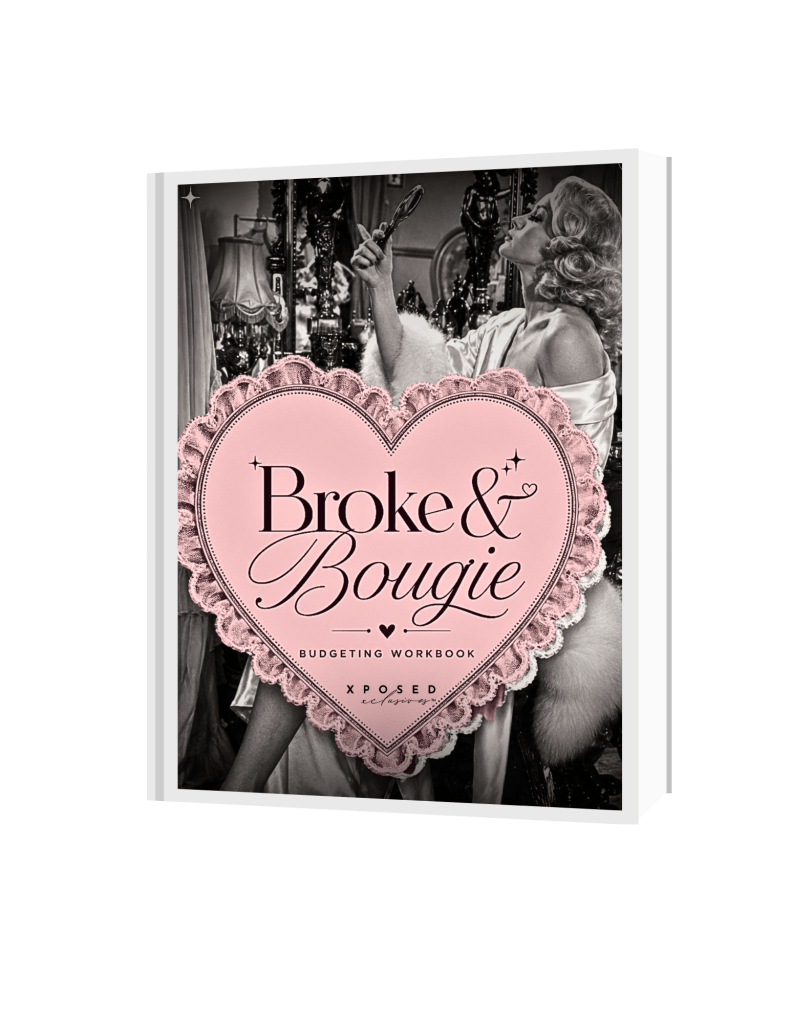
Now, let’s begin breaking down each worksheet bundle so you are able to determine which one is best suited for you and your current financial goals.

The first worksheet in the bundle is called

The Budget Creator Spending Plan & Tracker (Monthly)
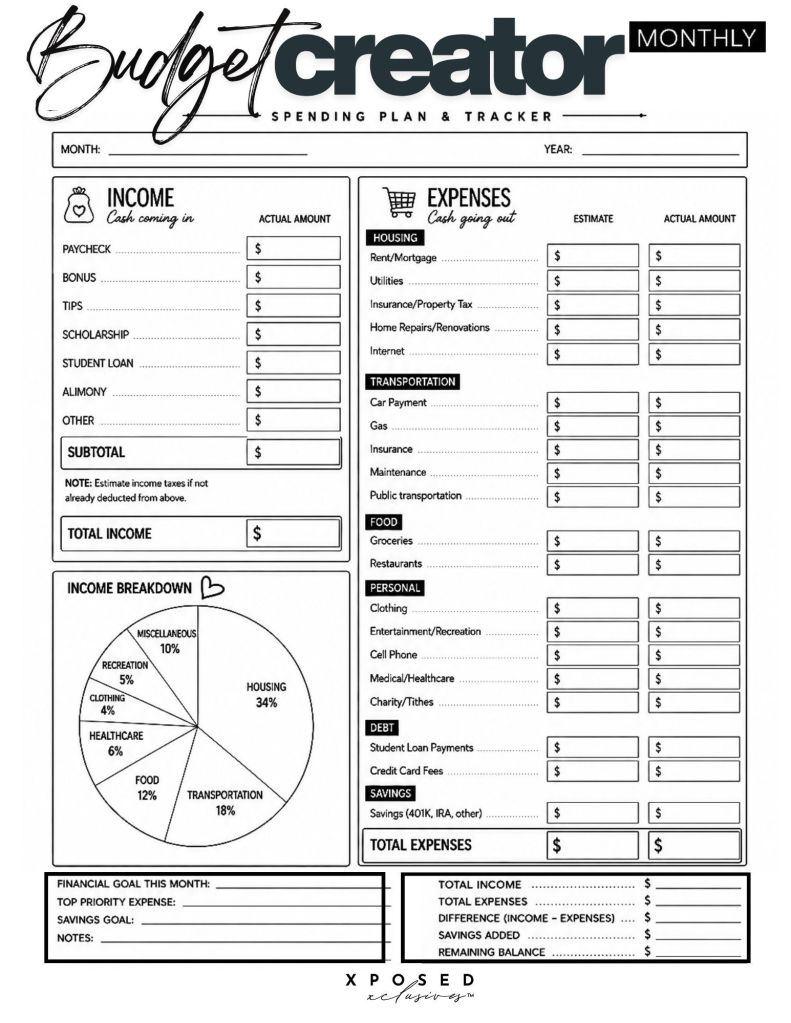
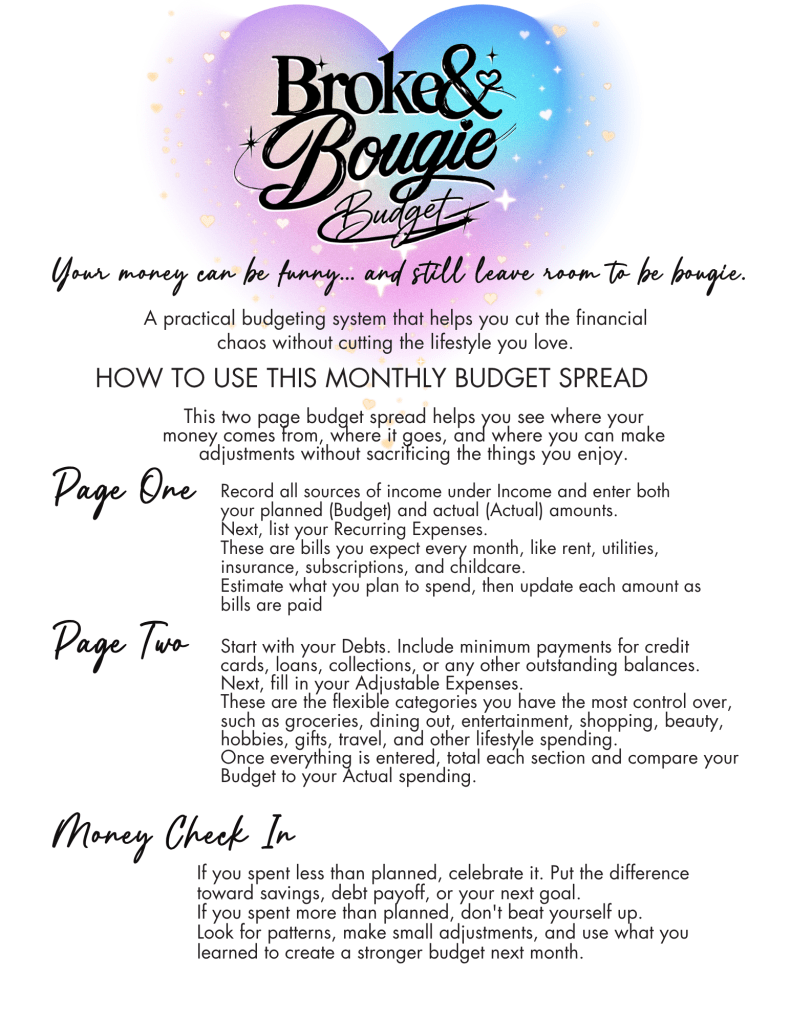
This is for the person who wants to stop reacting to their finances after the bills arrive and start deciding where their money is going before the month has a chance to spend it for them.
The Monthly Budget Creator helps you build a realistic financial plan around your actual income, expenses, priorities, and goals. Whether you’re creating a budget from scratch for the first time, managing a household, dealing with fluctuating expenses, or simply tired of wondering where your paycheck disappeared to, this worksheet gives you a structured place to figure it out.
You’ll map out your income from multiple sources, organize your expected expenses, establish your monthly financial priorities, and assign your money a purpose before you spend it. Then, as the month unfolds, you can compare what you planned to what actually happened.
That estimated versus actual comparison is where this worksheet becomes especially useful.
Instead of simply recording what you spent after the fact, you begin learning how accurately you can predict your own financial behavior. You’ll start seeing where you consistently underestimate expenses, where you tend to overspend, where you have more flexibility than you realized, and which categories may need to be adjusted.
Over time, your budget becomes less about guessing and more about knowing.
The worksheet also includes organized spending categories for your major expenses, monthly financial goals and priorities, a spending percentage chart that helps you visualize how your income is being distributed, and a monthly summary that allows you to see where your money ultimately went.
That makes the Monthly Budget Creator different from a basic expense tracker.
An expense tracker tells you where your money went.
The Budget Creator asks you where you want it to go first.
That small distinction changes the entire mindset.
Instead of waiting until the end of the month to discover that you spent more than you intended, you have the opportunity to make intentional decisions before the spending happens. You can identify potential problems ahead of time, make adjustments, create room for your priorities, and reduce the amount of money that disappears through impulse spending or unplanned expenses.
And if you’ve ever said, “I make enough money, but I have absolutely no idea where it goes,” this is probably the worksheet you want to start with.
It’s especially useful for planners, goal oriented budgeters, first time budgeters, families, individuals with inconsistent or fluctuating expenses, and anyone who wants to stop hoping their money will somehow work itself out and start giving it an actual assignment.
The goal isn’t to control every penny just for the sake of controlling it.
The goal is to understand your money well enough that you can make decisions with it instead of constantly wondering where it went.

The next worksheet in the bundle is called

Broke & Bougie Budgeting Worksheet
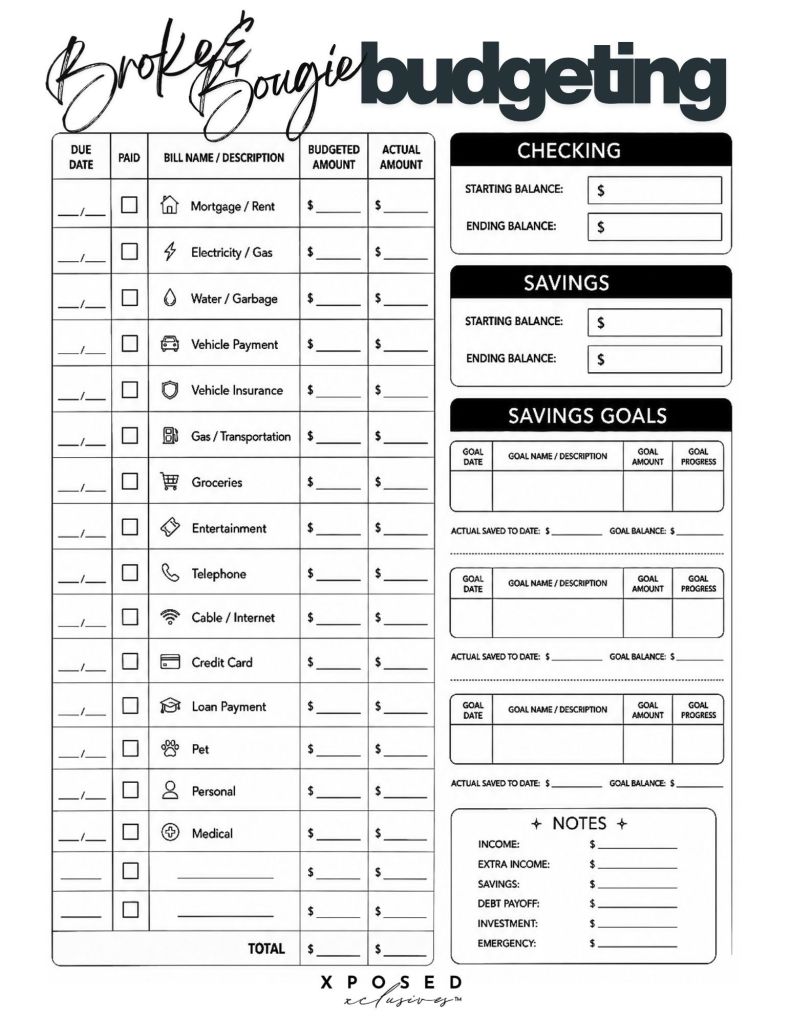
This is the worksheet for people who are ready to stop wondering where their paycheck went and start knowing exactly where every dollar is going.
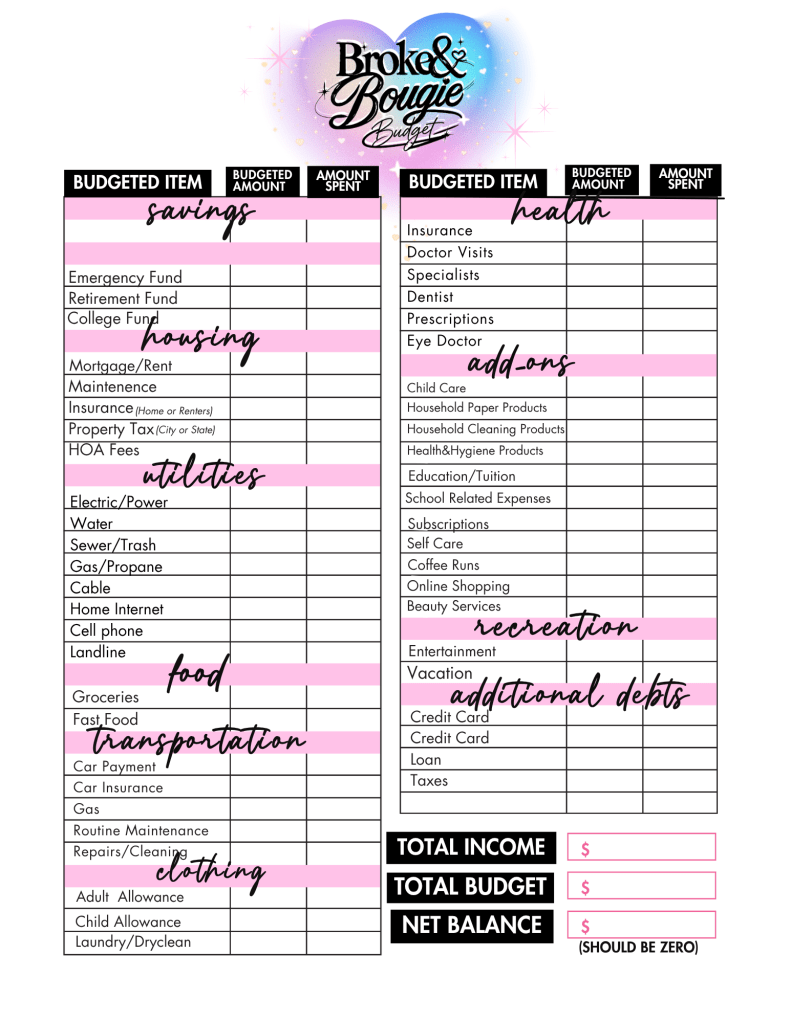
The Broke & Bougie Budgeting Worksheet takes the idea of intentional spending a step further by using a true zero based budgeting approach. Every dollar of your expected income is assigned a purpose before it leaves your bank account.
That doesn’t mean every dollar has to go toward a bill, debt, or some traditionally “responsible” expense.
This is where the Broke & Bougie philosophy comes in.
Your money should have a job, but that job can include enjoying your life.
The worksheet breaks your finances into detailed lifestyle categories so you can see the entire picture in one organized layout. You can account for savings, housing, utilities, transportation, food, clothing, healthcare, child related expenses, personal care, entertainment, debt payments, and the everyday expenses that tend to get forgotten when you’re trying to create a budget from memory.
It gives those expenses somewhere to go before they have the opportunity to sneak up on you.
You’ll be able to see exactly how much income you have available, how much you’re assigning to each category, and whether your planned spending actually adds up to the money you have coming in.
That visibility matters.
Because sometimes the problem isn’t that you’re spending money on the wrong things.
You simply haven’t been able to see the whole picture at once.
Once everything is laid out in front of you, spending patterns become easier to recognize. You can identify spending leaks, notice categories that consistently consume more money than expected, adjust your priorities, and redirect money toward the areas that matter most to you.
Maybe you need to save more.
Maybe you’re trying to pay down debt.
Maybe you need to prepare for an upcoming expense.
Maybe you’re trying to build an emergency fund.
Or maybe you simply want to know that there is money intentionally set aside for the things you enjoy instead of feeling guilty every time you spend it.
That’s what makes this worksheet different.
It isn’t designed to make you afraid of spending.
It’s designed to make your spending visible.
When every dollar has a purpose, you can spend with more confidence because you know what that money was intended to do.
And when you notice that you’re making progress in a category, you get to actually see it.
This worksheet is especially useful for people who enjoy organization, like planning ahead, want greater visibility into their finances, or are serious about building healthier financial habits.
It’s also for anyone who has ever looked at their bank account and thought, “Where the hell did all my money go?”
The Broke & Bougie Budgeting Worksheet helps answer that question.
Not by telling you that you can’t have the things you want, but by helping you figure out how to afford them intentionally.
Because every dollar should have a job.
And sometimes, that job is paying the light bill.
Sometimes it’s building your savings.
And sometimes, it’s making sure you have enough money set aside to enjoy the damn pedicure without feeling guilty about it.

The next worksheet in the bundle is Financial Triage, an in-depth financial assessment designed to give you a complete picture of the money coming into and going out of your household each month.
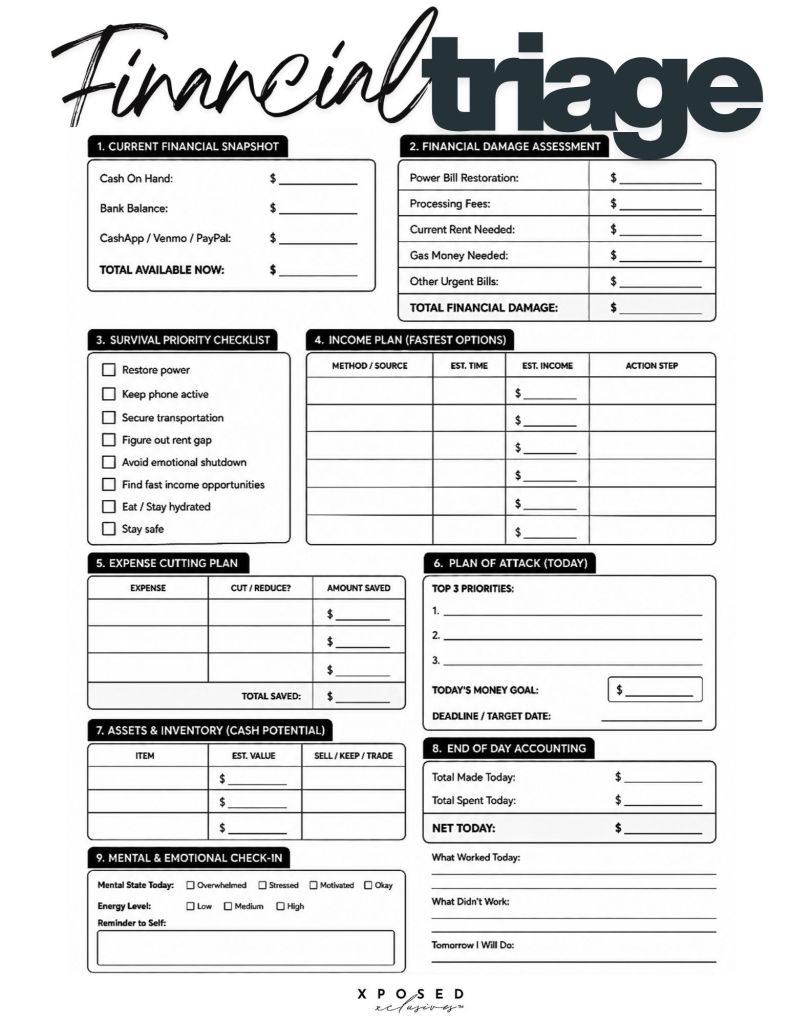
This worksheet is for financial emergencies, job loss, unexpected expenses, reduced income, overwhelming debt, or anyone who feels like they’re constantly trying to survive from one paycheck to the next.

Financial Triage is different from a traditional budgeting worksheet because it wasn’t created for people whose finances are running smoothly.

It was created for the moments when life throws everything off course and simply making a budget isn’t enough.

When you’re in financial crisis, your priorities change.

You aren’t necessarily thinking about retirement contributions, long term savings goals, or optimizing your spending percentages.

You’re thinking, “What do I need to do right now?”

Financial Triage helps you answer that question.

Instead of spending your energy analyzing where your money went last month, this worksheet helps you assess your current situation and determine what needs your attention first.

It gives you a structured way to slow down, take inventory, and make thoughtful decisions instead of reacting from fear, panic, or financial exhaustion.

You’ll assess how much money you actually have available right now, identify which bills and expenses are truly essential, determine what financial damage needs immediate attention, and look for expenses that can be delayed, reduced, negotiated, or eliminated.

You’ll also examine what resources you already have available.

Are there items you could sell to generate quick cash?

Are there opportunities to bring in additional income?

Are there expenses you can temporarily pause?

What needs to happen tomorrow?

What needs to happen next week?

And what can wait until you’ve stabilized?

Those questions matter because when everything feels urgent, it becomes incredibly difficult to determine what is actually urgent.

Financial Triage helps you separate the two.

One of the most important parts of this worksheet is the emotional check-in.

Financial stress doesn’t just affect your bank account. It can affect your judgment.

When you’re overwhelmed, you may avoid opening your bills, make impulsive decisions, spend money for temporary relief, shut down completely, or convince yourself that there’s no point trying because the situation already feels too far gone.

The emotional check-in gives you a moment to acknowledge where your head is before making decisions that could affect your finances.

You’re not being asked to ignore your emotions.

You’re being asked to recognize them so they don’t quietly make the decisions for you.

Financial Triage is designed to bring structure to financial chaos.

It helps you prioritize limited resources, identify the problems that require immediate action, create a realistic short-term action plan, and begin rebuilding your sense of control.

This isn’t the worksheet you pull out when everything is going perfectly.

This is the one you reach for when everything has gone sideways.

It’s for the person thinking, “I’m not trying to build wealth right now. I’m just trying to stop the bleeding long enough to get back on my feet.”

And there’s nothing wrong with that.

Sometimes, the first financial goal isn’t growth.

It’s stabilization.

Financial Triage meets you exactly where you are and helps you create a practical roadmap for getting through the immediate crisis so you can eventually move from surviving to planning and from planning to building.


One of the most important features of this worksheet is emotional check-in. Financial stress often leads to impulsive decisions, avoidance, shame, or complete paralysis. Before making important financial choices, you’ll have an opportunity to acknowledge your emotional state, recognize how it may be influencing your judgment, and approach your next steps with greater clarity and confidence.

The next part in the bundle isnt a sungle worksheet but a mini sort of bundle within the bundle that provides yet another approach to budgeting still separate from the worksheets above.

Broke & Bougie Budget Workbook

(Pages One & Two)
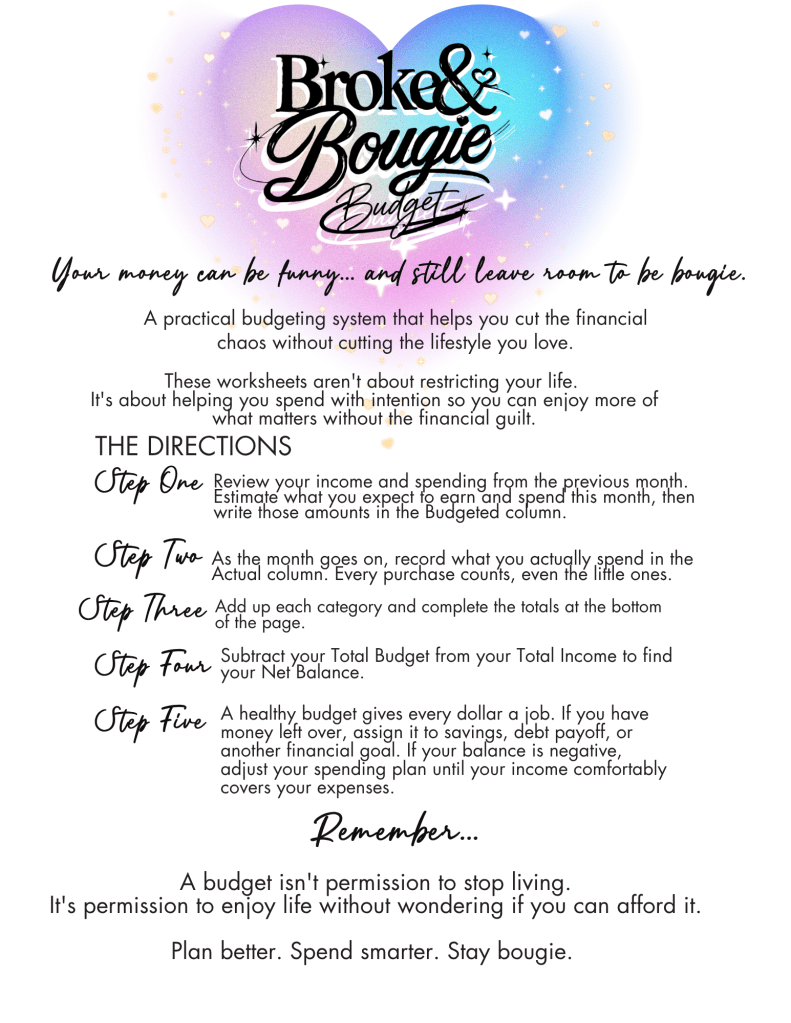
Best for:

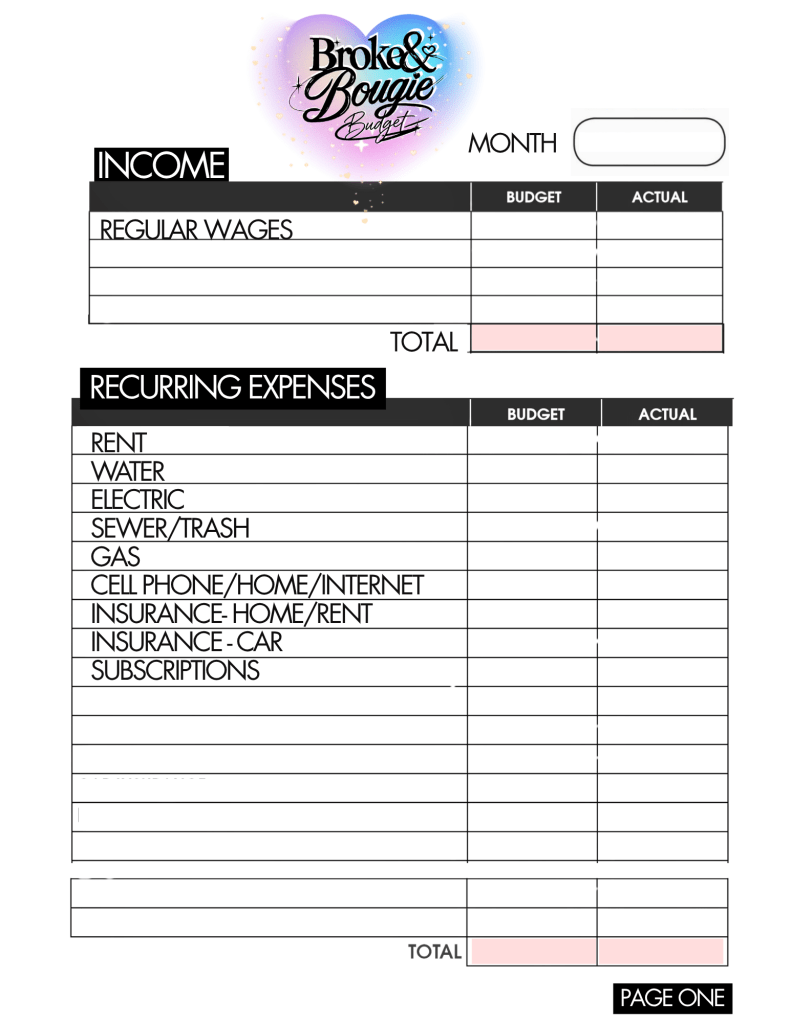
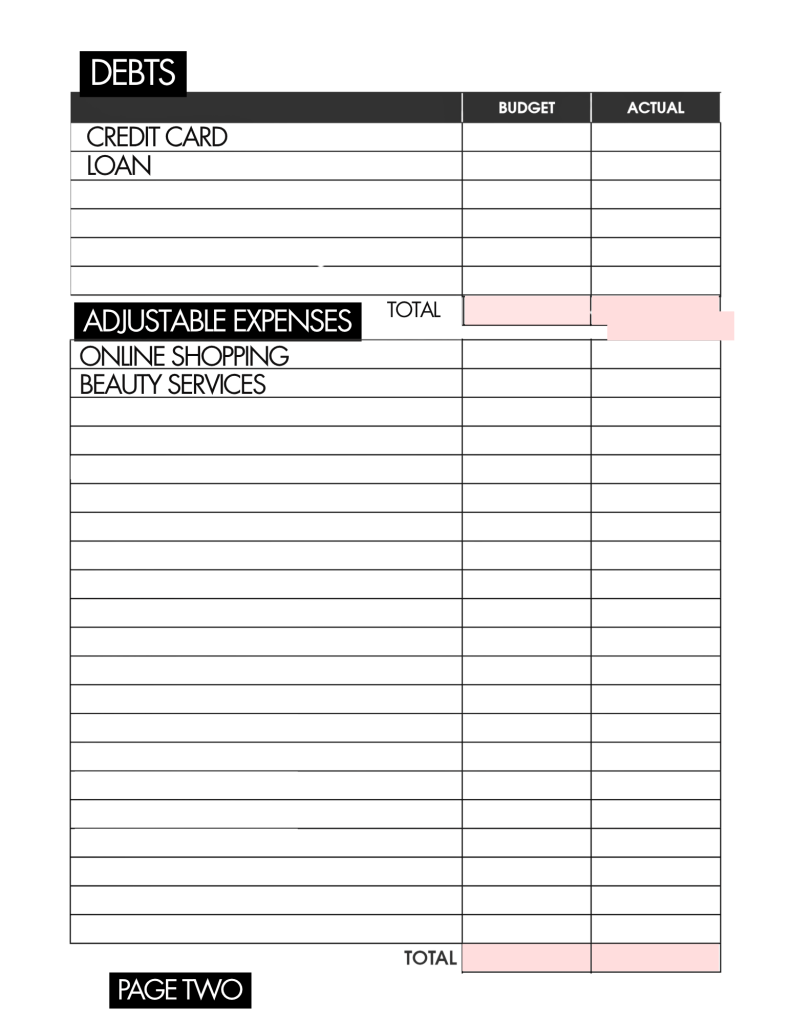
The next resource in the bundle is the Broke & Bougie Budget Workbook, a comprehensive monthly budgeting system designed for people who are ready to understand and manage every area of their financial life.

This workbook is ideal for individuals, couples, and families who are ready to move beyond simply paying bills and start managing their money with intention.

The philosophy behind the workbook is simple.

Every dollar should have a destination before it’s ever spent.

Instead of reaching the end of the month wondering where your paycheck disappeared to, you’ll have a complete picture of where your money is supposed to go before you spend it.

This creates a true zero based budget, giving every dollar a purpose while giving you greater visibility into your overall financial picture.

Unlike basic budgeting worksheets that throw expenses into a handful of broad categories, the Broke & Bougie Budget Workbook breaks your finances down into detailed sections that actually reflect real life.

Your mortgage has a place.

Your morning coffee has a place.

Your emergency fund has a place.

Your online shopping habit has a place.

Even the expenses you might normally forget about have somewhere to be accounted for.

That level of detail makes it much easier to recognize patterns that might otherwise stay hidden.

You may discover that one small expense isn’t really the problem, but several small expenses happening repeatedly are quietly draining hundreds of dollars each month.

You may realize that you’re spending more than you thought in one category while consistently underspending in another.

You may even discover that you have more financial flexibility than you realized.

The workbook includes dedicated categories for savings, emergency funds, retirement contributions, housing, utilities, transportation, food, clothing, healthcare, child related expenses, household supplies, subscriptions, personal care, recreation, vacations, debt payments, taxes, and adjustable expenses.

There’s also space to create your own categories based on your lifestyle, priorities, and financial goals.

Because your budget should reflect your actual life, not somebody else’s version of what your life is supposed to look like.

Throughout the month, you’ll record both what you planned to spend and what you actually spent.

That comparison is important.

Your budget tells you what you intended to do.

Your actual spending tells you what really happened.

When you compare the two, you begin learning your own financial patterns. You can see where you consistently overspend, where you’re saving more than expected, where your estimates need adjusting, and which habits may be quietly affecting your financial goals.

At the end of the worksheet, you’ll total your income, total your budgeted expenses, and calculate your remaining balance.

The goal is for that balance to reach zero.

But zero does not mean you spent every dollar.

It means every dollar was intentionally assigned somewhere.

Maybe it went toward your mortgage.

Maybe it went into savings.

Maybe it went toward retirement.

Maybe it went toward paying off debt.

Maybe it was intentionally set aside for a vacation, personal care, entertainment, or something else you value.

The point is that your money shouldn’t disappear without explanation.

It should be working toward something.

And this workbook isn’t built around restrictive spending.

It’s built around mindful spending.

It doesn’t tell you that you need to eliminate everything you enjoy in order to become financially responsible.

If shopping, beauty services, vacations, coffee runs, restaurants, hobbies, or entertainment matter to you, those things can have a place in your budget too.

Because the goal isn’t to create a life where you’re financially responsible but miserable.

The goal is to create enough awareness and intention around your money that you can enjoy the things you love without constantly wondering whether you can actually afford them.

Financial freedom isn’t about never spending money on anything fun.

It’s about knowing what you can afford, planning for it, and spending without the guilt and uncertainty that comes from having no idea where your money went.

If you’ve ever reached the end of the month staring at your bank account thinking, “Where the hell did my paycheck go?”

This workbook is designed to give you the answer.

It transforms your finances from a collection of random transactions into an organized financial plan that accounts for your responsibilities, your goals, your priorities, and yes, even the life you actually want to live.

Because being financially responsible shouldn’t require you to stop being Broke & Bougie.

Then last but not least, the bundle within a bundle, The Broke & Bougie Budget Plan.
The next resource in the bundle is the Broke & Bougie Budget Workbook, a comprehensive monthly budgeting system designed for people who are ready to understand and manage every area of their financial life.

This workbook is ideal for individuals, couples, and families who are ready to move beyond simply paying bills and start managing their money with intention.

The philosophy behind the workbook is simple.

Every dollar should have a destination before it’s ever spent.

Instead of reaching the end of the month wondering where your paycheck disappeared to, you’ll have a complete picture of where your money is supposed to go before you spend it.

This creates a true zero based budget, giving every dollar a purpose while giving you greater visibility into your overall financial picture.

Unlike basic budgeting worksheets that throw expenses into a handful of broad categories, the Broke & Bougie Budget Workbook breaks your finances down into detailed sections that actually reflect real life.

Your mortgage has a place.

Your morning coffee has a place.

Your emergency fund has a place.

Your online shopping habit has a place.

Even the expenses you might normally forget about have somewhere to be accounted for.

That level of detail makes it much easier to recognize patterns that might otherwise stay hidden.

You may discover that one small expense isn’t really the problem, but several small expenses happening repeatedly are quietly draining hundreds of dollars each month.

You may realize that you’re spending more than you thought in one category while consistently underspending in another.

You may even discover that you have more financial flexibility than you realized.

The workbook includes dedicated categories for savings, emergency funds, retirement contributions, housing, utilities, transportation, food, clothing, healthcare, child related expenses, household supplies, subscriptions, personal care, recreation, vacations, debt payments, taxes, and adjustable expenses.

There’s also space to create your own categories based on your lifestyle, priorities, and financial goals.

Because your budget should reflect your actual life, not somebody else’s version of what your life is supposed to look like.

Throughout the month, you’ll record both what you planned to spend and what you actually spent.

That comparison is important.

Your budget tells you what you intended to do.

Your actual spending tells you what really happened.

When you compare the two, you begin learning your own financial patterns. You can see where you consistently overspend, where you’re saving more than expected, where your estimates need adjusting, and which habits may be quietly affecting your financial goals.

At the end of the worksheet, you’ll total your income, total your budgeted expenses, and calculate your remaining balance.

The goal is for that balance to reach zero.

But zero does not mean you spent every dollar.

It means every dollar was intentionally assigned somewhere.

Maybe it went toward your mortgage.

Maybe it went into savings.

Maybe it went toward retirement.

Maybe it went toward paying off debt.

Maybe it was intentionally set aside for a vacation, personal care, entertainment, or something else you value.

The point is that your money shouldn’t disappear without explanation.

It should be working toward something.

And this workbook isn’t built around restrictive spending.

It’s built around mindful spending.

It doesn’t tell you that you need to eliminate everything you enjoy in order to become financially responsible.

If shopping, beauty services, vacations, coffee runs, restaurants, hobbies, or entertainment matter to you, those things can have a place in your budget too.

Because the goal isn’t to create a life where you’re financially responsible but miserable.

The goal is to create enough awareness and intention around your money that you can enjoy the things you love without constantly wondering whether you can actually afford them.

Financial freedom isn’t about never spending money on anything fun.

It’s about knowing what you can afford, planning for it, and spending without the guilt and uncertainty that comes from having no idea where your money went.

If you’ve ever reached the end of the month staring at your bank account thinking, “Where the hell did my paycheck go?”

This workbook is designed to give you the answer.

It transforms your finances from a collection of random transactions into an organized financial plan that accounts for your responsibilities, your goals, your priorities, and yes, even the life you actually want to live.

Because being financially responsible shouldn’t require you to stop being Broke & Bougie.

Our Broke & Bougie Budgeting Bundle provides you with multiple ways to budget, all for free, too! It would honestly be crazy to pass this up.

If you aren’t convinced yet, let me keep going. 

I’ll go ahead and list the perks, with all the worksheets combined, what they could do for  you. You can:

• Gain complete clarity on where every dollar is actually going.
• Stop guessing and start making intentional financial decisions.
• Catch wasteful spending before it becomes a habit.
• Create a realistic budget that works with your life instead of against it.
• Keep your bills organized so fewer due dates slip through the cracks.
• Track your savings progress and stay motivated with visible goals.
• Build healthier money habits one small decision at a time.
• Reduce financial stress by having a plan before problems happen.
• Identify financial emergencies before they become full blown crisis’
• Prioritize expenses based on urgency instead of panic.
• Develop a same day action plan when money gets tight.
• Find quick ways to generate extra income when you need it most.
• Discover expenses you can reduce without sacrificing what matters.
• Keep track of checking and savings balances in one place.
• Monitor your monthly income, spending, and overall financial health.
• Turn overwhelming finances into simple, manageable steps.
• Reflect on both your financial progress and your mindset because money is emotional too.
• Create consistency even if you’ve never successfully stuck to a budget before.
• Spend with confidence instead of wondering if you’ll regret it later.
• Have a complete budgeting system that grows with you month after month.
Then close with something like:
The best part about this bundle is that even though all the budgeting worksheets are different, every one of the worksheets are designed to work together, so instead of downloading random budgeting printables that don’t connect, you’ll have one complete system that helps you budget smarter, recover faster, and finally feel in control of your money, through every financial phase you are in. And, it’s all yours completely free.

No redirects to sign up necessary for you to get thid bundle.

No subscriptions
No pay walls.

No email marketing to sign up for to clog up your inbox.

Just practical resources designed to help you  take one small step toward financial peace.

Without any strings attached.


Money management shouldn’t be looked at in a negative light.


It’s about making intentional decisions with what you already have.


Being “Broke & Bougie”, despite the obvious title suggesting otherwise, isn’t about appearances. 

It’s about finding beauty in progress, celebrating small wins, and proving that financial responsibility doesn’t have to look dull.

You can still wear designer. Just order from DHgate and retire your daily McDonald’s habit.


Download your free budget printables below.

Print what you need.

Print an extra page for a friend.


Even though your bank account may still be a work in progress… You can start today and make your first investment in becoming someone who has their finances in order. ❤️

XX

The Truth About Energy Transfer

Every interaction you have has the potential to leave an imprint.

It can have either a positive or a negative influence over you. 

And no words have to be exchanged for it to affect you.

Have you ever had anyone confess to you after talking with them, something like,

“I feel so much better after talking to you.”

They might have been going through something emotionally prior to talking to you, and even if they didn’t divulge the details to you before the exchange, you somehow helped them unknowingly just by being pleasant and friendly to them in that moment.


You might not have discussed anything of real substance.

It could be as simple as a run-in with your neighbor at the mailbox, and you all have a few minutes of back and forth about the weather.


It didn’t have to be some gut-wrenching emotional exchange to dramatically affect the other person.

You don’t know that, just moments earlier, they were going through some really intense feelings.

They  walked out to the mailbox, feeling one way and returned inside, feeling better.


They really can’t comprehend why that is.

There was nothing uplifting said that seemed capable of brightening their day.

Yet, they felt better.

They just don’t understand why.

You’ve also probably experienced the opposite of that as well.

If you come in contact with someone in an irritable mood, it has the potential to change the atmosphere of an entire room just as the exchange with the neighbor. 

It also can potentially linger long after they’ve gone.

These emotional exposures between one another can influence our thoughts, mood, patience, and overall well-being without us even being aware it’s happening.

The conversation may end, and everyone continues on separately in their day, yet the emotional impact doesn’t.

If you work in a people centered profession such as hairstyling, barbering, nail technology, tattooing, massage therapy, esthetics, healthcare, or counseling, you’ve probably joked once or twice about needing to charge your clients a separate bill for the therapy sessions.

There’s actually more truth in that joke than people realize.

Energy transfer is the emotional impact people, places, and situations can have once that access has been given.

Establishing a healthy boundary in these  interactions  can lessen the effect they have on you after the conversation ends.

That doesn’t mean treating people like they need a warning label.

Don’t get me wrong.

Some of your clients very well might need one.

Ethically, though, you can’t go around slapping stickers on people.

You also can’t dismiss someone as a client simply because they’re chatty.

What you can do is take a few preventive measures that soften the experience while maintaining an unspoken boundary.

Instead of verbally telling someone they’re sharing too much, you can subtly guide the conversation in another direction or create an environment that naturally encourages them to tone down certain topics.

Here’s an example to give you a better idea of how to handle this type of client if you have one who sounds familiar.

Maybe you have a regular client who is pleasant, respectful, and not difficult to deal with necessarily but has a tendency to overshare. I’m talking literally the moment they sit down.

They may tell you deeply personal details about themselves or other people, even sharing private information that has nothing to do with you.

Their personality doesn’t come across as messy or dramatic, and nothing they say sounds malicious.

To them, they’re simply giving you an update on what’s been happening in their life.

To avoid unintentionally steering the conversation in those directions, I changed the way I greeted the clients I knew were prone to oversharing. I quickly realized that what I said during the first few moments after they arrived played a huge role in determining how the rest of the appointment would unfold.
Instead of automatically asking, “How have you been?” I started opening with something less personal. I’d compliment something they were wearing or comment on something that had nothing to do with their personal life. If a holiday was coming up, I’d ask if they were ready for it. The goal was to introduce a topic that didn’t naturally invite deeply personal conversations they had become accustomed to having.
The closest I’d come to making it personal was saying something like, “I feel like I haven’t seen you in a while.” It’s warm and welcoming without opening the door to every detail of what they’ve been through since your last appointment.

Those simple changes often kept the conversation from immediately turning into a recap of someone’s personal life.

There will always be a few clients, though, who naturally steer every conversation back to the subjects they’re known for.

Instead, you have to adjust the things I did have control over.

I paid close attention to the things I could control and made intentional alterations to my environment.

I focused on the music, the scents, the lighting, and even the tone of my own voice.

I created an atmosphere that subtly encouraged people to become calmer and more relaxed.

Surprisingly, those small adjustments often made a noticeable difference in how emotionally intense the conversations became.

I also learned to prepare myself ahead of time for those clients.

Whenever possible, I scheduled those clients as my last appointment of the day, even if it meant making an exception to my normal schedule.

I knew those conversations would require more emotional bandwidth than most, and I didn’t want to carry the weight of them into my next client’s appointment.

There was one client in particular who would tell me intimate details about her daughter’s life. She shared everything from her toxic marriage and divorce proceedings to how the stress had affected her parenting. She explained that her daughter had begun paying less attention to her children, they were getting into trouble at school, and instead of getting a handle on everything, she had developed a habit of drinking every night after work.

Eventually, it became so overwhelming that my client had to temporarily take care of her grandchildren while trying to get her daughter the help she needed.

I didn’t interrupt as she spoke, but I could feel the weight of the conversation settling on me. Without warning, I found myself wondering if, somewhere, my own mother might be sitting in someone else’s chair, sharing deeply personal details about my life in the very same way.

There were no real parallels between her daughter’s situation and my own.

It wasn’t the story itself that affected me.

It was the realization that I had just become the keeper of deeply personal information about people I had never met and who never consented to having their lives discussed with a complete stranger.

I don’t believe my client intended any harm. She wasn’t being malicious. She was simply talking. But good intentions don’t erase the emotional weight those conversations can leave behind, nor do they change the fact that the people being discussed never agreed to become part of the conversation.

I couldn’t help but think about what might have happened if that conversation had taken place with someone whose morals or intentions were very different from mine.

In just a few minutes, she had shared enough deeply personal information that someone else could have twisted it into ammunition. Those details could have been repeated, exaggerated, taken out of context, or used to fuel gossip. In the wrong hands, they could have caused real harm to her daughter, her grandchildren, and even complicated an already difficult legal battle.

She trusted me enough to share those things, but trust doesn’t guarantee discretion. Whether we realize it or not, information has value, and once it’s spoken aloud and once deeply personal information leaves your mouth, you no longer have control over where it goes. 

You should also be honest with yourself about what you are willing to accept from others in general because it sets the tone for how much you’ll allow it to show up in other client relationships, too.

While a certain level of customer service is expected from you in your line of work, no amount of money can justify feeling awful just to maintain their loyalty.


If you find yourself believing that you have to indulge or encourage conversations and behaviors you don’t agree with just to guarantee someone remains a regular client, it’s probably time to recalibrate your approach.

A simple alteration to your greeting and the changing of your Playlist prior to their arrival sometimes is not enough, and you need to make some tougher decisions.

Remember, the issue isn’t that people share too much.

You can listen without absorbing.

You can care without collecting.


Learning to recognize that difference is one of the most valuable forms of protecting your own energy.

Once you start to notice it, you’ll see the pattern emerge.

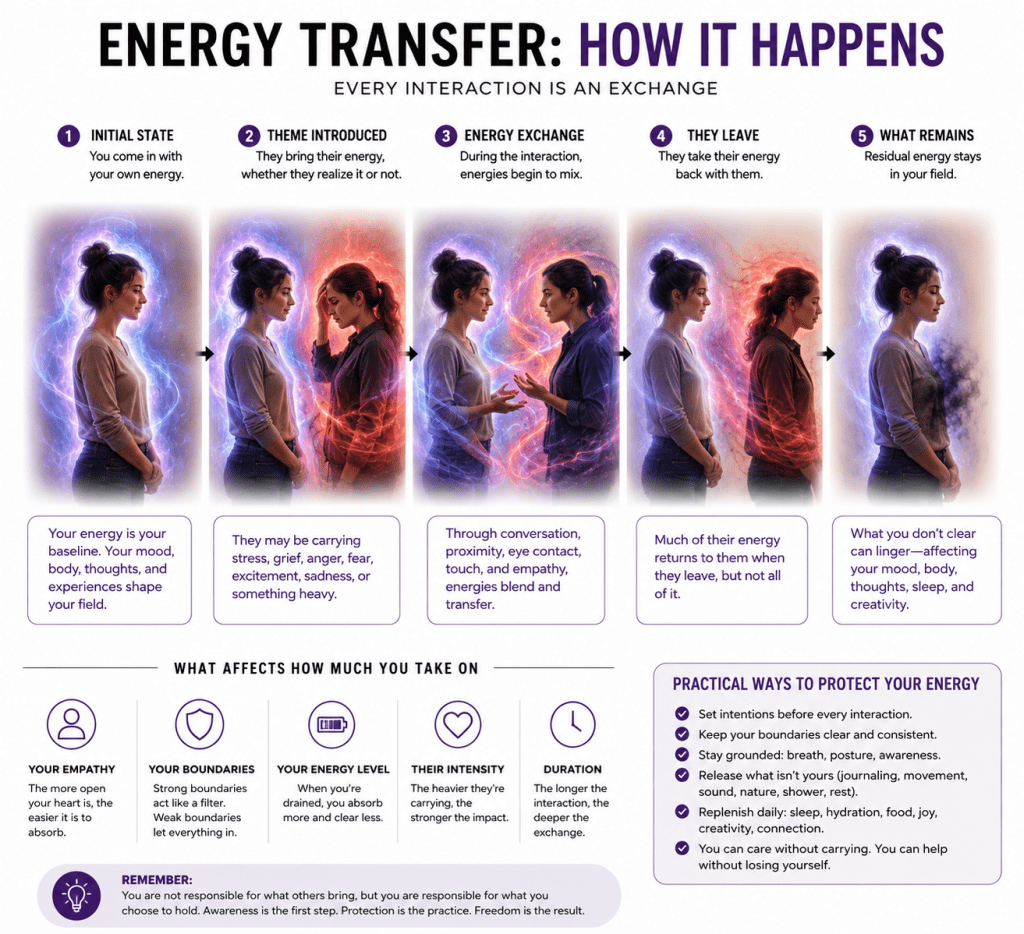
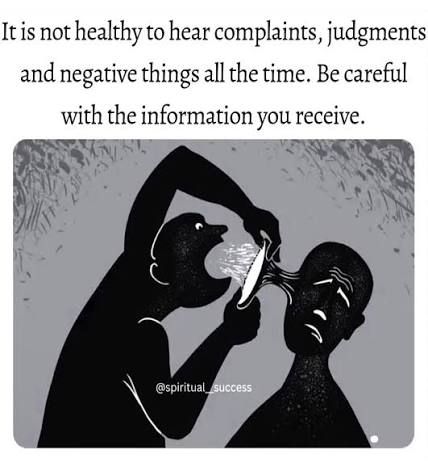
Look at the diagram below.  It illustrates the residual, stagnant energy that remains on you from a brief interaction with someone for just a short exchange.

Check out this TikTok I found that provides an alternative example of energy  transfer with an object that detects energy.

The device used in this video is called an Energy Stick.  It is used mostly in educational environments to demomstrate the detection of energy by lighting up or omitting soubd and light to indicate the shared electrical response through physical conductivity.  While researchers have not established that our emotional connections are caused by the same electrical currents demonstrated by the device, it serves as a useful visual reminder that our bodies do conduct electricity and are electrically active. It’s also another way to appreciate that human beings are not only chemical and mechanical but also electrical systems whose interactions can influence one another in measurable and meaningful ways, even without being officially legitimized by scientists to verify it exists.

Allow me to give you another example of how something unwanted can quietly accumulate without your awareness and the impact it can have on you once you’ve carried it long enough.

Imagine walking into a grocery store with a carefully planned shopping list and a strict budget.
Before you leave the house, you check the fridge and the pantry and do a thorough inventory to assess what needs to be purchased.

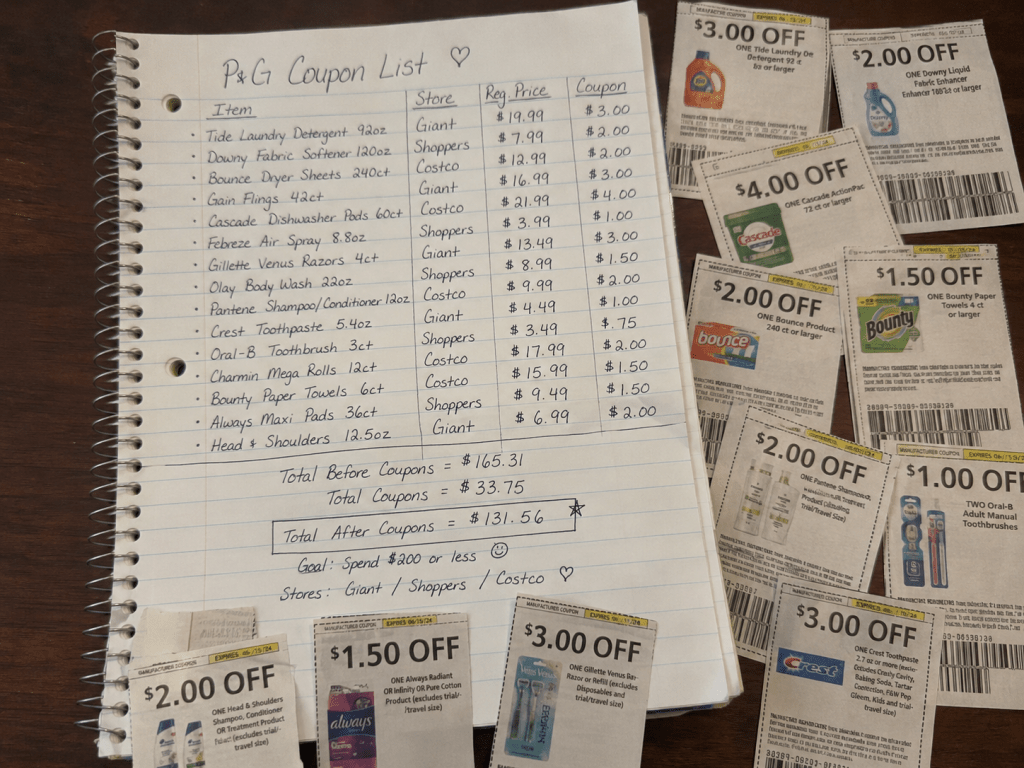
You stopped on the way to the store and pulled out the cash to cover the cost of the items on your list that you already added up and factored in all the discounts and coupons fir the trip to know your exact budget. 

You recently implemented a new budgeting system to help manage your expenses, and this shopping trip is part of that process.
It requires a little more effort while you’re in the store because many of your digital coupons apply only to specific brands, sizes, quantities, or package varieties. You have to pay close attention to what you’re placing in your cart to make sure each item qualifies. Otherwise, the coupon will be rejected when you hand your phone to the cashier at checkout.


You don’t want to be that customer holding up the line while trying to figure out why the discounts didn’t apply.
None of this catches you by surprise, though. You knew these requirements before leaving the house. You expected to spend a little extra time in the store, planned accordingly, and accepted that it was simply part of the process.

As you’re making your way through each aisle, you’re paying close attention to your digital coupons on your phone one minute and carefully studying products the next to make sure they meet the exact size and quantity requirements. You’re feeling accomplished because your new budgeting system is working exactly as you intended.
Unbeknownst to you, another pair of shoppers has been watching you for the past few aisles.

For whatever reason, they find your careful, methodical shopping entertaining. They laugh with one another,  and while your back is turned, they quietly slip a few small but somewhat expensive items into your cart, thinking it’ll be funny when you discover them later.
At first glance, their effort seems pointless. You’ve been so intentional throughout your shopping trip that the chances of those items actually making it to the checkout are incredibly slim. You’re constantly comparing products to your coupons, reviewing your cart, and making sure every purchase belongs there.
The only way those extra items would become your responsibility is if your attention drifts long enough for them to go unnoticed.As you approach the checkout, the pair deliberately falls in line behind you and begin to create commotion to distract you to ensure their little prank was successful and just as you are mud way through unloading your cart onto the conveyor belt, your phone rings. While your attention is pulled in another direction for only a few seconds, you continue placing items on the belt without giving your cart one final glance.  This is mainly due to their unnecessarily loud banter and very unnatural shopping etiquette but, hey, you are almost done and headed home and won’t see these two idiots again.  You have unknowingly added these items to your total cost.
You hand your phone to the cashier to scan your digital coupons, confident that you’ve done everything right. Then, the total appears on the screen.

It’s much higher than you expected.

Confused, you begin questioning yourself.

Did one of the coupons fail to apply?

Was something priced incorrectly?

Did an item get scanned twice?

You know exactly how much cash you brought because you planned ahead. As the people behind you continue talking loudly, laughing, and waiting for the line to move, you begin to feel rushed.

Rather than holding everyone up while you search through every item in your cart, you pull out your credit card and pay the balance.

You walk out of the store, frustrated.

Minutes earlier, you walked in feeling confident because your new budgeting system was working exactly as you intended.

Now you’re leaving second-guessing yourself, replaying the entire shopping trip in your mind, wondering where you went wrong. You’re upset about the unexpected phone call, disappointed that you abandoned your process, and frustrated that all of the preparation you put into sticking to your budget seems to have failed.

The truth is, your system didn’t fail.

And you don’t even know about the prank that was pulled on you yet. 

After all, the prank itself isn’t what costs you money.
The distraction was.
Those items were never yours to begin with, but because your awareness was redirected at the exact moment you needed it most, you unknowingly claimed responsibility for them. 

You leave the store carrying more than you intended.

Once you’re home, you’ll have to reshuffle your finances to make up for money you never planned to spend.


Emotional burdens work much the same way.

No matter the circumstances, it’s important to be mindful of both what you carry and what you leave behind.
Just as important as recognizing what belongs in your cart is recognizing what doesn’t.
Not everything that ends up in your possession was meant for you to carry.
Some things are placed there intentionally.
Some arrive through distraction.
Some simply go unnoticed.

It’s also like having one moldy orange into a bowl of fresh ones. You don’t notice it because it’s molding at a part that is not visible unless you take them off the fruit bowl one by one.

Over time, the mold spreads.

People can influence us in much the same way.

Prolonged exposure to chronic stress, negativity, anxiety, or conflict can gradually affect your own mood and outlook, often without you realizing it.

That’s why it’s important to periodically ask yourself the following questions.

“Is this feeling actually mine?”

“Did I feel this way before this interaction?”

Awareness creates choice.

As you start recognizing what drains your energy and what replenishes it, you can become more intentional about limiting the emotional impact others have on you.

Below are two worksheets where you do an evaluation of what you have in your life that is draining you and what is fueling you.  The pdf is available at the bottom of the page for you to download and complete.

Use these worksheets to identify the people, places, and situations that consistently restore your energy and the ones that leave you feeling overwhelmed.

The value isn’t in completing the worksheet.

It’s in recognizing patterns and using them to create healthier boundaries and better protect your emotional well-being.

Energy Tranference in the Workplace

If you work in a field that involves having many different clients, patients, customers, students, or the public, that you come in contact with daily you need to understand that you’re providing them more than a service.
Every interaction at work requires your attention, patience, emotional bandwidth, and presence.

Because of that, it’s important to have a personal protocol put in place for protecting your emotional well-being before, during, and after those interactions.

Make Alterations to the Ambiance @ Work

If you have the luxury to have a little flexibility in your work environment and your designated space, I can not emphasize enough, DO IT!

Even if it’s limited to just your workspace, do a lot with what little you have. 

Sounds


Music has the ability to shape the atmosphere of a space long before the first conversation begins. Rather than allowing the emotional tone of everyone around you to dictate your day, intentionally choose sounds that create the environment you want to work in.


If it’s just you:

Start listening before you even arrive. Play your playlist during your commute while setting up your station or through one earbud if permitted. Over time, those familiar sounds become a cue that it’s time to leave the outside world behind and step into a calmer, more focused mindset.
If you have your own workspace:
Let your workspace reflect the same intention. If you’re able to play music softly, choose sounds that encourage relaxation without demanding attention. Your clients may never comment on the playlist, but they’ll remember how your space made them feel.


If you own the storefront:


Think of your music as another part of your brand. Just as carefully as you choose your décor, lighting, and scent, curate the soundtrack that fills your business. Create playlists that complement different parts of the day, welcome clients as they enter, maintain a calm atmosphere during busy hours, and help everyone transition into closing time.


No matter which category you fall into, check out my YouTube channel, @Xposed_Rituals, and my Peaceful Plays™ playlist.

It was created specifically for professional work environments and is just as effective for a personal workstation as it is for an entire storefront.

It blends ethereal R&B, neo soul, ambient instrumentals, nature sounds, crystal singing bowls, and carefully selected frequency inspired mixes, including many 432 Hz and binaural beat remasters of songs you already know and love.

The atmosphere is woven together, so naturally, you may not even realize why the space feels different. You may simply notice that everyone, including yourself, leaves feeling a little lighter.

Here’s the link to check that out. 

https://youtube.com/playlist?list=PLSLjPzq2cVDo&si=wCujiuHQrRUsA6y-

Even if that’s not your thing, be sure to choose music that grounds you.

If you want to skip all the individual suggestions, you can head straight over to my Amazon Storefront, where I’ve created an Idea List specifically for the products I highly recommend incorporating into your professional space.
Whether that means lighting a Diva candle the moment you arrive because the scent instantly gives you that familiar sense of comfort, or walking into your workspace and heading straight to your Amazon Echo Show 15, where my Peaceful Plays™ playlist is already saved and ready to go with just a few swipes, these little details can completely change the atmosphere of your day.
Before you know it, calming chords are filling the room, the lighting is right, the space smells good, and you’ve created another layer of ambiance that doesn’t just help you move through your day. It creates an experience your clients can feel too, even if they can’t quite put their finger on why the space feels different.
Life is too short to spend every day simply enduring the environment you’re working in. Find little mood enhancing accelerants that make you feel good, ground you, and help you shift into the energy you need, even when you’re walking into a busy day that already has a hundred things waiting for you.

Here’s the link

https://www.amazon.com/shop/influencer-c0175a48/list/2XLBORA96W95H?ref_=aipsflist

Scent

Scent is one of the strongest memory triggers we have. Long after someone forgets a conversation, they’ll often remember how a place smelled. Whether it’s for yourself, your clients, or your team, a signature scent can help create a subtle sense of familiarity, comfort, and consistency.


If it’s just you:


Choose one fragrance, perfume, essential oil, or aromatherapy roller that you wear only while working. Over time, that scent can become a personal cue that it’s time to transition into work mode.
If you have your own workspace:
If your workplace allows it, use a small diffuser, reed diffuser, linen spray, wax warmer, or lightly scented hand lotion. Keep the fragrance subtle. The goal is to create a pleasant atmosphere, not overwhelm the space. Be mindful that some people have fragrance sensitivities.


If you own the storefront:


Develop a signature scent that becomes part of your brand identity. Just like your music, lighting, and décor, scent contributes to the overall experience. Customers may not consciously notice it, but they’ll remember how your business made them feel. Consider using the same fragrance throughout your lobby, waiting area, restrooms, and retail space to create a consistent sensory experience.

My Favorite Scent Upgrade


If it’s just you, wash your work clothes with Tyler Candle Company’s Diva Glamorous Wash.

And No, I’m not an affiliate.

I simply love it.

If it’s just you:
One of my favorite little luxuries is Tyler Candle Company’s Diva® Glamorous Wash. It’s available on Amazon and from many boutiques.
A little goes a long way. I use about a capful when washing my work clothes, and once the dryer activates the fragrance, getting dressed for work feels a little more intentional. It’s a simple ritual that helps me transition into my workday.


If you own the business:

Invest in a waterless diffuser and a few hotel inspired fragrance oils.

Subscribe to one of those Facebook group that’s for Amazon Deals and Codes. 

They have the waterless diffusers on there all the time with extreme discounts. 

Heres the link to one:

https://www.facebook.com/share/g/1GqcKUzFak/

I always go on google first and look for the cheapest site before I head to Amazon right away.

The hotel scents are uni-sex, and all share that same clean, luxurious atmosphere people associate with high-end hotels. It’s one of the simplest ways to elevate the experience before you’ve even greeted your first customer.

Vine Vida is a good &  affordable start. Amazon sells Vine Vida, and if you already pay for Prime, you might pay a few dollars more on Amazon, but you aren’t paying shipping like you would through the Vine Vida site.  I suggest getting the hotel scent bundle pack and small bottles, and check which one you like the most before blindly buying a big bottle.

Here’s the link for the whole set for $20 on their site.

https://www.vinevida.com/products/luxury-hotel-diffuser-fragrance-oil-set?variant=50047668388063&tw_source=google&tw_adid=816147640443&tw_campaign=24012270363&tw_kwdid=pla-294682000766&gad_source=1&gad_campaignid=24012270363&gbraid=0AAAAACR60SQ0v57UI17-cH-OoMqRJT1PR&gclid=CjwKCAjwvsvTBhBaEiwAmf-3nqQOdI2q8URYW0gFPP5OUIMYzPySEho5kwsmXDWt0SSjXUoQYfmi4xoCn-gQAvD_BwE

Or if you wanna save a few dollars, order from Vine Vida still, just through Amazon.

Here’s the link.

https://www.amazon.com/VINEVIDA-Luxury-Hotel-Scent-Collection/dp/B0GHZL2NK4/ref=ast_sto_dp_puis

https://www.amazon.com/VINEVIDA-Luxury-Hotel-Scent-Collection/dp/B0GHZL2NK4/ref=ast_sto_dp_puis

Lighting
Lighting influences more than just how a space looks. It affects mood, energy, focus, and the overall experience of everyone in it. While you may not always have control over the overhead lights, you can usually make small adjustments that create a noticeably different atmosphere.


If it’s just you:
Use warm lighting whenever you can outside of work to help your mind transition into and out of your workday. If you’re getting ready before sunrise or winding down after your shift, avoid harsh overhead lighting and opt for warm lamps instead.


If you have your own workspace:
If your workplace allows it, add a small warm LED lamp, battery operated accent light, or soft puck lighting to your station. Even subtle lighting can make your workspace feel more inviting while helping reduce the harshness of fluorescent lights.


If you own the storefront:
Lighting is one of the most overlooked parts of the customer experience.
Layer your lighting instead of relying solely on bright ceiling fixtures. Use warm lighting in waiting areas, decorative lamps throughout the space, under cabinet lighting, wall sconces, candles where appropriate, and accent lighting to highlight retail displays or architectural features. Natural light is always a bonus whenever possible.
A well lit business doesn’t have to be the brightest room. It should be the room people feel most comfortable walking into.

Schedule

Your schedule is just as much a part of your environment as your workspace. Sometimes the fastest way to reduce stress isn’t changing your job. It’s changing when and how you do it.
If it’s just you:
Take an honest look at your week. Which day consistently leaves you exhausted? Which part of your day feels rushed? Sometimes a small adjustment can make a noticeable difference.
Maybe taking your lunch at 1:30 instead of noon helps you avoid the rush and actually enjoy your break. Maybe preparing tomorrow’s clothes and lunch the night before makes your mornings feel less chaotic.


If you have control over your schedule:
Challenge routines you’ve accepted without question.
If Mondays are consistently overwhelming, could you make that your day off and work a longer shift on Friday instead? If you’re more productive in the morning, could you block that time for your most important work? If you’re constantly interrupted, could you schedule uninterrupted focus time before opening or after closing?
The goal isn’t to work harder.
It’s to work smarter.


If you own the storefront:
Design your business around what actually works, not what everyone else is doing.
Stagger employee lunches so no one feels rushed. Schedule your administrative work during slower business hours instead of squeezing it between clients. Reserve time each week for inventory, deep cleaning, ordering supplies, marketing, and planning instead of waiting until everything becomes urgent.
Protect your calendar as intentionally as you protect your finances.
Every “yes” to one thing is a “no” to something else.
Do Something Different
If something drains you every single week, stop assuming that’s just the way it has to be.
Ask yourself the following things…


• What could I rearrange?
• What could I automate?
• What could I simplify?
• What could I delegate?
• What could I stop doing altogether?


Small adjustments made consistently often have a greater impact than major changes made once.


Every change begins with a plan.
Whether you’re adjusting your work hours, redesigning your mornings, creating a better lunch routine, or restructuring an entire business, write it down before you try to live it.
That’s why I use one planner for everything.


My Vault Master Planner goes everywhere with me.

It’s my calendar, notebook, project manager, brain dump, and decision-making system all in one place.
The best planner isn’t the one with the most features.
It’s the one that’s with you when life happens.

Flowers & Plants


Fresh flowers and greenery have a way of softening a space. They add warmth, color, and life while creating an atmosphere that feels more welcoming and thoughtfully designed. You don’t need an expensive arrangement to make an impact.


If it’s just you:
Treat yourself to a small bouquet of fresh flowers every week or two. Place them somewhere you’ll see them while getting ready for work or when you come home. If fresh flowers aren’t practical, choose a low maintenance plant that brings a little life into your routine.


If you have your own workspace:
If your workplace allows it, place a small vase of fresh flowers or a simple plant at your station. Even one stem can brighten your workspace and subtly enhance the experience for both you and your clients.


If you own the storefront:
Flowers and plants become part of your brand’s first impression. Display fresh arrangements at your entrance, reception desk, or waiting area. Add greenery throughout your business to soften the space and make it feel more inviting. Rotate seasonal flowers to keep your environment feeling fresh and intentional.


My Favorites


Some of my favorite low-maintenance plants include peace lilies, snake plants, Pothos, and Monstera.  They’re beautiful, relatively easy to care for, and instantly make a space feel more alive.
For fresh flowers, you don’t have to spend a fortune. Grocery stores like Trader Joe’s, Costco, Aldi, Sam’s Club, and even your local supermarket often have beautiful bouquets at reasonable prices. Sometimes, a simple arrangement does more for the atmosphere than an expensive piece of décor.
People may not remember every detail about your business, but they’ll remember how it made them feel. Fresh flowers and greenery quietly communicate that someone cares about the space and, by extension, the people in it.

Crystals
Whether you view crystals as meaningful symbols, reminders of your intentions, or simply beautiful natural décor, they can serve as a visual cue to pause, refocus, and reconnect with how you want to show up throughout the day.
If it’s just you:
Carry a crystal in your pocket, purse, or backpack, or wear one as jewelry. Every time you notice it, let it be a reminder to check in with yourself. Ask, How am I feeling? What do I need right now?

If you have your own workspace:
Place one or two crystals somewhere you’ll naturally see them throughout the day. They don’t have to be large or expensive. Even a small stone beside your computer, cash register, or workstation can become a quiet reminder to stay grounded.


If you own the storefront:
Incorporate crystals into your décor in a way that feels authentic to your brand. Display them on shelves, reception desks, retail displays, or waiting areas. Whether your customers believe in their metaphysical properties or simply appreciate their beauty, they add texture, warmth, and a natural element to your space.


Whether you believe crystals carry energy or simply appreciate them as beautiful reminders of your intentions isn’t the point.
The value comes from creating small moments throughout your day that encourage you to pause, reset, and become more intentional about the energy you bring into every interaction.

These aren’t just aesthetic choices.

They’re anchors that help you return to a place of balance throughout the day.

Your workspace shouldn’t only support your clients.

It should support you, too.

Simple rituals can also help.

Take a few intentional breaths before greeting your next client.

Let washing your hands becomes more than a sanitary habit.

Use it as a mental reset between one interaction and the next.

Most importantly, learn to filter what deserves your emotional investment.

Not every complaint requires your attention.

Not every argument deserves your energy.

Not every opinion belongs in your mind.

There’s a difference between acknowledging reality and allowing it to become your permanent emotional environment.

At the end of each day, ask yourself one question:

What did I carry home today that was never mine to begin with?

The answer may explain more than you realize.

Your greatest asset isn’t just your talent, intelligence, or work ethic.

It’s your ability to remain grounded while surrounded by people carrying heavy burdens.

Empathy allows you to understand what someone else is feeling.

Healthy boundaries remind you that understanding it doesn’t mean you have to carry it.

If you’ve been feeling unusually irritable, mentally exhausted, less creative, impatient, or burned out, ask yourself whether the work is truly draining you or whether you’ve been carrying emotional weight that was never yours.

Often, it’s not one difficult conversation that overwhelms us.

It’s the accumulation of dozens of small ones.

By the end of the day, you’re no longer carrying only your own experiences.

You’re carrying pieces of everyone else’s, too.

Learning to recognize that difference is one of the most valuable forms of self-preservation.

Making Difficult Decisions

When I first began tattooing, I was obsessed.

Every blank piece of skin was a chance to create something permanent and meaningful. Being trusted with that responsibility felt like an honor, and those projects reminded me why I fell in love with tattooing.

Over time, those moments became fewer.

The work became repetitive. The constant revisions, late arrivals, cancellations, and emotional investment slowly chipped away at my enthusiasm.

At the time, I thought I was burning out because of the industry.

Looking back, I think I was exhausted for a different reason.

I wasn’t just tattooing people.

I was spending hours immersed in their lives.

Every appointment became a place where people shared grief, trauma, divorce, addiction, fear, hope, loss, and dreams they had never spoken aloud before. I wasn’t only creating artwork. I was listening, reassuring, comforting, and remaining focused while carrying the emotional weight of those conversations.

My clients often left feeling lighter.

I didn’t realize I was leaving heavier.

Years later, I came across the idea of emotional contagion, which many people also describe as energy transfer. Whether you explain it through psychology, neuroscience, empathy, or spirituality wasn’t the part that mattered to me.

For the first time, I had language for an experience I had been living for years.

I finally understood why I felt emotionally exhausted even when I wasn’t physically tired.

Why did my creativity had faded.

Why I needed more silence than I used to.

Walking away from tattooing wasn’t about losing my passion.

It was about saving the parts of myself that constant emotional exposure had slowly worn down.

If I could go back and tell my younger self one thing, it would be this.

Protect your creativity by protecting your energy.

Listen with compassion.

Create with intention.

But don’t leave carrying what was never yours to keep.

That’s a lesson that extends far beyond tattooing.

Anyone whose career revolves around people eventually learns that talent alone isn’t enough.

Your greatest asset is your ability to leave work with your own peace, your own mind, and your own sense of self still intact.

XX

❤️Leave me a comment & tell me what piece of advice you took with you that worked, and don’t hesitate to share a photo!❤️

Are you curious about energy transfer and want to know more?

Download the Entire Packet Below!

Here’s the free download for all three freebies!

In the Beginning, We Budgeted…

(I just didn’t know that’s what was going on)

I was first introduced to budgeting as a child, probably as early as kindergarten, although I didn’t recognize it at the time.

My grandmother never sat me down with a lesson or handed me a workbook.

Instead, she taught me by inviting me into her weekly routine.

I followed her through grocery stores, watched her compare prices, clip coupons, and organize receipts. She made careful decisions about every dollar she spent.


To me, it just felt like spending time with my grandma.


It wasn’t until years later, after I became an adult and struggled financially myself, that I realized what she had actually been teaching me.


I found myself wondering, on more than one occasion, how she managed to work what felt like magic with a grocery budget of only $200 a week.


She didn’t just stretch it, either.


She somehow managed to keep our entire house stocked.
The refrigerator was always full. The freezer stayed packed. The pantry shelves never looked empty. We even had a second refrigerator and a deep freezer in the basement.
My grandfather gave her a grocery budget of about $200 each week, and somehow, she made it work.


She shopped at Giant, Shoppers, and Costco.

Giant was where she bought most of the meat because she was particular about quality unless Shoppers happened to have an exceptional sale. Lunch meat always came fresh from Giant’s deli. Every week, she’d order two pounds of roast beef, turkey, ham, and several different cheeses. Those lunches were for my grandfather, my Aunt Michele, and all of us kids.
Shoppers was where she’d buy most of the bakery items, produce, and shelf stable groceries.
Costco was reserved for bulk purchases, household supplies, toiletries, cleaning products, flowers, and anything else that made more sense to buy in larger quantities.

The stores changed slightly depending on that week’s sales.
Her strategy remained the same.


As a child, I thought I was simply tagging along while she ran errands.


Now I know I was being taught a crucial lesson in one day, managing my own household.


Being with my grandmother the majority of the time, and being the little idea machine I was, I was regularly bouncing ideas off of her almost as much as they came to me.  As exhausting as I imagine I was, she never discouraged my ideas, no matter how unrealistic they were.
Instead, she let me explore them.
If it was something where I struggled to articulate properly, which would end in me feeling discouraged, she would reassure me in unique ways that pushed me to finish my delivery. If she saw I was getting distracted, she’d gently redirect me. Even in instances where she already knew how something would turn out, she’d still let me experience it for myself because she understood something I wouldn’t appreciate until much later.
Experience teaches lessons that advice never can.
After one of my failed attempts, she never left me alone to feel embarrassed or defeated. We’d sit together, talk through what happened, figure out why something worked or didn’t work, and then move on.
It was almost like every idea became a structured lesson, looking back on it today.
I now realize how significant that was.
She wasn’t just encouraging creativity.
She was teaching resilience.
To give you an example of one of those lessons firsthand, I am going to paint a picture of something that didn’t necessarily take place for the sake of the post. I can confidently depict the details of how it would happen because, even though she’s no longer with us anymore, she was truly an individual.   Her personality was a difficult one to forget, no matter the years gone by that could be used for interest. Just knowing her well enough to know how it would unfold, I can confidently portray her in the light I feel would provide you with the lens necessary for this post.   The idea is extreme couponing. This idea of stacking coupons I’ve obviously depicted it taking place before it was a thing but, I used this idea specifically because its something so simple on one end but also not widely practiced at the time.  It has a mixture of uncertainty and familiarity, which provides the right context I needed to appropriately portray how it would unfold.


I can picture the entire scene.

I’d walk into our living room, carrying a notebook full of crooked handwriting, poorly drawn charts, and pages of messy math.


“Okay, Grandma. Hear me out, I have an idea!”


She’d lower the paper she was reading, push her bifocals back up the bridge of her nose, look up at me curiously, and say

“Let’s hear it.”


I’d launch into my presentation with complete confidence.


“When I had a sleepover last week, I saw Bethany’s mom cutting out coupons, just like you do, only she had a ginormous stack of papers beside her.  I asked her about it and she told me how she did it so i could cone home and tell you and I forgot about it intil now but yeah, anyways, we have to go out and get a bunch more then just the one.   We need about fourteen more Sunday newspapers.”


She’d allow me to finish and then ask me,


“Okay… but where are we getting the money to buy all those newspapers?”


Without missing a beat, I’d confidently answer,


“Well, I’m sure there is an ATM we can stop by on the way to the store? “


At that age, I still believed the ATM was some magical money machine.

I hadn’t yet connected the dots that the money actually had to exist in the bank before you could withdraw it. I still had a little learning to do.

She would’ve probably reminded me that buying a stack of newspapers just for the coupon inserts seemed wasteful.
The rest of the papers would end up being thrown away.
If that argument hadn’t convinced her. I’d immediately start negotiating.“What if we donated the newspapers to the retirement home afterward?”
Then I’d quickly add,
“Only if you feel up to it.”
Today, I cringe a little thinking about that phrase.
As a child, I didn’t fully understand my grandmother’s physical limitations.
She lived with several chronic health conditions, yet hated being treated like she couldn’t do things herself.
“If you feel up to it” was probably one of the phrases she disliked hearing most.
Sometimes, even when she wasn’t feeling well, she’d push herself harder simply to prove she still could.
That was who she was.

I already know that I’d have to remind her as we were going through the motions a few different times that she needs to hold on, that I’d show her how it all comes together and to be patient with me and soon she’d see how it all would be justified, that we’d eventually recover the upfront costs, after it was all said and done.
Knowing my grandmother, even if she understood the assignment, there was a small chance she’d actually keep it up and adopt it into into her already established routine. It wasn’t that she was closed off to new ideas. She just wouldn’t deem it necessary .
But she’d listen either way.
She always did.
This imaginary scenario, without a doubt, would’ve turned into a real strategy that she’d allow me to lead, just for the sake of the experience.
After all, it wasn’t too much of a deviation from her normal routine.

Every Sunday, for as long as I can remember,  we’d all sit together in the morning and read parts of the paper together and clip coupons from the newspaper and organize them by category. She’d write down the meals she had planned for the week in her trusty notebook, drafting a structured and multilayered grocery list thar she separated by the different stores we frequented.

Back then, she just used the traditional manufacturer coupons we would cut each Sunday. If they had a few dollars off a particular item on our list, we’d make a note of it and clip the coupon and organize them by a ziolock baggy.

We didn’t overlook the other ads that varied by the week. We absolutely used them to gauge the best priced for specific things.

This strategy meant we’d instead be comparing each manufacturers coupon against every week’s store ads, looking for opportunities to stack multiple coupons with sale prices.

Let’s use Tide for an example.

Tide is for sale at Giant.

The regular price of Tide is $12.99.
The sale price this week is $9.99.

On top of the sales price for the week at Giant,  there is also a manufacturer coupon for $2.50 off one Tide. Now, with 15 newspapers with 15 coupon inserts you have
15 coupons for $2.50 off.

Stack that cost of the bottle after the coupon that takes the sales price of $9.99 minus $2.50 = $7.49 each.  The final price of each bottle of Tide is now $7.49, ultimately saving $5.50 per bottle.
If you choose to take advantage of this $5.50 off per bottle, and you utilize all 15 manufacturer coupons and buy 15 bottles of Tide, you will only be paying $112.35 for 15 bottles that would typically be $194.85.

That means you saved $82.50 simply by combining the store sale with manufacturer coupons.


The bigger lesson isn’t just that you saved money today. The most important thing to take away is that you bought enough laundry detergent to keep your household stocked for months, maybe even a year, depending on your family size.

While everyone else is paying full price all throughout the year for detergent, Tide will already be checked off your grocery list.

That gives you more room in future grocery budgets for things you can’t stockpile, like milk, eggs, produce, or meat.
That’s the real power of couponing.

It isn’t about saving a couple of dollars on one shopping trip. It’s about buying tomorrow’s necessities at today’s lowest price.

Let’s do another item that’s regularly found in the p&g brandsaver.

Here’s the same concept using Charmin.

Instead of spending almost $180 on toilet paper and paper towels, you spend $89.85 and save $90.00.


The real strategy behind it was the money you spent, but the money you saved.

It’s that you stocked your home with enough laundry detergent and paper products to last for months.

Every week, someone else has to buy toilet paper and laundry detergent at full price.

Yours is already sitting in the closet.

That means more of your future grocery budget can go toward fresh food and other necessities instead of items you could have bought at their lowest price. That’s how small weekly coupons turn into hundreds, and eventually, thousands of dollars saved over the course of a year.

I know that I would be so proud of myself for carrying out this perfectly executed plan that she might potentially do again. 

I might have contributed towards saving a few dollars, and that would have made me feel good.

Looking back on experiences in my childhood was how I was able to, after all this time, be able to describe how something like stacking coupons and accurately portray how it would go over in my house.

Not only was I properly supported in all my sporadic ideas, but in similar situations, like my hypothetical coupon project, I wouldn’t have just interrupted her Sunday routine.

It would’ve taken up the better part of the day and the small window of time that she felt physically well enough to be out.


Those good hours became more valuable as she grew older.
I never fully appreciated how much it took for her to give into my moments.
I do now.
Thinking back on my childhood can be painful sometimes. Most of all, because I miss the simplicity.
Anxiety didn’t live there.
Worry felt much farther away.
I was fortunate enough to grow up surrounded by experiences that quietly prepared me for adulthood.

They were shaping me into the woman and mother I would eventually become.

I really didn’t fully recognize the lessons until life placed me in the exact situations they had been preparing me for.

When I became a teenager, though, I couldn’t wait to grow up.

I wanted independence without fully understanding responsibility.

I thought I knew everything despite having very little life experience to draw from.

I confused freedom with wisdom.

They’re not the same thing.

By the time I realized that, there was no turning around.

The consequences of rushing into adulthood followed me for years.

Ironically, some of my hardest seasons became my greatest teachers.

Financial hardship became the common denominator behind many of my struggles.
What I failed to realize was that I’d already been introduced to financial awareness years earlier.
I had simply dismissed those moments as ordinary childhood memories.
They weren’t ordinary. Not everyone has that growing up.  I didn’t know how significant it was. Until I got older and saw my grandmother wasn’t just teaching me how to grocery shop.
She wasn’t just teaching me how to clip coupons.
She wasn’t just teaching me how to stretch a grocery budget.
She was teaching me how to think.
She was teaching me how to prepare.
She was teaching me how to build a life.
She had been teaching me all along.


My grandparents had already raised their own children.


They weren’t obligated to raise another.


They could have easily decided they were finished.
Instead, they stepped in because they understood something many people never do.
Sometimes, the greatest gift you can give someone isn’t money.


It’s an opportunity.


They weren’t trying to replace my mother.
They were trying to help her.
By raising me, they gave her something she desperately needed.
Time.
Support.
Stability.
The chance to go back to school, build a career, become financially independent, and create a life that didn’t depend on someone else continually rescuing her.
Looking back now, I see the strategy behind what they were doing.
They weren’t creating dependence.
They were creating opportunity.
As a child, I simply knew I was loved.
As an adult, I finally understood everything they were actually giving me.

I can’t allow a blog post to be written without giving you something to leave with, so here’s where I’ll leave it.

Extreme Couponing Still Exists, it’s just more Environmentally Friendly and Most of it Can Be Done from your Smart Phone and It Can Extend Much Farther Out then Just what Is commonly found in your Sunday Paper.

Forget everything you picture when you hear the word “couponing.” Today’s couponers aren’t carrying around giant binders stuffed with newspaper clippings. Most of the best deals can be found right from your phone in just a few minutes.
The biggest secret to saving money isn’t finding one great coupon. It’s knowing where to look and how to combine multiple savings opportunities into one purchase.

A lot of people assume extreme couponing ended when Sunday newspaper inserts became less common. The truth is, extreme couponing still exists. It just looks different than it did years ago.
Today’s couponers are using a more modern, convenient, and environmentally friendly approach. Instead of stacks of paper coupons and overflowing binders, most savings can now be managed directly from your smartphone.
Digital couponing allows you to access thousands of deals that go far beyond what was ever available in a Sunday newspaper. Manufacturer websites, store apps, cashback platforms, loyalty programs, and deal websites have expanded the possibilities for saving money on everything from groceries and household essentials to clothing, electronics, restaurants, and services.
The biggest difference is that modern couponing isn’t just about clipping coupons. It’s about finding opportunities to combine together. You can combine:


• Digital coupons
• Store promotions
• Manufacturer savings
• Cashback offers
• Loyalty rewards
• Rebates
• Clearance deals
• Seasonal sales
• Price matching when available


The Sunday paper used to be the starting point.
Today, your smartphone is your coupon binder, your savings planner, and your deal finder all in one.
Extreme couponing has become less about collecting piles of paper and more about using technology strategically to make every dollar stretch further.

Start Here: The Krazy Coupon Lady ⭐

https://thekrazycouponlady.com/coupons

If you only bookmark one coupon website, make it The Krazy Coupon Lady.
It is the gold standard of modern couponing.

Their team searches hundreds of deals every day and breaks everything down into easy, step by step instructions.

They show you exactly which coupons to clip, which stores have the best sales, what rewards to stack together, and what you’ll actually pay at checkout.
Whether you’re just getting started or have been couponing for years, this should be your first stop before planning any shopping trip.

The Krazy Coupon Lady App: Your Digital Coupon Assistant

The Krazy Coupon Lady (KCL) app brings modern couponing straight to your smartphone. You no longer have to search through newspapers, flyers, or dozens of websites trying to find the best deals. The app helps you find coupons, store deals, promo codes, cashback opportunities, and step by step breakdowns showing exactly how to save.

Download the app and customize it based on the stores and brands you shop for. You can create shopping lists, save deals for later, receive alerts when your favorite products go on sale, and learn strategies used by experienced couponers.

Not every coupon works the same way. Taking a few seconds to read the terms and conditions can save you time, frustration, and unexpected surprises at checkout.

Before using any coupon, check for:

• Expiration dates

• Purchase limits such as “Limit 1 per customer” or “Limit 4 identical coupons per day”

• Eligible product sizes, scents, flavors, or varieties

• Quantity requirements

• Whether the coupon is a manufacturer coupon or a store coupon

• Whether it can be combined with other coupons or promotions

• Digital coupon redemption limits, since many can only be used once

• Store specific coupon policies and exclusions

Think of the Krazy Coupon Lady app (KCL) as your digital coupon binder. It helps you find the deals, but the real savings come from learning how to combine those deals with store apps, sales, rewards, and cashback offers.

Here’s the link to the app to check it out.

Android:

https://play.google.com/store/apps/details?id=com.thekrazycouponlady.kcl

iPhone/iPad:

Search “KCL: Coupons, Deals, Discounts Promo Codes” in the Apple App Store

P&G brandSAVER

https://pgbrandsaver.com/

If your home uses brands like Tide, Gain, Charmin, Bounty, Dawn, Cascade, Pampers, Gillette, Crest, Febreze, or Swiffer, this is a must visit website.

P&G brandSAVER offers manufacturer coupons on many of the products families buy every week. Pair these coupons with store sales for even bigger savings.

Giant Food Digital Coupons

https://giantfood.com/savings/coupons/browse

Before shopping at Giant, log into your account and clip any digital coupons you think you’ll use. These coupons are automatically applied when you enter your phone number or scan your loyalty card at checkout.

When combined with weekly sales and manufacturer coupons, the savings can add up quickly.

Target Circle

https://www.target.com/circle

Target is one of the best retailers for stacking discounts.

Clip Target Circle offers in the app, combine eligible manufacturer coupons, watch for Target GiftCard promotions like “Spend $50, Get a $15 GiftCard,” and, if you have one, use a Target Circle Card for an additional everyday discount.

Many shoppers save far more than they realize simply by activating offers before they shop.

Walgreens

https://www.walgreens.com/offers/offers.jsp

Walgreens is another excellent place to maximize savings.

Take advantage of digital coupons, Walgreens Cash rewards, sale prices, and promotional offers. Many household, health, and beauty items can be purchased at a fraction of their regular price when multiple offers are combined.

Rakuten

https://www.rakuten.com/

Rakuten pays you cash back for shopping online at thousands of retailers.

Before making an online purchase, check Rakuten first. Activate the cash back offer, complete your purchase, and earn money back on purchases you were already planning to make.

Think of it as getting rewarded simply for clicking one extra button.

Valpak

https://www.valpak.com/

Valpak isn’t just for grocery coupons anymore.

You’ll find discounts for local restaurants, oil changes, home services, entertainment, medical providers, retail stores, and much more. It’s an easy way to save money on everyday expenses beyond the grocery store.

Always Read the Fine Print

Not every coupon works the same way. Taking a few seconds to read the terms and conditions can save you time, frustration, and unexpected surprises at checkout.
Before using any coupon, check for:
• Expiration dates
• Purchase limits such as “Limit 1 per customer” or “Limit 4 identical coupons per day”
• Eligible product sizes, scents, flavors, or varieties
• Quantity requirements
• Whether the coupon is a manufacturer coupon or a store coupon
• Whether it can be combined with other coupons or promotions
• Digital coupon redemption limits, since many can only be used once
• Store specific coupon policies and exclusions

The Real Secret to Couponing

Most people think couponing is about finding one really good coupon.
Experienced couponers know it’s about stacking savings.
A single purchase might include:
A store sale
A manufacturer coupon
A digital store coupon
Cash back through Rakuten or another rebate app
Store rewards
A promotional gift card offer


Each discount lowers your total even more.
That’s how a product with a regular price of $15 can sometimes cost only a few dollars out of pocket.
The average shopper sees a sale.
A smart shopper sees five different ways to save on the exact same item.

Don’t Chase Deals You Don’t Need

A common mistake is buying something just because it’s on sale.
A great deal on something you’ll never use isn’t saving money. It’s spending money.
Before every shopping trip, ask yourself one question:
“Would I have bought this if there wasn’t a coupon?”
If the answer is no, leave it on the shelf.
The goal isn’t to collect deals.
The goal is to build a home, pantry, and budget that work smarter for you.

Track Your Savings Like a Pro

Saving money isn’t just about spending less. It’s about seeing your progress. When you track your savings, you stay motivated because you can actually watch your hard work pay off.
You don’t need anything fancy to get started. A simple notebook, planner, spreadsheet, or notes app on your phone works just fine.
Here are a few things worth tracking after each shopping trip:
Date of Purchase
Store
Amount Before Coupons
Amount Paid Out of Pocket
Total Saved
Cash Back Earned
Rewards or Gift Cards Received
Money Spent
Notes such as a great deal you found or coupons that will expire soon.
At the end of each month, total everything up.
Ask yourself:
• How much did I spend?
• How much did I save?
• Which store gave me the biggest savings?
• Which coupon source helped me the most?
• How much cash back did I earn?
• How much did I save this year so far?
Seeing those numbers grow can be incredibly motivating. Saving $20 here and $35 there may not seem life changing in the moment, but over the course of a year, those small wins can add up to hundreds or even thousands of dollars.

But don’t worry, we got you….again…

Your Free Extreme Couponing Tracker Below.

Save the photo to your device and print.

Or..

Download the template link below and save a copy to your canva to edit and use as much as you want!

Here’s the link:

https://canva.link/4xrmg0zmbcwhge6

Your Welcome!

*If you found this article helpful,  leave me a comment!

XX
The Tumultuous Tales From the Toy Room

How We Finally Created a Toy Organization System That All Ages Can Maintain


Any normal, rational person would probably assume I exaggerated the title.

That’s just what people do these days.

Dress up something ordinary with a dramatic headline because, apparently, nothing can simply exist anymore without being called life-changing.


I wouldn’t blame you if you thought this article was headed in the same direction.


But it isn’t.
You aren’t going to get three paragraphs in and start feeling like you’ve read this exact article before… even though you haven’t.


I know I can’t be the only one who notices AI-generated writing the moment I come across those weird figures of speech called contrastive amplification, by the way.

That’s usually my cue to move my cursor to the little X in the corner and close the tab.


It’s unfortunate that’s what it’s become, really.


It just doesn’t feel like anyone’s actually home anymore.


You aren’t going to find that here.


I absolutely use AI in other areas of everyday life. I just don’t invite it into the parts that I feel need to remain human.
The stories.
The opinions.
So don’t assume that, just because you see a freebie, it’s attached to one of those articles designed to drive search engine traffic.

I know that’s what most people expect when they see something being given away online, but that isn’t the case here.
This is simply a freebie for anyone who wants it, with no strings attached.
Solely because that’s something I enjoy doing whenever the opportunity presents itself.
Like now.
Anyway…
With that out of the way, let’s begin.


The Toy Room.

The toys in our home have done that one thing that people commonly say when things have refused to conform despite efforts to be done regularly to avoid such actions.

“The toys have simply taken on a life of their own”

That was until last week, around 9:00 a.m. or so.

I didn’t make that decision because I grew tired of hearing the avalanches of toys tumbling each day from the unstable piles stacked on top of the bins. I didn’t base it off of the fact I was fed uo of the involuntarily parkour workout I was faced with, multiple times a day, that I was required to participate in just to get from the living room to my bedroom.

This happened on one particular morning last week.

I woke up and did what I always do.
I headed towards the bathroom and prayed I don’t have to take a number.
About two steps out of my bedroom door, I completely overlooked a toy bin that had tipped over onto its side and momentarily lost my footing only to thankfully regain my balance, but only as I landed, abruptly, directly in front of our wooden toy organizer  thatni managed to thankfully avoid ceashi g down on it but not before my pinkie toe met the wooden stabilizer at the bottom of the toy organizer.  The impact had just enough force to make me want to grab the nearest object and Hulk Smash the entire setup, somehow convincing myself it would lessen the pain radiating through my foot. This happened one particular morning last week.

I woke up and did what I always do. I headed toward the bathroom, silently praying I wouldn’t have to take a number.

About two steps outside my bedroom door, I completely overlooked a toy bin that had tipped onto its side. I lost my footing for a split second, somehow managed to catch myself, and landed abruptly in front of our wooden toy organizer. Miraculously, I avoided crashing directly into it.

Unfortunately, my pinkie toe wasn’t nearly as lucky.

It slammed directly into the wooden stabilizer at the bottom of the organizer with just enough force to make me want to grab the nearest object and Hulk Smash the entire setup, somehow convincing myself that destroying it would lessen the pain radiating through my foot.

I’m also fairly certain I woke up everyone in the house.
Because of its awkward, oblong shape, the organizer had somehow ended up parked in the hallway. There it stood, partially naked after I’d removed several of the bins, almost grimacing at me as I stood there hopping on one foot and clutching the other in pain.


As I glared down and watched my toenail slowly change from its normal color to an ominous shade of black right before my eyes, I made the decision.


Today, I wasn’t going to let this thorn in my side ruin another morning.
Today, the game plan was changing.


Maybe this would’ve been groundbreaking if it had been the first time this had happened.
It wasn’t.
This wasn’t some eye-opening epiphany that suddenly changed everything.
This toy situation had been an ongoing project. I simply hadn’t been able to officially check off my list.


Then I had a lightbulb moment.
Instead of approaching it the same way I’d approached it every other time, I decided to document the entire process.
Even if nobody ever reads it.
Maybe writing about it would become the missing ingredient that finally produced a different result.


Maybe that’s exactly what this project needed.

A witness. Maybe, just maybe, it might be just enough to reinforce me finishing the mission, to completion.


So, this is how it came to be that you are along for the ride,  acting as my accountability buddy. Your job is to nag me enough that I force myself to do the one thing I struggle most with.

Finish Something.

Im trying something new to sed if it has a positive effect on my overall performance. 

I have never been someone who lacks motivation. Quite the opposite.

My mind is rarely occupied by a single idea. It is constantly generating new ones, connecting dots, solving problems, and imagining what something could become. While most people struggle to find one thing that excites them, I usually have twenty competing for my attention at the same time.

Finishing isn’t difficult because I don’t care. It’s difficult because my attention is already racing toward the next possibility before the current one has crossed the finish line.


If there were an award for having too much motivation packed into one brain, I’d probably be accepting it for the twenty seventh year in a row.

I’m sure you can kind of guess that about me as you read my blogs, huh?

So, what started out as another attempt to organize my daughter’s toys somehow evolved into a mission worthy of an entire blog post.
Probably not the kind of article the algorithm is hoping for, but hey…
That’s okay.
I’d rather write something a few people genuinely enjoy than something a thousand people skim over before disappearing forever.
So, to not draw this out any longer, let’s dive in.
Let’s talk about the toy room.


For most, organizing toys is nothing special.  In fact,  it’s as boring and tedious as it sounds. 
A repetitive, mundane chore that hardly seemed worthy of an entire article, you’d think.

But, like most things that are fairly simple and aren’t known to contain a great deal of complexity,  my house is the common denominator, evert time, to guarantee that you will be given a run for your money.

Nothing is simple.  Who ever is responsible for the storyline in my simulation has a sense of humor.  I gotta give them credit for imagination. 
Something happens differently in our house then the average house.  I’m not sure what’s driving it.  I haven’t found the source yet, although I’ve searched high and low for proof we aren’t being filmed because if it’s not being captured,  someone is losing some real revenue. 


Our home is, as I mentioned before, small.
Small, but ours.
Somewhere along the way, it started feeling less like we had furniture surrounded by toys and more like we had toys with little islands of furniture scattered between them.
That wasn’t exactly part of my original vision.
I’ve always been one of those parents who insisted toys weren’t going to take over the living room.
Then reality showed up.
When we moved here about three years ago, we were so grateful to finally have stability that downsizing didn’t seem like a huge sacrifice.
At first.
We still had a storage unit full of belongings from our old three bedroom house.
If you’ve rented enough storage units, you already know how the story goes.
They lure you in with a reasonable monthly rate.
Then, before you know it, that bill quietly climbs from under a hundred dollars to several hundred.
By then, you’ve packed everything so tightly that dealing with it feels like a full weekend project, so you keep paying to avoid dealing with it.
Out of sight.
Out of mind.
Until it isn’t.
We’d slowly chip away at it whenever we could.
Then we’d get distracted halfway through another tote.
More than once, I solved the problem by stacking everything neatly in a corner, throwing a lace tablecloth over it, and pretending I’d just created a brand new piece of furniture.
That strategy only works so many times in 865 square feet.
Eventually, I had to accept something I’d spent years refusing to believe.
In this season of life, toys were going to live in the living room.
Whether I approved of it or not.
Needless to say, containing them became a daily ritual.
Every toy would finally find its place.
Every bin would be neatly organized.
Every shelf would look picture perfect.
Then I’d turn around.
By the time I looked back, it was as if an invisible force had swept through the room, scattering everything with astonishing speed.
The toys weren’t just making messes anymore.
They seemed to be working together toward a common objective, and I was beginning to suspect that objective was my complete psychological collapse.
The longer it continued, the stranger it became.
After enough unexplained incidents, I started entertaining theories that probably belonged somewhere between childhood imagination and quantum physics.
Maybe there are still forces we haven’t named.
Maybe science simply hasn’t caught up yet.
Or maybe…
Toy rooms exist in a dimension where the laws of time, space, and organization quietly surrender the moment a toddler walks through the door.

We had already abandoned logic while trying to wrap our minds around how the toy population kept multiplying. There was simply no mathematical equation capable of accounting for the numbers we were seeing.
If we didn’t know any better, I’d swear we have our own off brand version of Toy Story, where my daughters favorites joined forces to quietly send out APBs to every neglected plaything within a twenty five mile radius, promising safe harbor, unlimited playtime, and immunity from the donation pile if they can just make it to our house.
The dusty ones.
The forgotten ones.
The toys that exist in neighboring houses, still trapped inside unopened boxes because they’d been replaced by glowing screens and endless brain rot.
If it doesn’t light up…
Chime every three seconds…
Or come equipped with a touchscreen…
The box is where it has remained.
That is, until they are given hope for a better tomorrow.

A part of me envisions this elaborate scheme, lead by my daughter’s top plush recruiters, sending out a promise to all nearby forgotten toys the chance to have a potential playdate  with the real world equivalent of little Bonnie from the later Toy Story movies. At our address.

If you’re familiar with the Toy Story films at all, she’s the little girl who inherited Andy’s beloved collection after he left for college in Toy Story 3.


Since we’re talking about Toy Story… specifically Toy Story 3…
We found ourselves watching it again recently.
This time with my five-year-old.
Either I hadn’t given the movie my undivided attention before, or I’d simply overlooked it before.
Now I can’t unsee it.
I’m talking about the ending.
Naturally, I went to Reddit to see if anyone else had picked up on it.
Nope.
Everyone seemed to see nothing but sunshine, rainbows, and, “Aww… Andy is so sweet.”
Meanwhile, I’m over here thinking that I must be crazy. 

I genuinely couldn’t find a single person who shared my same POV.
Maybe I’m just weirdly paranoid.
Or maybe I’ve become hyperaware of the kinds of hidden dangers that often go unnoticed because they don’t always look dangerous.
A lot of that comes from the countless hours of research I put into writing The Xpendibles and with The Little Survivors Academy,  where I went even deeper into unseen threats in the child-focused version.
If I learned anything from all that research, it’s that the people we’re often taught to be most cautious around aren’t always complete strangers.
Sometimes, they’re familiar strangers.
Someone who’s known to someone you know and trust… just not you. Maybe not even them either.
That’s why my internal alarm bells started going off the moment the ending began to unfold.
As much as people praise Andy for this supposedly selfless act of kindness, I think that admiration can make it harder to step back and look at the interaction from another perspective.
Once we’ve decided someone is unquestionably “the good guy,” it’s easy to overlook details that might otherwise catch our attention.
I’m not saying everyone has to agree with me.
I’m just surprised that I seem to be the only one who walked away thinking there was something… off about the ending.
Not just one part of it.
Several.

I managed to find a clip that I was permitted to embed in this article so you can watch it right now.  At least a part of the scene Im referring to. Take your time. Pay Attention.   You might have to rewatch it another time after reading over what I point out to you that I noticed recently.


First thing I want to say is that if that scene were created today, and a legal adult or somewhat close to one, as Andy was, just randomly pull up to this sweet, unsuspecting little girl he’d never officially met before who play inside her front yard, proceed to open the gate and advance further inside, without an invitation and carrying a big box in their hand, all while completely disregarding the fact that Bonnie was startled by his actions to the point she felt she needed to screamed out “Mom!”, in a panicked tone .
Bonnie’s mom looks over and stands up from the kneeling position she was in and walks over to meet him..
He really has very things to say to Bonnies mom that could potentially justify this lil pop-up appropriately.   It feels like he’s forcing out a pee practiced dialog as its clear hes over the awkwardness and get on with what he actually came there to do.
Bonnie, meanwhile, is doing exactly what we’d hope a preschooler would do when an unfamiliar adult suddenly enters her space.

She clings to her mom and hides behind her legs. 
Am I the only one who notice Bonnies immediate uneasiness? Are you all also waiting for her mom to notice the hesitation? To kneel down beside her? To introduce Andy? To reassure her? To help facilitate the interaction?
A simple, “What do you say, Bonnie?”
Or, “Bonnie’s a little shy.”
Or even introducing the two of them herself to help bridge the interaction.
But, she does none of the above.
Maybe I’m unnecessarily bothered. But, it makes me wanna swoop in and provide Bonnie the type of reassurance she is hoping to get from her mom that was completely avoided.

While everyone else seems focused on praising Andy, I’m barely paying attention to him.
I can’t overlook how Bonnie is responding. 
Bonnie’s mom simply becomes a physical barrier while Andy continues exactly where he intended to.
He helps himself to a spot in the grass, plops down, and starts pulling the toys out one by one.
He makes one thing very clear before he begins.  Hes not necessarily giving them to Bonnie to keep forever. He just needs her to provide temporary guardianship over them.  He asks her to promise she will play with them often.  But, not as she chooses.  He begins with the rules.
He starts introducing each toy as he pulls each out the box and goes into detail their personalities, their relationships, and how they’re supposed to be played with.
It’s almost as if his biggest concern before leaving for college is making sure Bonnie doesn’t accidentally rewrite years of imaginary lore he’s created around his favorite toys.
The whole interaction feels less like an act of kindness and more like an evaluation.
As Bonnie slowly starts warming up, he watches each of her reactions as if he’s quietly deciding whether she’s worthy of becoming their next caretaker.
I understand Andys reason for outsourcing a foster situation because he knows the odds of those toys surviving at his own house aren’t great. His mom already mistook them for trash once, and Molly probably isn’t losing any sleep over preserving his childhood collection.
But I can’t ignore where these toys just were. Prior to being taken to Bonnie, we all saw the recycling disaster where they almost got chopped up in the trash compactor.

All I’m thinking is…
“My guy… these things were literally sitting in a trash bag in your attic.”
Even as he was heading out the door, he still had to be reminded to say goodbye to his dog, the same dog he’d neglected for years, and his sister, whom he spent most of the series yelling threats at.
If he was supposedly in such a rush to leave for college, how did he somehow have time to make an unscheduled stop, spend who knows how long introducing an entire toy collection, play one last game, have an emotional goodbye, and then casually head off down the road?
That urgency disappeared awfully fast.
I actually went back and rewatched the scene because I originally thought Bonnie’s mom didn’t even come outside when he arrived.
I was wrong.
Bonnie’s mom was already outside pulling weeds. So was her dad.
It was easy to miss because neither of them really does much to influence the interaction.

I get that the adults in every Toy Story movie are intentionally portrayed as distracted, so the toys have room to exist unnoticed.
But this isn’t even a scene with living toys.
This is just people.
I just find several things about this “epic” ending people still talk about… odd.
Sure,  much has changed since 2010.
If that exact same scene debuted today, I think more people would see it as I have most recently. 
Or maybe not. Do you think parents today would feel completely comfortable with it?
If shown in a classroom today,  would the teacher pause afterward to discuss child safety or how to respond when an unfamiliar adult approaches?
Would children watching today interpret it differently than children did fifteen years ago

Are we supposed to poison their perspective?
Or would they be watching an interaction that many trusted adults in their lives have specifically taught them to approach differently?
Obviously, I’m not ignoring the fact that the movie came out in 2010.
The things many parents worry about in 2026 aren’t necessarily the same things they worried about then.
Even this going on in 2010 feels off.
This is more 1995 etiquette.

Then, I can’t help but go a layer deeper and wonder if these scenes intentionally are done to  normalize a level of trust that most parents would question today.
Maybe I am overthinking it.
That’s entirely possible.
But it still feels weird to me.
Maybe there was more context than we were shown.
The amount of trust she placed in a complete stranger simply because he showed up with parting gifts is wild.
The scene just feels a little creepy through today’s lens.
Don’t even get me started on the irony of Andy suddenly tapping into this  endless patience for Bonnie when, throughout the series, he had very little patience for Molly whenever she got anywhere near his room or even so much as looks in the direction or inquires about a toy he owns..
Go back and watch the clips yourself. 
Youll see, up until moments before leaving out the door to head to college, he states, again, a reminder of her forbidden entry in his lair.
But today, out of nowhere, he entrusts his entire childhood collection to a little girl he barely knows.
I don’t want to be the one pointing out the weirdness…
But hey…
It struck me as weird.


Although, the fact that I’ve spent this much time analyzing the ending of Toy Story 3 is probably even more concerning.
At this point, the idea of an elaborate magical toy conspiracy honestly feels more believable than trying to rationalize every detail.
It’s also a convenient distraction from the task sitting in front of me because I’m nowhere near the “throw everything into a donation box while the kids are at school” phase with my youngest.
Her toys are still deeply loved.
More impressively…
They’re remembered.
They’re memorized.
She can identify the rightful owner of a random accessory that’s been missing for eight months before I can even finish asking whose it is.
So yes…
These toys have absolutely earned their own series.
If nothing else…
That’s reason enough to stand behind the title.

I wanted to add one more necessary mention.
When I said “toy room” in the title,  I was a little modest. The truth is, I was attempting to compartmentalize our toy situation by shrinking it down to seem as though it only occupied the area within a single room, specifically for the sake of the title.
Truth be told, they’re not confined to one room at all.
They occupy every single one of the 865 square feet we call home.
They’re scattered all over & tucked between couch cushions, hiding in kitchen cabinets, buckled in next to her car seat in the back seat of my car, and somehow appearing in places I could swear they have absolutely no business being.

Don’t assume that I’ve ever allowed for a period of time to go by and completely disregard a pile up of these items, nor have any of their toys been ignored or intentionally left unmanaged.
Every single night, one adult oversees the  routine resetting of the family room before bed to avoid leaving it for tomorrow to meet us as soon as we emerge from our rooms.
We pick up daily.
We sort often.
We organize regularly. They just don’t stay that way for long.

At the same time, they occupy another place, too.
My daily to-do list.
I’m not denying reality here. These toys absolutely challenge me mentally, physically, and financially. Up until now, they’ve been winning the long game when it comes to claiming territory.
But don’t mistake that for surrender.
I haven’t waved the white flag because I gave up.
Quite the opposite.
I called for a time out.
I told myself I could no longer exhaust myself fighting the same battle every single day. I needed a better strategy.
Instead of pouring more energy into managing the mess, I decided to pour that energy into building a system that could manage itself.
My mission was no longer to win today’s cleanup.
It was to reclaim our territory.
Or… ahem…
Reclaim the space that wasn’t meant for them to occupy.
I know I’m not the only one fighting this battle.
There are parents everywhere quietly stepping on LEGOs at midnight, wondering how toys seem capable of reproducing without supervision.
Most of us are simply too exhausted to document our daily campaigns for the history books.
But someone had to.
So consider this my bold attempt to venture into uncharted territory and speak our truth. That way, if there ever is an uprising in the future, future generations will know how it all came to be.
If history ever records the moment an army of rogue action figures, dolls, and plushies successfully overthrew an alarming percentage of functioning living spaces across America…
They’ll have the evidence.
And I’ll be the one who sacrificed herself for the greater good by making sure it was documented.

The First Freebie

The Toy Decluttering Checklist

Before we get into the labels, It would be a good idea to take advantage of this checklist that Ive so graciously translated my system for toy decluttering equipped with my exact decision tree and all so later on, once you’ve sorted everything into categories, you’ll have this handy to grab to replace any temptation you might have to want to start filling bins with whatever is closest to you.

That might clear the clutter temporarily,  but it doesn’t solve the problem.  This worksheet helps you keep things from going left.

Having a simple system to follow is what separates an organized playroom from one that slowly slips back into chaos a week later.

Instead of debating every single toy, I simply ask the same questions that are on the worksheet.

If it meets the criteria, it stays.

If it doesn’t, it finds a new home through donating, selling, or the trash.


Consistency is what makes the system work.
There will always be toys that don’t fit neatly into a category or sentimental items that deserve an exception.

That’s okay. The goal isn’t perfection.

The goal is to create a home where every toy has a designated place to return to.

Print out a few copies.  Secure a master copy in a sheet protector in your household binder. Keep one in your playroom,  on a clipboard for future sweeps.

I’ve included this Toy Declutter & Organization Checklist as a free download.


If you are mid-sweep and can’t stop & print the checklist out just yet, simply save the image above to your device if you want it for a quick reference while you’re sorting. You can come back when you reach a stopping point and download a copy to keep for later uses.

The most satisfying part of the process is at the end, when you’re finished. Of course.  Although we haven’t even officially started yet. We want to totally recommend that once you do get there, take a moment to not just admire the organized bins but, snap a  picture.
It might sound silly now, but six months from today, you’ll be glad you have a visual reference of what “organized” actually looked like.

It also makes future cleanups faster & it helps your child learn where things are and gives you something to work toward when the toy invasion inevitably begins again.
Remember, you’re not organizing toys.
You’re building a system that makes staying organized easier than becoming disorganized.

Now let’s get into the step by step process.

But don’t forget to download the checklist!

You won’t wanna stop later and do it, so get it out the way now!

Step One Emptying Everything

First things first, take every bin and relocate each of them to an another room with an open floorspace.

DO NOT DO ONE BIN AT A TIME!


Once in the other room, with all the bins still full of the unorganized toys, you are going to dump everything out of each bin into one central location.

BUT NOT YET!
First, go to your linen closet and grab a king or queen size fitted sheet to lay down first before emptying them all out.

I know what you’re thinking.
It’s going to look like complete chaos.
I know you know your child, and you know that the moment the last toy bin is emptied out and a pile is standing before you, you’ll hear little footsteps approaching.
You already know it’s not the sound of someone coming to lend a helping hand.
Those footsteps usually belong to the littlest helper in the house, who suddenly becomes very interested in helping. As tempting as it is to forbid their offer, let them think they are.

They can’t do much more to make a bigger mess. Trust me, it’s going to look like a lot of work.  Don’t get discouraged.

I actually used to welcome these moments when my boys were little.
Whenever my kids were moping around,  needing to be reminded of things to do to occupy them because they better not dare utter the word “bored”to me.  I absolutely hate to hear any of my kids, who no matter our struggle, had an abundance of toys and other activities to occupy them. If they dared to claim or even hint that they were bored, or claimed they “had nothing to do,” the last thing I was gonna do was go out and buy something else I had to add to the mess.
I’d simply pull out everything they owned that they’d potentially forgotten about.
After letting them sift through it all and briefly reunite with their long lost, momentarily forgotten favorites, I officially declared it our Toy Sweep Day.
Instead of organizing around them, I organized with them.
It might have been a chore, but it didn’t cost me anything except my time.
If you’re wondering what the deal is with the fitted sheet, allow me to explain my method.

The Fitted Sheet Strategy

The purpose of the fitted sheet is simple.
It catches tiny accessories, keeps pieces from rolling under furniture, and makes cleanup a whole lot easier.
Every organization session starts the same way.
We make piles.
Keep.
Donate.
Broken.
Missing pieces.
Duplicates.
My boys were close enough in age that duplicates became inevitable.
Rather than throwing everything back into the bins, we’d create a donation pile together.
It quietly became a lesson in generosity without ever feeling like one.

Step Two Clean Out the Bins

Once every bin is empty, clean them before anything goes back inside.

If you own the Humble Crew organizer, you probably already know those plastic bins seem to attract every piece of lint, fuzz, pet hair, and dust floating through the house.
I made trips, taking them all into the bathroom to line the bathtub.
Sprayed them down.
Disinfected them.
Then, I turned up the shower pressure and rinsed every surface, including underneath the lip of each bin.
Once they were clean, I let them air dry completely.
Starting with clean bins makes the finished organizer feel brand new.

A Important Extra Step

You Don’t Want to Skip This!

Before you spend hours sorting, labeling, and organizing every category, take a few minutes to check your toy organizers’ wooden or metal frame.
Trust me on this one.
Think about how much wear and tear the organizer goes through from repeatedly pulling bins in and out, moving it around, and letting little ones climb, lean, and play on it. Those everyday movements can gradually affect its sturdiness.
Like any piece of furniture, the hardware naturally loosens over time and needs to be tightened every so often.
There are very few things more frustrating than spending hours sorting, cleaning, categorizing, labeling, and filling every bin, only to realize the organizer wobbles… or worse, starts falling apart because one loose screw finally worked its way out.
It’s a five minute job that can save you from having to unload everything and do it all over again.
Think of it as laying the foundation before decorating the house.
A sturdy organizer makes the entire system more reliable.
Sometimes, the smallest details prevent the biggest headaches later.

Step Three Build Better Labels

If time is the biggest thing standing between you and finally getting your toy organization system in place, don’t let price matching and running from store to store slow you down.
I’ve already rounded up everything I used, so you can skip the hassle and get started right away. Just click the link below to shop my Amazon Storefront and grab everything you need in just a few clicks.
https://amzn.to/4yGUwyU

There isn’t one right way to label your bins. Every storage system is different, so a one size fits all approach doesn’t really exist. The products above are a few of the most affordable options I found that get the job done without spending a fortune.
If you decide to use printable sticker sheets, I highly recommend picking up a clear adhesive laminate roll as well. Placing a protective layer over your labels helps shield them from sticky fingers, spills, scratches, peeling corners, and the everyday wear and tear that comes with life in a playroom. It’s a small, inexpensive step that can save you from having to redo all your hard work later.
Choose the option that best fits your budget, your storage bins, and the level of durability you need. A good labeling system should work for your space, not the other way around.

We tried two different routes with the labels before today.  The first labels, we opted for using permanent adhesive cricut vinyl.

The First Set of Labels

As you can see above, I did a fabulous job recreating the look.

Everything looked magazine spread worthy…

That was until I realized I was the only person in the house who could actually read cursive.

I was enlightened by my teenagers, who, of course, waited until after I’d gone through the entire drawn out process with the Cricut & after applying every last one of them and taking a moment to admire how good they looked, they informed me that cursive is no longer a mandatory part of the elementary school curriculum.

Apparently, it hasn’t been for years.

That meant asking my teenagers to sort toys using cursive labels was about as effective as asking my preschooler.

So who, you ask, ended up sorting every single toy after this beautiful new upgrade?

Take a wild guess.

Yeah, it’s not hard to figure out that I would, once again, be left alone in the toy management department.

So…
The cursive had to go.

Back to the drawing board.

The Second Set of Labels

Round two seemed to be the solution.
I bought the matte white adhesive sticker sheets for my inkjet printer. I planned to design the labels on Canva and print them directly onto the adhesive printer paper.
Problem solved🤞?
Unfortunately,  the first time I took them into being disinfected and began rinsing them off, I learned exactly why waterproof labels exist, and it quickly erased everything I’d worked so hard to create.

I’m going to wait until we work through our process before I give the big reveal on our third and final labels.

Let’s jump back into out process.

Step 4 | Do a Test Print Page

Before printing an entire sheet of labels, do yourself a favor and print a single test page first.
It only takes a minute, but it can save you an entire pack of sticker paper.
Hold the test print over your sticker sheet and check that every label lines up correctly. If anything looks even slightly off, adjust your print settings before using the actual sticker paper.
Things to double check:
• Scale is set to 100% or Actual Size.
• “Fit to Page” is turned off.
• Margins and orientation match your label template.
• Colors and text are easy to read from a distance.
Once everything lines up perfectly, load your sticker paper and print with confidence. Spending a few extra minutes on a test print is much better than spending another ten dollars replacing an entire sheet of labels because they printed a quarter inch too far to the left.

Step 5 | The Hidden Trick

Before filling the bins, I go into my linen closet and retrieve the dryer sheets to become a liner to fit the bottom of each one. The dryer sheets really are ingenious because they tackle the bins’ biggest issue for funk build-up.
It also helps reduce scratches and cushions on the toys, on top of the most important purpose of cutting down static electricity that attracts dust, lint, fuzz, and pet hair.
Every month or two, I simply replace it with a fresh piece.

Step 6 | How I Designed the Labels Like a Preschooler Thinks

Once I looked at the problem through my preschooler’s eyes earlier, instead of my own, the answer became obvious.
Children don’t organize with words.
They organize with pictures.
That’s when this project stopped being about organizing toys and became an experiment in designing a better system.
One that would be obvious enough for a preschooler.
Specific enough for a teenager.
Durable enough for everyday life.
Simple enough that I wouldn’t become the permanent toy sorter.


What I did differently this time was that I created every label to include a large picture of the toy collection, bright colors that are easy to recognize from across the room, and clear lettering that older siblings and adults can still read at a glance.
The goal wasn’t to create the prettiest labels.

But they still look great.
The goal was to remove as much thinking as possible.
When my daughter picks up a Bluey figure, she doesn’t have to stop and ask where it goes.
She simply looks for Bluey.
Decision made.
That’s exactly what a good organization system should do.
It shouldn’t require extra thought.
It should eliminate it.
Looking at the finished product now, they almost remind me of a grocery store aisle. You don’t have to read every sign to know where the cereal is. Your brain spots the colors, logos, and familiar packaging before you’ve even realized you’re looking for them.
That’s exactly what I wanted these labels to become.
Visual shortcuts.
Because when you make it easier for a child to succeed, they usually do.

Step 7 Putting The Pieces Together

Looking at the bigger picture, the toys were only the variable. The real lesson had very little to do with organizing them and Looking at the bigger picture, the toys were only the variable. The real lesson had very little to do with organizing them and everything to do with the way I was approaching the problem.
What I thought was a toy storage issue turned out to be something much more significant.
It became a lesson I needed to learn myself.


If something only works when you’re standing there holding it together…
you don’t have a system.
You have a dependency.
The biggest transformations rarely happen because we work harder.
They happen because we finally stop asking people to adapt to broken systems and start building systems that work for the people they’re meant to serve.

Our kids aren’t secretly conspiring against us every time they leave a trail of toys behind. They aren’t failing to keep things organized because they’re lazy or unwilling to help.
The same is true for us as parents.
We aren’t consistently falling short because we aren’t trying hard enough.
More often than not, we struggle because we expect people to succeed within systems that were never designed with their abilities, perspective, or stage of development in mind.
Once I realized that, everything changed.
I stopped designing the playroom around what made sense to me and started designing it around the people who actually use it every single day.
That lesson extends far beyond toy bins.
I originally started this project believing I was simply redesigning a toy organization system that, despite our best efforts, we could never seem to keep under control.
What I was really redesigning was deficits within myself.
More specifically, I was recalibrating a system within myself that I never realized needed questioning.
I had to step back and ask why something I had worked so hard to put in place wasn’t working.
At first, it was easy to blame the kids.
“They just won’t keep it organized.”
“They don’t put things back.”
“They don’t care.”
But the more honest question was…
Had I created a system they were actually capable of following?
Or had I unknowingly built a system around my own expectations instead of their abilities?
That realization humbled me.
As parents, we sometimes forget that becoming an adult didn’t magically make us experts. We don’t suddenly know everything simply because we’ve grown up.
We make mistakes.
We overlook things.
We create unrealistic expectations without even realizing it.
And I think there’s something incredibly powerful about admitting that.
Out loud.
Not because it makes us look weak.
Because it teaches our children that accountability isn’t weakness.
It’s wisdom.
When they hear us say, “I think I got this one wrong,” they learn that mistakes aren’t something to hide from.
They’re opportunities to learn, adjust, and grow.
Perfection is an unrealistic goal to set.
Those are lessons that will outlast every toy in our home.

Whether you’re organizing a playroom, building a business, creating routines, leading a team, or raising children, the principle remains the same.
The biggest transformations rarely happen because we work harder.
They happen because we’re willing to question our assumptions, admit when something isn’t working, and redesign the system instead of blaming the people trying to function within it.
Funny enough…it took the toy room to teach me that.
And if a bin full of rainbow colored blind box animals that refuse yo conform to all the other bins can come together to teach me a lesson that profound…
Maybe they really did deserve a story after all. ❤️

Second Freebie

Want to grab a set of the same labels?

Click the template link at the bottom to be redirected to Canva to the template link.

As soon as you click the link, your screen will look like the image below.

You will click use templste for a new design.  As soon as you are in the editor, go ahead and save a copy before proceeding.

Here’s a preview of what the editable page of labels looks like.

Here’s what mine looked like with the designs added in.

And here’s the template link below

Disaster Preparedness and Why It Hits Differently Now


If we had the ability to travel back in time and come face to face with a younger version of ourselves, what would we find?


What do we already know about ourselves back then?


What kind of person were we in our late teens?
Our early twenties?


Did we act similarly to who we are today, or were we entirely different back then?


Were you basically the same person you are now, just a tad less experienced?


Did you approach life with too much confidence?


Were you distracted by things that aren’t even a thought in your life today?


Were you superficial?


Did you possess an unusual degree of motivation and direction?


Or did you have an unhealthy level of optimism that life would eventually humble?


What would the version of you today tell the younger version of yourself if you could?


Would you even attempt to enlighten your younger self, or would you worry about the long-term consequences and the possibility of reshaping events that could never be undone?


I think one thing most of us can agree on is this: if we were to come face to face with a less informed version of ourselves, we’d recognize just how much we didn’t know then compared to what we know now.
We have enough perspective to recognize that who we are today is a more experienced and knowledgeable version of ourselves.
Few would dispute that time has a way of teaching us. As we move through life, our experiences shape our perspective, and the understanding we gain from them becomes wisdom.
At the same time, we also have to acknowledge something else. The more knowledge we accumulate, the easier it becomes to mistake familiarity for certainty.
We begin viewing the world through a framework built from our own experiences, and anything that exists outside that framework becomes easier to dismiss. We settle into our beliefs, grow comfortable with our conclusions, and sometimes place more confidence in our understanding than our understanding actually deserves.
There is nothing inherently wrong with having a belief system. There is nothing wrong with developing convictions or personal preferences as we mature. In many ways, experience is one of life’s greatest teachers. The lessons we live through often leave a far deeper impression than the ones we simply read about.
If you had asked me in my mid twenties what disaster preparedness meant, I probably would have pictured underground bunkers, stockpiles of canned food, and people wearing tinfoil hats.
Then life gave me a broader perspective.
I eventually realized that preparedness isn’t about expecting the end of the world. It’s about recognizing that disruptions, emergencies, and unexpected hardships are an unavoidable part of life. The question isn’t whether something will happen. The question is whether you’ll be ready when it does.
Even knowing that, I also understand the reaction this subject tends to provoke.
As a general rule, I would not recommend bringing it up with just anyone.
People are often uncomfortable preparing for uncertainty. Some laugh it off. Others assume you’ve fallen down an internet rabbit hole or watched one alarming video too many. They mistake preparation for paranoia because they associate planning with fear instead of responsibility.
Think back to the pandemic.
Very few people anticipated how dramatically everyday life would change. Information emerged gradually, mixed with uncertainty, conflicting opinions, and reassurances that there was little reason for concern. By the time many people recognized the seriousness of what was unfolding, they no longer had the luxury of preparing the way they would have preferred.
Preparation is almost always easier before an event than during one.
The challenge is convincing ourselves that uncertainty alone is reason enough to prepare, even when everyone else insists there’s nothing to worry about.

As I was researching deeper into disaster preparedness, I started noticing something I couldn’t ignore.
Preparedness has developed an aesthetic.
Suddenly, it wasn’t just about learning practical skills, building resilience, or creating backup plans.
It had become content.
You know the accounts I’m talking about.
Perfectly organized pantries.
Rows of matching containers.
Color coordinated storage bins stacked from floor to ceiling.
Beautiful labels.
Soft background music.
Someone effortlessly restocking shelves larger than most people’s apartments.
Before the first video ends, another one begins.
More bins.
More labels.
More products.
More affiliate links.
More discount codes.
I’m not criticizing the amount of work that goes into creating those spaces.
Organization takes discipline.
Planning takes intention.
There is real value in both.
But somewhere along the way, the image began overshadowing the purpose.
Preparedness slowly started looking less like resilience and more like home décor.
The problem is that most people watching those videos don’t live in homes with dedicated storage rooms and unlimited budgets.
They live in apartments.
They live paycheck to paycheck.
They’re raising children.
They’re paying bills.
They’re juggling responsibilities.
They’re already carrying enough stress without feeling like preparedness requires another expensive project.
When preparedness is presented through that lens, it becomes difficult to relate to.
Instead of inspiring action, it often creates distance.
People watch and think,
“I could never afford that.”
Or worse.
They begin believing preparedness itself is only for people with more money, more space, and more time.
But resilience has never belonged exclusively to wealthy people.
Some of the most resilient people I’ve ever met had very little.
They simply learned how to adapt.
How to solve problems.
How to function when life stopped cooperating.
Those aren’t things you can order online.
They’re things you develop.
That’s when I realized the conversation had drifted away from what mattered most.
The focus had shifted toward what people should buy instead of how people should think.
Because when systems fail, whether it’s a power outage, a severe storm, a supply shortage, job loss, or a family emergency, your ability to adapt matters far more than the appearance of your storage shelves.
Preparedness isn’t a collection of products.
It’s a mindset.
It’s understanding your vulnerabilities before they become emergencies.
It’s recognizing your dependencies before they become problems.
It’s creating options before you’re forced to make decisions without any.
The more I learned, the more I realized preparedness wasn’t really about disasters at all.
It was about uncertainty.
And uncertainty isn’t rare.
It’s part of life.
Every single one of us is preparing for something, whether we realize it or not.
Some people are preparing for retirement.
Some are preparing for parenthood.
Some are preparing for a career change.
Some are preparing for a diagnosis they hope never comes.
Some are simply trying to make it through the week.
Preparation exists on a spectrum.
We just tend to reserve the word “preparedness” for the most extreme examples.
Mention disaster preparedness, and most people immediately picture bunkers, gas masks, tactical gear, underground shelters, and enough freeze dried food to survive three apocalypses.
Meanwhile, they overlook the fact that they already practice preparedness every day.
Insurance is preparedness.
Savings accounts are preparedness.
Smoke detectors are preparedness.
Seat belts are preparedness.
A spare tire is preparedness.
Extra batteries in a junk drawer are preparedness.
We prepare for uncertainty constantly.
We just call it different things depending on the situation.
That realization became the foundation for something much bigger than I expected.
It eventually became the foundation for Xpendibles.

The Xpendibles is something special, and it’s not just reserved for a specific group of people.  It’s for everyone at any stage of preparedness. 

Soft-Core Survivor Seal of Approval.

The Anatomy of AI, Automation, and Advocates with Affiliate Links

Not too long ago, I discovered something on social media that I had previously been unaware of.
I’m sure it wouldn’t seem like a big deal to some people, but I’d be lying if I said it didn’t bother me.
I mean, I’m going out on a limb here by revealing this and opening myself up to a lot of criticism.
I’m willing to accept whatever comes from sharing it because I believe people need to know about it.
The best way I can explain it is by using the internet as an example.
The internet has existed long enough for most of us to understand that there are risks involved in using it. One of the most frequently discussed topics is protecting your personal information. We all know how important it is to pay attention to where we shop, which websites we visit, and which platforms we trust with our data.
The people who understand these risks best often learn the hard way. Many have experienced identity theft or credit card fraud.
It usually begins with unauthorized purchases appearing on an account. Charges show up that the account holder never made.
Unfortunately, this type of crime has become so common that most banks have streamlined the process. Today, you can often report fraud, freeze your cards, request an investigation, and begin replacing your cards and account numbers without ever stepping inside a branch.
Sometimes, depending on the institution and the circumstances, the bank may decide not to close the compromised account immediately.
Instead, it continues monitoring activity.
The goal is to gather information that may help identify the person responsible.
Even when your money is protected, the experience can still be deeply unsettling. There is something disturbing about watching someone violate your financial security from behind a screen.
You never see it coming. You never see the person responsible, yet unauthorized transactions continue appearing one after another, reminding you that someone, somewhere, has gained access to something that belongs to you.
It creates a profound sense of vulnerability.
In some cases, it almost feels as though you’ve become bait while investigators quietly monitor the activity in hopes of identifying the offender.
Although people have been warned about these risks for years, they continue to happen every day.
Most of us eventually learn that protecting our online data matters.
We learn to use trusted websites.
We learn to avoid suspicious links.
We learn to be cautious about where we enter our information.
There are other forms of intrusion that are just as invasive, yet almost nobody is talking about them.
Why?
I think it’s important to share what I recently uncovered.
Are you aware that every time you use social media, you’re not only sharing information with the platform itself but also helping shape data that marketers, advertisers, and content creators use to understand audiences?
Yes, I realize this is different from financial fraud. It isn’t about someone stealing your money.
Every time you open a social media app and casually scroll through your feed, you’re interacting with an ecosystem designed to learn about your interests, habits, preferences, and behavior.
Within sixty seconds of opening most platforms, you’ll probably encounter a sponsored advertisement, an influencer recommendation, an affiliate promotion, or branded content presented as something else.
None of that is accidental.
If you don’t believe me, try a simple experiment.
Find someone else in your home or workplace. Stand beside one another and open the same social media platform at the same time.
Slowly scroll through your feeds together.
Pay attention to everything you see. Advertisements. Influencers. Short videos. Local businesses. Recommended posts.
Even if you live in the same area, share friends, visit many of the same places, and have similar interests, your feeds will still be remarkably different.
Much of what appears is influenced by your online behavior.
What you watch.
What you search.
What you click.
How long do you pause on a post.
Even slowing down to read something without clicking can become another behavioral signal.
These interactions help platforms personalize what you see over time.

All of your clicks, in app navigation, conversations, interactions, and online behavior contribute to a digital profile that platforms use to better understand your interests. While that information is not publicly accessible in the way a social media profile is, it is collected, categorized, and used in ways most people rarely think about.
That data can become part of broader audience segments used by advertisers, marketers, and businesses. Search engine optimization, audience targeting, and advertising tools help identify groups of people who share similar interests, behaviors, demographics, or purchasing habits. The goal is simple. Create content that captures the attention of people who are most likely to engage with it.
For many creators, the objective is to generate views, build an audience, earn affiliate commissions, sell products, or eventually qualify for monetization.
Artificial intelligence has accelerated this process.
Instead of manually planning every post, marketers can now analyze audience data, generate dozens of content ideas, write captions, create graphics, produce videos, schedule uploads, and optimize publishing times with very little human effort.
Imagine creating twenty, thirty, or even fifty pieces of content in a single afternoon.
Each post serves a different purpose.
Some are designed to build awareness.
Some are meant to establish credibility.
Some educate.
Some entertain.
Others exist solely to move someone one step closer to making a purchase.
The entire campaign can then be scheduled to publish automatically over days or weeks, often timed to coincide with periods when the intended audience is most active online.
If you work a traditional schedule, you probably check social media before work, during lunch, after dinner, and again before going to bed.
Modern marketing platforms can identify patterns like these across large audiences and help determine when content is most likely to receive attention.
None of this is inherently unethical.
In fact, it’s remarkably effective.
The concern arises when people fail to recognize just how sophisticated these systems have become.
What appears to be a spontaneous recommendation or a casual post is often part of a carefully planned marketing strategy.
By the time a post reaches your feed, it has likely been researched, tested, optimized, and scheduled long before you ever see it.
Some posts offer genuinely useful information.
Some provide free downloads in exchange for an email address.
Some encourage viewers to comment with a specific word to receive a guide, checklist, or resource through direct message.
Some invite you to join a webinar, masterclass, or private community.
Each interaction helps measure engagement and can trigger additional automated follow up messages.
Again, automation itself isn’t the problem.
The problem begins when the relationship becomes less about helping people and more about guiding them through an increasingly complex sales funnel without them fully realizing that’s what’s happening.
Not every creator operates this way.
Many genuinely care about educating their audience and recommending products they truly believe in.
Others, however, build content almost entirely around conversion.
The educational content becomes the bait.
The trust becomes the currency.
The sale becomes the destination.
That distinction matters.

Imagine a typical content campaign.
It rarely consists of a single post.
Instead, it may include dozens of pieces of content, each serving a specific purpose within a larger strategy.
One post introduces a problem.
Another builds credibility.
Another tells a personal story.
Another offers a free download.
Another invites comments.
Another encourages viewers to subscribe.
Another promotes a product.
Viewed individually, each post appears harmless.
Viewed together, they reveal a carefully designed system.
Some content exists to build trust.
Some are intended to be educated.
Some are purely entertaining.
Some create curiosity.
Some are designed to encourage engagement because every like, comment, share, save, or click provides additional information about what captures your attention.
One person downloads a free checklist.
Another signs up for a newsletter.
Someone else comments a single word to receive a guide through direct message.
To the user, these interactions often feel unrelated.
Behind the scenes, they can become part of a larger automated marketing sequence.
An email may arrive the following day.
A follow up message appears a few days later.
Another recommendation follows.
Eventually, a product or service is introduced.
Again, none of this is automatically unethical.
Marketing has always involved building relationships before making an offer.
The question is whether the audience understands that’s what is happening.
Transparency matters.
People deserve to know when they’re entering a sales funnel instead of believing they’re simply receiving unbiased advice.
This becomes especially important when the content centers on subjects people care deeply about.
Financial hardship.
Personal safety.
Parenting.
Mental health.
Emergency preparedness.
Disaster readiness.
Career changes.
Education.
These are areas where people often arrive, feeling uncertain, overwhelmed, or desperate for answers.
That makes trust incredibly valuable.
It also makes trust incredibly easy to misuse.
Some creators recognize this responsibility.
Others recognize an opportunity.
Those are not always the same thing.
One creator asks, “How can I genuinely help someone solve this problem?”
Another asks, “How can I turn this problem into a conversion?”
From the outside, those two approaches can look almost identical.
Both may produce polished videos.
Both may sound compassionate.
Both may recommend similar products.
The difference often isn’t visible until you follow the trail.


Does every conversation eventually lead to a purchase?


Does every solution require another download?


Another subscription?


Another course?


Another affiliate link?


If so, it’s worth asking whether education is the mission or simply the method.
That doesn’t mean affiliate marketing is inherently wrong.
Far from it.
Affiliate marketing can be an honest way for creators to support their work while recommending products they genuinely use and believe in.

The issue isn’t the existence of affiliate links.

The issue is whether financial incentives begin influencing the recommendations themselves.

That’s where trust starts to erode.

An illustration showing how marketers use website analytics, SEO tools, audience segmentation, and behavioral data to better understand who is interacting with their content. Demographics, interests, emotional triggers, search habits, and traffic sources can all help shape future marketing strategies. The technology itself is not the concern. The ethical question arises when this information is used to influence decisions without the audience fully understanding how targeted the content has become.

This blueprint demonstrates how AI and automation can transform audience research into a coordinated content strategy. Scheduled posts, platform specific optimization, engagement tracking, and performance analytics allow creators to reach audiences with remarkable precision. Automation has become an invaluable business tool, but it also raises important questions about transparency, authenticity, and whether trust is being earned through genuine value or engineered through increasingly sophisticated marketing systems.

And once trust erodes, it’s difficult to rebuild.

Audiences may not notice immediately.

At first, everything still feels helpful.

The advice still sounds reasonable.

The tone still feels supportive.

But over time, patterns emerge.

Recommendations begin to feel repetitive.

Solutions start to look suspiciously similar.

Every path seems to lead to the same destination.

That’s when people begin to question what they’re seeing.

Not just the content itself, but the intent behind it.

And intent definitely matters.

Because content isn’t just information.

It shapes decisions. It influences behavior.

It affects how people spend their time, their money, and their attention.

When someone is in a vulnerable position, those influences carry even more weight.

That’s why clarity is so important.

Clear intentions and disclosures.

Clear boundaries between education and promotion.

When those lines are visible, people can make informed choices.

They can decide what to trust.

They can decide what to ignore.

They can engage on their own terms.

Without clarity, the relationship becomes one-sided.

The creator understands the system.

The audience does not.

And that imbalance is where problems begin.

Because influence without transparency is manipulation.

If they are already aware of how it may appear, they’ll attempt to frame it as transparency. 

And while not every creator crosses that line, the structure of modern content platforms makes it easier than ever to do so.

Algorithms reward engagements.

Engagements drive an emotional response.

Those emotional responses drive clicks, shares, and conversions.

It becomes a cycle that shifts priorities over time behind the scenes.

Helping people becomes secondary.

Keeping them engaged becomes the goal.

And once that shift happens, everything else follows.

Content becomes optimized, not for truth, but for performance.

Advice becomes tailored, not for accuracy, but for appeal.

Trust becomes a tool rather than a responsibility.

That’s why awareness matters.


This awareness is intended to heighten discernment.

To remind people that behind every piece of content, there is a creator making choices.

What to include.

What to leave out.

What to emphasize.

What to promote.

Understanding that doesn’t mean rejecting everything.

It simply means paying attention.

Asking questions.

Looking beyond the surface.

Because the more you understand how these systems work, the easier it becomes to navigate them without losing your autonomy.

And that, ultimately, is the goal.

Now, before anyone misunderstands me, this isn’t an argument against creators making money.
People deserve to be compensated for their knowledge, their time, and the value they provide.
Writers should be paid.
Teachers should be paid.
Researchers should be paid.
Developers should be paid.
Content creators should be paid.
There is nothing inherently wrong with earning an income through honest work.
The concern isn’t monetization.
The concern is what happens when monetization quietly becomes the purpose instead of the result.
There is a difference.
One creator begins with the question, “What information would genuinely help someone today?”
Another begins with, “What content is most likely to convert?”
Those starting points may produce content that looks almost identical on the surface.
Underneath, however, they’re driven by entirely different motivations.
The first measures success by whether people leave better informed.
The second measures success by whether people click.
One builds trust because the information has value.
The other builds information because trust has value.
That distinction is easy to overlook, yet it changes everything.
It also explains why so much content has begun to feel strangely familiar.
You’ve probably noticed it yourself.
Different creators.
Different voices.
Different branding.
Yet somehow they’re all saying the same things.
Using the same hooks.
Making the same promises.
Recommending the same products.
Offering the same free guides.
Following the same content formulas.
That’s not because hundreds of creators suddenly became original thinkers who reached identical conclusions.
It’s because many of them are learning from the same courses.
Using the same AI tools.
Following the same marketing frameworks.
Studying the same analytics.
Optimizing for the same algorithms.
The result is an internet that increasingly rewards predictability over originality.
Content begins to sound manufactured.
Not because it lacks effort.
Because it lacks perspective.
When everyone is chasing the same metrics, creativity slowly gives way to conformity.
The algorithm doesn’t ask whether something is meaningful.
It asks whether people engage with it.
Those aren’t always the same thing.
That realization changed the way I look at social media.
It forced me to ask a different question.
Instead of asking whether something is popular, I started asking why it’s popular.
Instead of asking whether someone is successful, I started asking what system helped create that success.
Sometimes the answer is talent.
Sometimes it’s consistency.
Sometimes it’s expertise.
And sometimes it’s simply a deep understanding of how to capture and redirect attention.
Attention has become one of the most valuable currencies in the digital world.
Where attention goes, influence follows.
Where influence grows, money often follows.
The question each of us has to answer is simple.
Who is directing my attention?
And more importantly…
Why?

That question sits at the heart of everything I create.  Everything I write. 
Not because I believe I’m immune to these systems, because Im not.
I use technology.
I use AI.
I study marketing.
I understand automation.
Those tools aren’t the enemy.
There’s no vendetta they harbor.
Like any tool, their value depends on the intention of the person using them.
A hammer can build a home.
The same hammer can break a window.
Technology works much the same way.
Artificial intelligence can help someone organize information, discover patterns, summarize years of research, or make knowledge more accessible than ever before.
It can also be used to manufacture trust that hasn’t been earned.
To imitate expertise that doesn’t exist.
To produce endless amounts of content without adding anything of substance.
That’s the crossroads we’re approaching.
Not one where humans compete against AI.
One where authenticity competes against optimization.
One where discernment competes against convenience.
One where truth competes against performance.
I don’t believe the solution is abandoning technology.
I believe the solution is becoming more intentional about how we use it.
Technology should strengthen our ability to think.  It’s not meant to replace it.
It should expand our understanding, not narrow it.
It should help us ask better questions.
Not just deliver faster answers.
That’s the standard I’m trying to hold myself to.
If I recommend something, I want it to be because I’ve taken the time to examine it.
If I share an idea, I want it to challenge people to think, not simply persuade them to agree.
If I earn money from something, I want people to know exactly how and why.
Transparency shouldn’t be a marketing strategy.
It should be a principle.
I don’t expect everyone to agree with my conclusions.
In fact, I hope they don’t accept them blindly.
Question them. Research them. Challenge them.
Look for evidence that proves me wrong.
That’s how real understanding develops.
Not through blind agreement.


Instead, through thoughtful examination.
If this article accomplishes anything, I hope it encourages people to become more conscious consumers of information.
Pause before clicking. sharing. Before assuming that popularity equals credibility.
Ask who benefits and what is being sold.
Would their recommendation would still exist if there were no commissions attached to it?

They answer will always be Yes.


Being able to spot the truth from the falsehood is a skill.
A skill that is increasingly valuable in a world where artificial intelligence can produce persuasive content faster than any human ever could.
The future doesn’t belong to the people who consume the most information.
It belongs to the people who learn to recognize the difference between information and influence.

It also belongs to those who have developed wisdom from what they’ve learned. 

The information tells you what happened.
The influence tells you what to do about it.
The wisdom teaches you how to decide for yourself.
If we lose that distinction, we won’t just misunderstand the internet.


We’ll misunderstand each other.


And that’s a price no algorithm should ever be allowed to decide.

Maybe the answer isn’t to become more skeptical of everything.
Maybe the answer is to become more intentional.
To slow down and, more importantly, 
think before reacting.
To recognize that attention is one of the few resources we can never earn back once it’s spent.
Every notification asks for it.
Every headline competes for it.
Every advertisement purchases it.
Every creator hopes to capture it.
Some will honor it.
Some will exploit it.
Knowing the difference has become part of being digitally literate.
Perhaps that’s the real lesson here.
Not that algorithms exist.
Not that automation is advancing.
Not that artificial intelligence is changing the internet.
We already know those things.
The real lesson is that we still have a choice.
We choose what deserves our trust.
We choose whose voices we amplify.
We choose which ideas we carry forward.
Most importantly, we choose whether we become passive participants in these systems or conscious participants.
Technology will continue to evolve.
Marketing will become more sophisticated.
Artificial intelligence will become more convincing.
Automation will become more seamless.
None of those things are likely to change.
What can change is us.
Our awareness.
Our discernment.
Our willingness to ask one more question before accepting the first answer.
That isn’t fear.
That’s responsibility.
Maybe that’s what being prepared really means.
Preparedness isn’t only about storing supplies.
It isn’t only about emergency kits, generators, or backup plans.
Preparedness begins with awareness.
Understanding the systems that shape our decisions before those decisions quietly begins shaping us.
The first thing any system hopes to influence doesn’t begin at your wallet.
It’s to get your attention because your attention shapes your habits.
Your habits shape your decisions.
Your decisions shape your future.
Protecting that may be one of the most practical forms of preparedness there is.
If this article causes you to pause the next time you scroll, question the next recommendation you receive, or look a little deeper before accepting someone’s advice, then it has served its purpose.
Not because I  want it to lead you into trusting me.
I hope you become the kind of person who doesn’t need to look outwardly for trust
I hope you become someone who asks better questions, seeks better evidence, and arrives at better conclusions because you chose to think critically for yourself.
That’s worth more than any affiliate commission.
More than any viral post.
More than any algorithm could ever calculate.
Because in a world increasingly designed to influence how we think, the most valuable thing we can protect may be our ability to think independently.
That is what I write these blog posts for. That  has always been what I use this soapbox for.
I’m not telling you what to believe.
Inviting you to look beneath the surface.
To question what appears obvious.
To examine what others overlook.
To Xpose what matters.
And to burn away everything that doesn’t.

The Cash Catastrophe Chronicles: The Room to Recovery Method,Mission 001:2 (Master Bedroom)

The Master Bedroom.

My Room.

Aka The Mecca of a Clothing Catastrophe.

I will admit, the living room haul surprised me.

I didn’t plan for it to go the way that it did.

I think that I underestimated how much integrating AI in such a non-technical task.  I don’t know what made me even think of such a thing, but I’m glad I did. I mean, look how much I was able to stack in potential profits with just a few extra moments of my time!

If you missed it, stop everything you are doing and head there now to see it for yourself…

Click on Mission 001:01 The Room to Room Recovery Method, The Living Room.

I said it in that post but I’ll say it again here. 

I am fully aware of the criticism that AI gets. It’s a topic I find that I’m constantly needing to tip toe around. 

I mean, so many people were long overdue for a new nemesis, and AI arrived to live up to the task that was assigned and it packed enough to stay a bit.  It didn’t take its time to debut, and everyone couldn’t shut up about it.  Even those who never entertained conspiracy theory jargon before have found themselves buying into the  fear of a robot revolution recently. Because of the current sensitivities, I have made sure to approach the suggestion of using AI lightly and make it a challenge and a choice that is completely optionalnot required.

I didn’t want to skip past the parts where I knew it could really offer a clear advantage, especially during a disadvantage.

Think about how AI came through in the first mission for a second. 

The Pokémon Binder that I completely overlooked in the bookshelf.  After I did my own manual room recovery, I picked up my phone and snapped the few extra photos of the room and uploaded in ChatGPT and it not only fed me back the photo I sent them with the binder circled for me to zero in on but, it assisted me in the retrieval of cards of value and gave me a few options of whete to sell them and how to increase my chances of selling them by drafting a SEO friendly product description to extend the reach on those sites. 

It saved me a lot of time of Google searching, and it drafted my posts in a way that makes it seen by more collectors. Then I would have typically done because I am just not a skilled sales poster in general, no matter the site or platform.

But more importantly,  any help I could get was very much appreciated. 

Now remember, the estimated total of everything we recovered in the living room may have been over $1,000 but, that’s only hypothetically. It was about estimate based on the retail/asking price online.  It wasnt in physical cash yet. The haul might have some real potential, but it still needed to be resold.  The posting portion is coming soon. In an entire post that I will take multiple rooms of items recovered and post it all up at once. 

For now, we continue this mission and a few more afterward until I feel like I’m in more of a safe zone.

Both short and long term.


When we first started the Room to Room Recovery Method, we already knew there was more than just one step.  We knew it wasn’t an instant cash grab. We needed to proceed further, speed up our pace in the recovering so we could advance onto that next phase that converted the clutter into cash..

One thing I believe we all can agree on was that there is definitely value that exists within the four walls.

At the same time, I would be lying if I said i wasn’t dreading my bedroom, the master bedroom. I knew what would sell the fastest and what had potential, without AI needing to tell me ahead of time.

Hair Accessories.
Beauty products.
Accessories.
Purses.
Lotions.
Skin care.

Knowing ahead of time where I needed to focus my efforts.


Then, take additional close ups of:
Brand labels
Size tags
Serial numbers
Style numbers
Unique details
Damage or flaws
Interior compartments
Zippers and hardware

The moment I stepped into the room, I immediately realized this wasn’t going to be a simple inventory mission.

So the only way to avoid a spiral was to set some ground rules immediately..

With myself. 
We dont have time to be distracted by an identity crisis.

Or a reminiscent session to different periods in my life that were revisited with every article of clothing that had a little nostalgia attached to it.
Because bedrooms are different.
Living rooms contain things.
Bedrooms contain versions of ourselves.
Every shirt hanging in a closet represents someone we once were.
Maybe even someone we wanted to become.
Or someone we’re still refusing to let go of.

The expensive outfit purchased for an event we never attended.
The jeans we’re saving for when we lose weight.
The dress we bought because we loved it on the mannequin but secretly hated it the second we got home.
The shoes we swore we’d wear more often.
The jacket that no longer fits our lifestyle.
The purse that made us feel successful.
The unopened beauty products purchased during a brief and ambitious phase where we were apparently becoming skincare influencers.
The bedroom is where good intentions go to retire.
I stood there staring at racks of clothing and immediately recognized the problem.
Nothing in this room was being stored because it lacked a home.
Everything had a home.
The problem was that too many things were still occupying space despite no longer serving a purpose.
That’s a very different problem.
Because now we aren’t evaluating usefulness.
We’re evaluating attachment.
Attachment is significantly more difficult to price.
Somewhere along the way, I realized I wasn’t looking at clothing.
I was looking at postponed decisions.
Every hanger represented a choice I never fully made.

Keep it?
Wear it?
Sell it?
Donate it?
Alter it?
Replace it?

I had simply chosen Option Six.
Ignore it.
For years.
The longer I looked around the room, the more obvious it became.
The bedroom wasn’t cluttered because I owned too much.
It was cluttered because I had accumulated too many future versions of myself.
Future Me Who Loses Weight.
Future Me Who Attends Fancy Events.
Future Me Who Starts Going Out More.
Future Me Who Becomes More Organized.
Future Me Who Finally Finds Somewhere To Wear Six Inch Heels.
Future Me apparently had the intention of having an incredible social life.
Current Me was exhausted.

The mission itself was simple.
Anything brand new with tags automatically entered the review pile.
Anything unworn.
Anything barely worn.
Anything purchased within a moment of optimism but abandoned shortly afterward.
Anything designer.
Anything collectible.
Anything that could realistically be replaced if I suddenly realized I missed it.
The objective was not to strip the room bare.
The objective was to identify what still actively contributed to my life and what was simply occupying real estate.


The hidden mistake people make during a cleanout is spending 3 hours listing a $12 sweater, while a $200 to $500 item is buried under a pile of laundry.

Because, after all, closet space is valuable.
Mental space is definitely valuable.
Physical space is definitely valuable.
And if something is consuming all three while contributing nothing in return, it deserves a second look.
As I worked through clothing categories, I began noticing patterns.
Some pieces carried memories.
Some carried guilt.
Some carried unrealistic expectations.
Others carried absolutely nothing except a price tag I had forgotten existed.
Those became easy decisions.
The difficult decisions were the things connected to identity.
The dress that reminded me of a different season of life.
The purse that once made me feel successful.
The shoes that represented a version of myself I wasn’t entirely ready to release.
Those required a different question.


Not “Could I sell this?”
But:
“If this disappeared tomorrow, would I genuinely miss it?


Or do I simply miss the person I was when I bought it?”
Those are very different answers.
And very different losses.

The deeper I moved through the room, the more I realized this mission has less to do about clothes.

Without making it look like I’m avoiding the task at hand, I couldn’t ignore my epiphany.
The bedroom recovery was about making peace with evolution.
Not everything is meant to come with us.
Some things serve their purpose and quietly expire.
Not because they failed us.
Because we outgrew them.
And if we’re being honest, some of these items stopped serving us years ago.
They’re just finally receiving their exit interview.
By the time I finished the first round of sorting, several piles had emerged. Keep.
Sell. Research. Maybe.
The “Maybe” pile was, unsurprisingly, the largest.
Because apparently I am still me.

But unlike yesterday, something felt different.
The room felt lighter.
Not because much had actually left yet.
Because decisions had finally started being made.
And sometimes that’s where recovery begins.
Not with selling.
Not with profit.
Not with money.
With movement.
Because stagnant things stay stagnant.
The moment something moves, change becomes possible.
Today, the master bedroom finally started moving.

Now onto the mission…

What I did is similar to the living room.

I pulled open my notes app in my phone (I lost my notebook somewhere between yesterday and today), as I dug through the closet, under the bed, in laundry piles…as I stumbled across things that l could feel comfortable parting with or ones I might not have necessarily wanted to get rid of but knew they were of value, I set them to the side so they could advance along in the process.

Just to simplify this process for you, you can access this free reseller tracker bundle that I so graciously created to compliment our First mission in the Cash Catastrophe Chronicles.

I thought it would make things a little easier for you, and I’ve also included a few more added bonuses in this free bundle tracker.

Here’s a photo of the inventory tracker.

Of course,  yours will be ready to fill out moments after being redirected to the template link. 

https://canva.link/om1igg8yujmiukf

Here’s a snapshot of another free template included in the bundle!

This is kind of an alternative version to the first template that just lists the inventory.  Just an added bonus in the bundle to choose from.

Heres another free tracker you’ll find in the bundle.  It’s reserved for when you have already sold your items online and need to track your shipping.

I created this bundle to support your mission so you didn’t have to pause to create an inventory list.

If for whatever reason you dont want to use the free trackers or you dont have the capabilities to print, Ill give you an idea of how to section off a paper in a notebook and make one on your own.

Here’s the format.

• Item • Brand • Size • Condition • Original Retail • Estimated Resale • Listed? • Sold?


The room isn’t clutter, remember?
It’s unprocessed inventory.


That’s the lens and the mindset you need to maintain for your entire recovery and especially during your master bedroom purge.

It can get overwhelming. 


Now I’d start hunting for:


• Coach

• Kate Spade

• Tory Burch

• UGG

• Nike

• Jordans

• Lululemon

• Free People

• Anthropologie

• North Face

• Patagonia

• Columbia

• Michael Kors

• Victoria’s Secret PINK older collectibles

• High end makeup tools

• Dyson products

• Anything purchased for more than $100 originally


Now, you should have a decent pile to work with. 

Now for my haul…

First…

I found an ugly bright yellow & black North Face jacket that I won’t wear. It’s too big, and my two sons wouldn’t get caught dead in it. 

Second…

I pulled out a pair of these shoes that were sent to my daughters father. A pair of  Balenciagas, from one of these vendors he had an arrangement with.  I guess he spent so much money with them that when the tariffs were imposed and then lifted for a short period, they flooded us with free clothing just to try and keep our loyalty.  They are ugly.  I think he wears them to walk the dog because they are a size too big.  That’s crazy.  They are $1,000 brand new. Eff that. I’m selling them.

Third…

The other thing i found was a pair of apple bottom jeans I had from decades ago. I think a friend of mine gave them to me, and they were too big, but just having them for the pockets on the butt I guess, is why I got them from her.  They never quite fit. I am not able to fill in a pair of suze 8 apple bottoms, sadly, even today, 4 kids later and still too bony.  Now that Y2k is back in style, these should be worth something.

Fourth…

I found another Y2k item. This ugly purse.  I let my baby girl play with it typically.  Like, what even fit in here? Anyway,  it can go.

Fifth..

I’ve got 2 pairs of grey yeezys with the orange stripes. One can go.

Sixth…

This Michael Kors purse was the second one I ever owned, and I bought it with my first big girl paycheck.  But it’s too small inside, regardless of how spacious it seems, for the things I haul these days.  So let’s see what kind of magic I can make from these.

But I remember how much help ChatGPT was in the living room.

Is it so bad to admit that I need a little help.

Before those AI opposed haters come for me…

Yes, it is optional. 

The Extra Set of Eyes Challenge we did in the living room can be done in your bedroom, too.

Save yourself the time and lean on ChatGPT to do the heavy lifting.

I do rely on ChatGPT often because I have a horrible case of ADHD. It’s not the kind that is only admitted because it became cool to be damaged.

Like actual clinical ADHD.

Probably disability check worthy.

If you knew me,  you would agree.

And baby, I need all the help I can get.

I mean, I technically could keep doing what most people do who aren’t familiar with this cheat.

They’d do the typical process by opening up eBay and Type the product info to compare other people’s words into a search bar. Get overwhelmed. Put the item in a pile and tell myself I’d deal with it later.
A pair of Balenciaga Runners.
Yeezy Belugas.
A Michael Kors tote.
A vintage Guess Y2K bag.
A vintage North Face pullover.
Apple Bottoms jeans straight out of the early 2000s.
The biggest mistake isn’t owning too much stuff.
The biggest mistake is having no idea what it’s worth.
Instead of spending twenty minutes researching every single item, I started taking multiple photos and letting AI help identify what I was looking at.
Front.
Back.
Sides.
The more information you provide, the better the results.
The real game changer is the 360° turn.


Now, feed the photos into AI and ask questions like:
“What is this item?”
“What year was this produced?”
“What is the exact model?”
“What is the average resale value?”
“What keywords should I use in my listing?”
“Write me an optimized eBay title.”
“Write me an optimized Poshmark description.”
“Create a listing using the information from these photos.”


The goal isn’t just identifying an item.
The goal is reducing friction.
Every minute spent wondering what something is becomes another reason the item sits in a pile for six more months.
Every minute spent researching manually is time that could have been spent recovering.
The faster you can move from discovery to listing, the faster clutter becomes cash.
And here’s the funny part.
The more I dug, the more the room looked like a disaster.
At the same time, every shelf became inventory.
Every drawer became potential profit.
Every forgotten purchase became a possible payday.

A few prompts to try out…


Hidden Treasure Finder


Prompt:
“Refer to the attached photos and uncover items I may have overlooked for value. Identify anything that may be collectible, vintage, designer, discontinued, trending, rare, or highly sought after.”


Value Estimator


Prompt:
“Look online and provide an estimated resale value for this item. Include low, average, and high resale estimates.”


Item Identification

Prompt:
“What is this item?”Attach a photo with promot


Production Year
Prompt:
“What year was this produced?”


Exact Model Identification


Prompt:
“What is the exact model, style name, colorway, and product name shown in these photos?”


Product Information
Prompt:
“Provide detailed product information on the item shown in these photos.”
Resale Market Analysis
Prompt:
“What makes this item valuable and who is most likely to buy it?”
Fastest Selling Platform
Prompt:
“Where should I sell this item for the quickest turnaround? Compare eBay, Poshmark, Mercari, Facebook Marketplace, OfferUp, Etsy, Depop, and local resale options.”
Platform Recommendation
Prompt:
“If my goal is speed instead of maximum profit, where should I list this item?”
LISTING CREATION PROMPTS
Keyword Generator
Prompt:
“What keywords should I use in my listing to maximize visibility and search traffic?”
eBay Title Generator
Prompt:
“Write an optimized eBay title using the information visible in these photos. Use the maximum amount of searchable keywords without keyword stuffing.”
Poshmark Listing Generator
Prompt:
“Write an optimized Poshmark description using the information visible in these photos.”
Complete Listing Builder
Prompt:
“Create a complete resale listing using the information visible in these photos. Include title, category, condition, item specifics, description, measurements needed, and suggested pricing.”
SEO Listing Upgrade
Prompt:
“Improve this listing for search optimization and buyer engagement.”
PROFIT MAXIMIZER PROMPTS
Pricing Strategy
Prompt:
“What price should I list this item for if I want it sold within 7 days?”
Best Offer Strategy
Prompt:
“What is the lowest offer I should reasonably accept for this item?”
Bundle Potential
Prompt:
“Should this item be sold individually or bundled with similar items?”
Flaw Detection
Prompt:
“Review these photos and identify any flaws, wear, damage, missing parts, stains, discoloration, repairs, or condition issues I should disclose.”
THE EXTRA SET OF EYES™ RULE
Before donating anything, ask AI:
“Am I about to donate money?”
You’d be surprised how often the answer is yes.
Every drawer.
Every shelf.
Every closet.
Every room.
Take photos.
Ask questions.
Let AI become the extra set of eyes that sees value where others only see clutter.

The goal was to identify hidden inventory and convert overlooked items into cash. Before donating, trashing, or stuffing anything back into another drawer, I needed AI to help me see what I might have missed.

And then AI spotted the fragrances.


On top of my beauty cabinet were two bottles. One was a sealed vintage Christian Dior Poison Eau De Cologne, 100mL, 3.4oz, worth approximately $180. The other was Mind Games Mentor, worth even more.
But here is the part people miss.
I am not selling the My Mind Games.
That is my everyday scent.
That bottle stays.
The Dior became inventory.

The Mentor became a non-negotiable.
That is the real point of this method. The goal is not to sell everything you own. The goal is to know what you own.
Once you know the value of an item, you can make an actual decision.
Keep it.
Sell it.
Gift it.
Bundle it.
List it.
Store it with intention.
The power is not in selling everything. The power is in awareness.
Before AI, those bottles were just sitting on a shelf.
After AI, one became cash, and one became a choice.
By the end of the master bedroom sweep, the sell pile included…

Ok, now let’s sell them.

These aren’t marketplace finds, sorry.

Here’s an example of what to post on Ebay for the Balenciagas.

And one for the  Yeezys

Now, here’s a little bit of help with wording these things for sale online. If you are not a pro at selling online, these will help make you seem more knowledgeable. 

And here’s an honest comparison of different places to sell clothing online that isn’t bias because I am an affiliate that profits off of driving sales. I dont currently have any affiliate programs Im involved in.  This is just a one sheet breakdown of where to go and what platform is best for what you have to sell.

Now is the moment in Mission 001:2 that I stop taking up anymore of your time. I am going to leave you with this abundance of information and your free trackers and the rest of the day to get back to work. 

Since I’m doing thus right alongside of you, I got work to do too.

Don’t get distracted.

Get atleast 5 items.

Take your photos.

Lean on ChatGPT. 

Pick your Selling Platform.

Rely on Chat again with drafting your sales post and determining a fair price and post it.

Document your process and

You finished your Mission. 

This has developed into a choose your own adventure cash catastrophe..

Only the only choice is cash. 

And many avenues of obtaining clever cash.

Without you needing anything up front.

You don’t need to subscribe to anything.

You don’t need to do anything other than show up daily and have the intention to do something.

Anything to put you one dollar out of the hole.

And read my blog to get the newest, latest update on how to come up without having to do a whole bunch of extra shit that really is just not where you need to be bothered by now.

You got this!

Now get to work!

This is only 2 rooms!

We got more to go!

The Cash Catastrophe Chronicles, The Room to Room Recovery Method:Mission 001:01, The Living Room

Regardless of how cluttered you believe your home is, the things you think are junk might actually not be considered junk at all. 

Surprisingly enough, some of it might actually convert into cash.

Maybe it’s furniture that’s still tucked in your entryway closet.

Maybe it’s forgotten collectibles that are now quite valuable.

Older gaming consoles or electronics that are highly sought after.

Your childhood toys in a tote tucked away in your attic that you forgot were even up there.

Maybe it’s vintage décor, barely worn clothing or something that you didnt consider a hot commodity just because its no longer available to purchase in stores.  

These random belongings have quietly blended into the background of your everyday life and theres a good chance there are many that have become valuable right under your nose.

So, for Mission 001 being simple enough.  Grab some things we don’t want and sell them. 

I also know that it may be simple to someone else, but for me, well, I know myself well enough to understand exactly what would happen if I head into this mission with unrealistic expectations.

I wanted to be able to approach this constructively but also realistically.  Or I know what the end result would be.  Me, late at night after everyone else was asleep, still awake, just mentally walking myself through my motions earlier in the day.

Deconstructing every decision. Evaluating every distraction. Determining whether I deserved a pat on the back for making progress or a lecture for wandering off course somewhere along the way.
I knew I couldn’t pencil in time for that kind of lashing later so, instead, I decided to proceed into this mission fully aware of both my strengths and my weaknesses.
I know my tendency to overcomplicate things.
I know my obsessive need to analyze every angle.
I know how easily I can disappear down a rabbit hole chasing details that have very little to do with the actual objective.
But I also know something else.
Fighting against my nature rarely works.
So, instead of resisting it, I decided to use it.


If I was going to overanalyze something, it might as well be in service of the mission.


If I was going to obsess over details, those details might as well help me uncover opportunities I would have otherwise missed.


If my brain was determined to turn a simple room sweep into a full-scale investigation, then I was going to let that complicated nature work in my favor for once.

The moment I scribbled the last item’s information onto my notebook paper, I found my mind traveling elsewhere.

And I’d need help.  

But ultimately, the key is not losing sight of the primary objective.
Process not perfection.
Not organization.
Not creating the world’s most detailed inventory that’s exactly how I would want it assembled with perfectly designed labels for every drawer.
What this about is actual recovery.
The mission wasn’t to create more work.
The mission was to uncover value.
So I decided to come up with a method to prevent a meltdown later on or half the day gone and nothing to show for.

The Room to Room Recovery Method was born from the catastrophe.  Right now, the lack of cash was the cure.  We needed to recover some shit to resell for some revenue. 

This method was not created from my desk that sits in the middle of some perfectly curated lifestyle where every bin is labeled and every drawer contains exactly what it’s supposed to.

It was created because I found myself in a position where life demanded solutions faster than I could comfortably produce them.

My first instinct, like many people facing financial pressure, initially, was to look outward.
A quick side job. side hustle. An extra shift. A few freelance gig.

Really, I just need a miracle.

But before I could go chasing these kinds of opportunities somewhere else, I realized I hadn’t fully evaluated the resources already sitting around me.
The problem was that the process itself felt overwhelming.

The thought of sorting through an entire house while already carrying the weight of everything else felt like trying to solve a puzzle while someone continuously added more pieces.

I knew if I approached it as one giant project, I would eventually lose focus, get distracted, become overwhelmed, or abandon it altogether.

So I did what I often do when something feels too large to manage.

I broke it into smaller missions.

The Room to Room Recovery Method™ is a structured system designed to help uncover hidden value inside your own home without the pressure of tackling everything at once.

Whether you’re navigating financial hardship, unexpected setbacks, executive dysfunction, survival mode, or simply trying to regain control over an environment that feels heavier than it should, the objective remains the same:

Recover what has been overlooked.

Room by room.
Shelf by shelf.
Drawer by drawer.

As you move through each mission, you will perform a recovery audit of your environment.

Every room becomes a checkpoint.

Every cabinet, tote, closet, shelf, basket, and forgotten corner becomes an opportunity to reassess what is actually occupying your space.

The goal is not to become a minimalist.
The goal is not to throw everything away.
The goal is not to sell your cherished belongings.
The goal is to identify what still serves a purpose, what no longer does, and what may still hold value.

Throughout each mission, you will inventory potential resale items, separate high value opportunities from low value distractions, document your findings, and create a practical recovery plan based on what you uncover.

Because sometimes the answer is not finding more.

Sometimes, the answer is finally recognizing what you already have.


They may have been sitting beside you all along.


Mission 001 begins in the room where most forgotten belongings eventually end up.

The Living Room.


Unlike bedrooms and closets where things are intentionally stored, the living room is where objects slowly migrate when nobody knows where they belong anymore.

It is essentially the Ellis Island of household items.

I looked around and immediately realized this room was no longer functioning the way it had originally been intended.

It was overburdened.

Lost beneath the weight of multiple people existing inside it and leaving behind tiny remnants to prove they had passed through.

Evidence of life.

Tiny remnants that are left behind every person that lives within the four walls.

And occasionally announcing that someone apparently had no intention of picking up after themselves.

Then again, why would they? They have me.

The designated collector of abandoned belongings.
The unpaid curator of everyone’s misplaced possessions.
The person constantly followed behind them, gathering whatever they left in their wake.

Then there are the things actually intended to live there.

Remote controls. Chargers. Blankets left unraveled. Candles. Books. Throw pillows.
Decorative pieces that survive year-round.
Seasonal décor that somehow overstayed its welcome.
Random electronics balanced on end tables and slowly disappearing between couch cushions.
Bluetooth speakers with dead batteries.
Tablets. Video games. Gaming Accessories.
Small furniture. Lamps. Plants.

And if you have children, add a few articles of clothing draped over chair arms, empty water bottles, rogue snack wrappers, and random dishes they so graciously leave behind for you to collect during your daily rounds of picking up.
It is very similar to a correctional officer making rounds.

Except you can not reach for a taser to restore order because, first of all, they are not criminals.

And secondly…

That’s child abuse.

Still, it does not eliminate the similarities in positioning.

Another profession you quietly assume the moment that version of you is needed.

Because somehow being a parent means becoming everything.

Driver. Cook. Mediator. Therapist. Teacher.
Housekeeper. Security. Detective.

Professional finder of missing objects.

It becomes exhausting not only being everything for everyone  but also carrying the weight required to keep the entire machine functioning.

Then, somewhere between picking up the fifth empty cup and relocating somebody’s sock from a location that defies logic, you remember something.

The only way to get something different is to do something you have never done.

As cliché as that statement sounds, it still carries the same weight it did the first time you heard it.

Because growth requires movement.

Physical movement.
Mental movement.

The uncomfortable kind where you have to push beyond your usual patterns and approach things differently to create a different outcome.

It might take several attempts before you see results.

But there is one important detail people rarely mention.

Growth exists in the middle of discomfort.
So today’s mission is simple.

Find something worth money.
Something you are not sentimentally attached to.
Something you can part with.
Something complete.
Something in excellent condition.

Something quietly sitting in plain sight, pretending it has not been occupying space rent-free for years.

As you begin the recovery sweep, resist the urge to grab a ladder and start overexerting yourself this early in the process.
Instead, simply scan.
Wall to wall.
Corner to corner.

Inventory what immediately stands out as potentially valuable.
Gather those items together.
Wipe them down.
Dust them.
Polish them.
Disinfect them.

If glass or reflective surfaces are involved, remove fingerprints, smudges, and dust.
Presentation matters.

Now, create your Living Room Recovery Record.
If you prefer digital records, open the notes application on your phone.
Apple.
Android.
Doesn’t matter.

If you prefer writing things down, grab a notebook and pen.
We are beginning a room inventory.

Time is of the essence.
There is no designated window for emotional attachment audits.

If it is not an heirloom, a rare collectible, a handcrafted piece, or something with genuine historical, artistic, or sentimental significance, leave the emotions out of the evaluation.

The questions are simple.

Have you used it this month?

The last six months?

The last year?

If you got rid of it today, could you realistically replace it tomorrow?

Would your daily life become noticeably more difficult without it?

We are not inventing hypothetical future scenarios where a future version of ourselves suddenly needs the thing we haven’t touched in four years.

We are collecting evidence.
List the room.
List the item.
Record the condition.
Estimate the value after a Google Image Search.
Note whether it is complete.
Document anything that may matter later.

I completed the same process alongside you, exactly as promised.

The inventory from the living room wasn’t substantial.  But, it was decent.  For a single room, at least.

My Living Room Recovery Looks Somewhat Decent!

1.A Scentsy Warmer and Wax Melts

2.A pair of Nike High Top Football Cleats

3. A Nintendo Switch & Carrying Case

4. A Geometric Bookshelf (in box)

5. A Echo Show 15 (In box)

As soon as I started feeling accomplished, a thought crossed my mind.

What if I’m overlooking something?

Not because it isn’t there.

Because I’m so distracted by my own problems that I can’t see it.

That possibility bothered me.

The more I thought about it, the more reasonable it seemed.

After all, I was conducting this entire recovery mission while carrying around enough stress to power a small city. My attention was divided between the room directly in front of me and the financial catastrophe looming overhead.

How many things had I already walked past?

How many opportunities had I unconsciously dismissed?

How many times had I looked directly at something without actually seeing it?

I wished I had an extra pair of eyes.

Unfortunately, I was home alone.

No second opinion.

No resale expert.

No friend to follow behind me, pointing out the obvious things I had missed.

Just me.

Then I got an idea.

Now, before I continue, this next part may not be for everyone.

Some people are going to love it.

Some people are going to hate it.

Some people are immediately going to start arguing about robots replacing humanity, artificial intelligence taking over the world, or whatever terrifying headline is currently circulating this week.

That’s fine.

This portion of the mission is completely optional.

Think of it as extra credit.

A side quest.

A bonus challenge.

If you’re the type of person who still refuses to use self checkout because it’s “taking somebody’s job,” feel free to skip ahead.


You’ll still complete the mission perfectly fine without it.

But if you’re willing to experiment, I’d like to propose an idea that might sound crazy. 

Its one of those things that sounds so crazy, it might end up really changing the game and helping out in ways I never thought possible. 

The fact Im experiencing a Cash Catastrophe makes it to where I need all the help ai can get. 

This only eliminates the uncomfortability that comes with asking someone for help and burdening another person witt yet another one of your many problems that seem to never end.

Let’s save ourselves the embarrassment today.  Let’s venture into a sort of Robot Recruitment Phase….

Heres the completely optional First Challenge.

The Extra Set of Eyes Challenge ™.

Whether we like it or not, artificial intelligence is here to stay.

Although this is not the type of thing I typically would rely on AI for, I thought to myself, ” Why not? What do I really have to lose? Not much.  What do I have to gain? I can only assume, possibility.”

Why did I even consider this?

Well,  it’s obvious I needed help, and it’s already widely known. I have a shortage of people available to me to have a wide open schedule that I can burden with my heavy load.

I also know enough about AI to know what its capable of.  My decision to intergrate it in my recovery method began with the obe thought. 

AI currently has one major advantage over human beings.

It isn’t emotionally attached to your situation.

AI also, is guaranteed to nor be attached emotionally on your material objects.

It isn’t invested in preserving a future version of you who may one day become a professional scrapbooker, candle maker, woodworker, reseller, crafter, baker, gardener, or whatever other identity your abandoned hobby supplies are still convinced you’re eventually becoming.

It simply evaluates what it sees.

And sometimes that’s exactly what you need.

Not because AI is smarter than you.

Because familiarity creates blindness.

The things we see every day eventually become invisible.

The bookshelf you’ve walked past a thousand times.

The storage bin you’ve moved three different times without opening.The longer something exists in your environment, the less attention your brain gives it.

That’s just how people work.

So, if you’re feeling adventurous, this challenge may be worth exploring.

Worst case scenario?

It finds nothing.

You lose a few minutes and move on with your day.

Best case scenario?

It identifies something valuable you’ve been walking past for years.

Considering the entire objective of this mission is recovery, I figured a second set of eyes couldn’t hurt.

So, I opened up ChatGPT and started snapping photos of my living room. 

I made a full 360° Turn and took several shots I intended to go through and see the best idea that weren’t blurred and upload those. No more then 10 at a time.

It took about 30 seconds to a minute to get a response.  .

Apparently, some Pokémon Binder of my son’s was spotted, and Chat asked me to open it up and take a photo of a few pages inside to see if there were any cards of value. 

Out of the first several pages I uploaded, multiple cards were immediately flagged as potentially valuable.
Not “worth a couple of bucks” valuable.
Actual collector cards.
The kind of cards that make you pause, sit up a little straighter, and suddenly pay much closer attention to what you’re looking at.
The Umbreon VMAX Alternate Art was identified as one of the stronger finds due to its popularity among collectors and continued demand in the market. The Charizard Special Illustration Rare was immediately recognized as one of the most sought-after cards from its set. Pikachu EX from Surging Sparks surfaced as another card with unusually high collector interest and a reputation for moving quickly when priced appropriately.
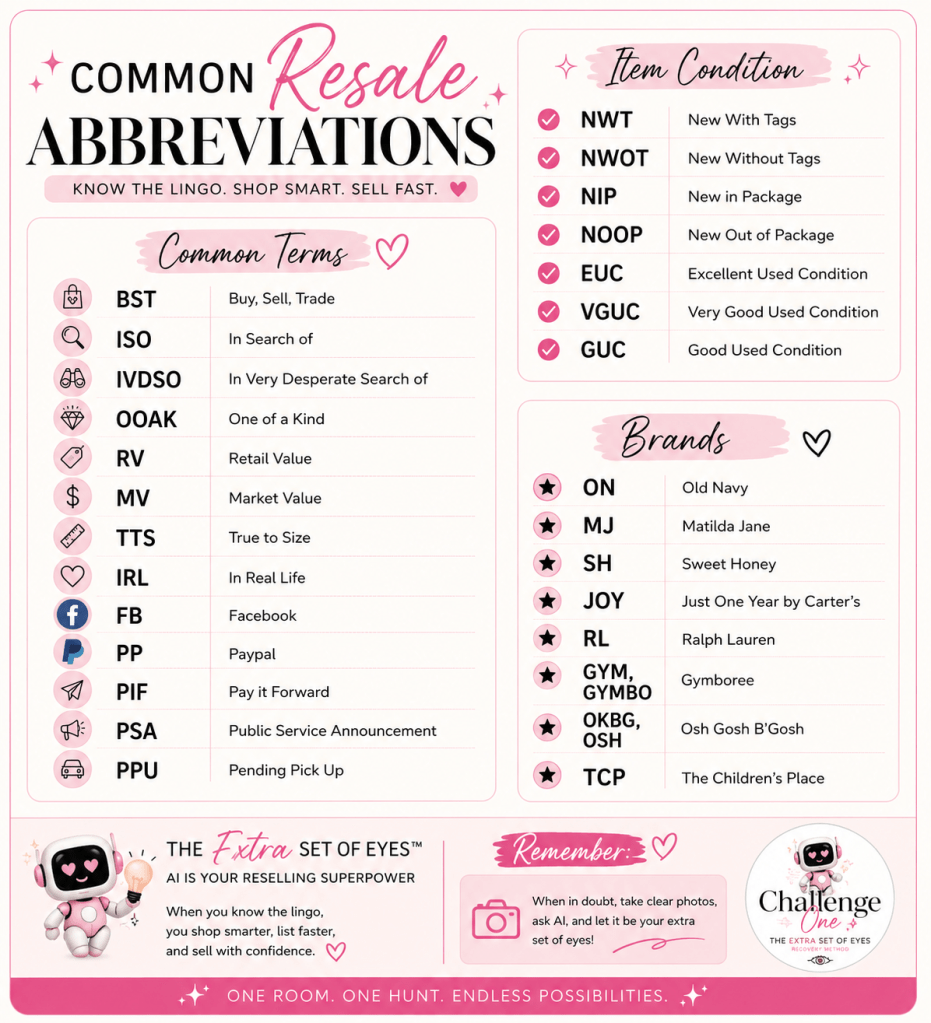
Team Rocket’s Mewtwo, Greninja EX, and several Umbreon cards were also identified as cards worth taking a closer look at.
What exactly was sitting inside this binder remained to be seen, but it was becoming increasingly clear that there might be genuine value hiding behind those plastic sleeves.
At the same time, I knew enough about collectibles to understand an important distinction.
Potential value and immediate cash are not the same thing.
These weren’t everyday Facebook Marketplace flips.
They weren’t the type of items where you snap a few photos, post them online, and have somebody knocking on your door thirty minutes later with cash in hand.
Collectibles are a different animal entirely.
The right buyer matters.
Condition matters.
Presentation matters.
Timing matters.
And in some cases, patience matters more than anything.
I could have easily overlooked the binder altogether and never fully understood the value sitting inside it. Had I relied solely on my own observations, I probably would have walked right past it.
But I also wasn’t about to convince myself that one promising discovery in the living room had suddenly solved all my problems.
The mission wasn’t over.
The room had simply revealed its first surprise.
People often make the mistake of assuming that value automatically equals liquidity.
It doesn’t.
Something can be worth hundreds of dollars and still require effort, research, patience, and the right buyer before that value becomes real money.
The Pokémon binder was an unexpected win, but it was still going to require a conversation with my son.
He understands the politics of Pokémon far better than I do.
The grading.
The condition standards.
The collector culture.
The tiny details that can dramatically impact value.
A card might appear flawless to me and still lose a significant percentage of its worth because of a tiny scratch, slight whitening around an edge, a fingerprint smudge, or some microscopic imperfection that only becomes visible once collectors start examining it like forensic investigators.
Before making assumptions, I wanted his input.
Still, even without grading or deeper inspection, the binder had earned a spot on my Living Room Recovery List.
Not as guaranteed money.
As potential.
And that distinction matters.
What originally looked like a random binder shoved onto a bookshelf had quietly transformed into possible inventory.
More importantly, it reinforced the entire purpose behind Challenge One.
Not because every home secretly contains thousands of dollars.
Not because artificial intelligence is magically uncovering treasure.
But because familiarity creates blindness.
The things we walk past every day eventually become part of the background.
And once you train yourself to look differently, something interesting happens.
You stop seeing clutter.
You start seeing assets.

As promising as the Pokémon binder discovery was, I had to remind myself why I started this mission in the first place.

The objective wasn’t to become a professional card grader.

It wasn’t to spend six hours researching market trends.

It wasn’t to disappear into another rabbit hole and convince myself I was being productive while avoiding the larger task at hand.

The objective was recovery.


And recovery requires momentum.

At some point, you have to stop analyzing and keep moving.

The living room had already given me more than I expected.

Several electronics.

A few household items.

Some potential collectibles.

A handful of things that could realistically be converted into cash.

More importantly, it had given me proof.

Proof that I wasn’t surrounded by useless junk.

Proof that value still existed inside my home.

Proof that I wasn’t nearly as trapped as my stress had convinced me I was.

The funny thing about financial pressure is that it narrows your vision.

The heavier the burden becomes, the smaller your world gets.

You stop seeing opportunities.

You stop seeing options.

You stop seeing anything beyond the immediate problem demanding your attention.

For a little while, the living room forced me to look beyond the problem.

Not solve it.

Just look beyond it.

And honestly, that alone felt like progress.

By the time I finished documenting everything, gathering potential inventory, and completing the first mission, the room itself didn’t look dramatically different. Most people probably wouldn’t have noticed much of a change.

But I did.

Because I wasn’t looking at the room anymore.

I was looking at it differently.

The bookshelf wasn’t just a bookshelf.

The storage basket wasn’t just a storage basket.

The forgotten electronics weren’t just clutter.

The Pokémon binder wasn’t just something collecting dust.

Everything had shifted categories.

The room had transformed from a collection of objects into a collection of possibilities.

Some immediate.

Some long term.

Some still require more investigation.

But possibilities nonetheless.

And that was enough.

I wasn’t looking for a miracle.

I was looking for movement.

The living room gave me that.

So, with Mission 001:1 officially complete, I closed my notebook, gathered my recovery list, and resisted the temptation to immediately start posting listings before the rest of the house had been searched.

There would be time for that later.

The mission was never to sell one item.

The mission was to build momentum.

One room wasn’t going to solve everything.

But one room was enough to prove the concept.

Enough to prove that opportunities still exist.

Enough to prove that I wasn’t standing in an empty house hoping for a miracle.

I was standing inside a house filled with resources I had simply stopped noticing.

Tomorrow, another room.

Another sweep.

Another opportunity to uncover value hiding in plain sight.

Because if the living room taught me anything, it was this:

The problem isn’t always that we have nothing.

Sometimes, the problem is that we’ve stopped seeing what we already have.

Mission 001: The Living Room

Status: Complete.

Recovery Value: Better than expected.

Most Valuable Discovery: Perspective and Optimism for Mission 001:2. 

Tomorrow, though, I can sleep a little easier now knowing the potential of tomorrow’s recovery might produce.

Stay tuned for the next room!

Coming to You Live From Ground Zero of My Own Catastrophe

I’d be lying if I told you I had figured out the secret to financial freedom.


In fact, I’m currently writing this from somewhere most people go out of their way to avoid documenting from entirely.
I’ll spoil it now to save you the time.

I don’t have a glow up story waiting at the end of this article to inspire you.


You aren’t going to keep reading and suddenly stumble across:


“I was broke and on the verge of losing my house a year ago. Fast forward to today, and I’m making six figures a year!

“Do you wanna know how I transformed my life? Comment “financially free” down below in the comments section to sign up for my masterclass OR  if you don’t need any convincing and your ready to start your journey today, click the link in my bio to purchase my workbook!

Take advantage of this limited time offer to not only pay a few dollars for million dollar secrets but, to completely transform your life by my proven method of unlocking a super simple path to success that they dont want you knowing!”

Let’s translate this post so that when you see these kinds of posts, you know what it really means.

“I was broke a year ago and now I’m making six figures!”
Translation:
“I need you emotionally invested in my struggle story before I try to sell you something because I know desperation is a huge market!”

“Want to know how I did it?”
Translation:
“I’m not actually going to tell you in this post or the masterclass because if I did, there would be nothing left to trick you into buying!”


“Comment ‘financially free’ below.”

Translation:

“Be so blinded by desperation that even if you don’t get suckered into my book, at the very least, your comment will boost my engagement so the algorithm shows this to more gullible people I can potentially fool all while collecting even more leads in the process to boost my sales funnel.”

When they say “they don’t want you to know this,” what I really mean is:
“There is no mysterious group hiding success from you. That’s just a convenient villain that makes my sales pitch sound more dramatic AND valuable.”

The biggest question nobody is asking is if the method made them so rich then why are they spending so much time trying to give their secrets away?

Oh, all of a sudden they feel compelled to pay it forward?

Well, maybe.  It does happens.

It typically doesn’t happen in this way though.

Typically, people who just arrived at a state of financial stability don’t turn around and do something that could jeprodize it. 

They wait for the exact moment they finally feel relief, and turn around and decide that their first order of business is to start recruiting others into the very system that changed their situation?

Wouldn’t that,  instead, create more competition for them?

That’s how it seems to me anyway.

They do a decent job at engineering this belief that you have access to the same success.

I’ll give them that.

But it all is quickly revealed for what it’s really about.

They make sure to cleverly word it that your success is accessible through them.

Only, its just sitting behind a checkout button.

The product is the sale.


They want you to think you were special.

That you were handpicked for some elite mentorship that not everyone has access to. 

They need you to believe the information is rare.

They want to dress it up so well and trademark with some clever AI generated title to not have it recognizable from the versions of it can be found for free across books, podcasts, YouTube channels, libraries, and thousands of other websites because it all began from a PLR ebook.


There is never a mention of what is required from you up front.

They don’t reveal the money that had to be spent for this “method”  before a dollar came in from it.


The hours that are necessary for troubleshooting.

How long it actually takes to get the first sale.

Your reoccurring payouts to keep up online storefronts, add on fees for payment intergration, the separate cost for website hosting and domain ownership, the social media marketing to promote, the small business startup costs to make it all legal and official. 
The refunds, mistakes, and the losses.

You don’t start adding it up once you arrive st these points in the process because by now,  you are too far in at this point.

You are supposed to keep your eye on the long-term rewards. 

They will assume that you are committed to the pay off and that you should already know ahead of time that it’s going to cost a few dollars here and there.

They don’t say it though.

They are only trying to keep you focused on
the montage and ignore what it really is.

Now, dont go assuming im mad about this method that has taken off lately.

I’m no hater.

I’m not criticizing their strategies because I didnt think of it first either.

I’ve actually been one of the ones dumb enough to fall for it. 

I mean, how do you think I am able to pick it apart so accurately and explain it to you in such detail?

I admit, I’m guilty of believing some of these stories. Because it provided me with hope initially.
But, what they are doing is something deeply unsettling.

Making money by intentionally misleading people who are already struggling is not admirable.
Creating a manufactured success story, packaging it as a low effort solution, and marketing it to people facing genuine financial hardship shouldn’t be mistaken for entrepreneurial success.

Its actually exploitation.


When entire systems are built around selling something that isnt legitimate to begin with but painting it up as a something its not, with overwhelmingly low success rates, just to turnaround and funnel in the direction of desperate people…is DISGUSTING.

That target demographic you are aiming towards happens to be someone who can’t afford another disappointment.


Maybe that is an unpopular opinion, but I find it far more unethical than many of the things people spend their time criticizing online these days that really doesn’t deserve the time it gets.
Personally, I’d rather stand on the busiest corner in my city with a cardboard sign and ask for help doing something that I consider one of the last resorts, for me, than Id ever consider becoming wealthy by profiting from another person’s misfortune while faking it as I was trying to help them escape it.

Most people only offer you the before and after.
They tell their story once they’ve already escaped it.
They share the lessons after they’ve already learned them.
They reveal the transformation after they’ve gained enough distance from the struggle to make it look intentional.
What rarely gets shown is the middle.
The middle of uncertainty.
The mid-point setbacks.
The constant flow of panic.
The feeling of never quite being able to catch your breath before the next problem arrives.
If you know it, you know exactly what I’m talking about.
In those very brief moments when you finally reach a temporary point of stability and all the bills are paid, your threat level of emergency  is no longer elevated. You allow yourself one brief exhale.
Then it’s knock. Knock. Knock.
Another unexpected expense you literally just paid less than a month ago.

Now it’s double the last amount you paid that you already thought was off, and you can’t understand where they come up with these numbers. These phantom fees they itemize on  a  bill to appear legitimate, but none of the fees you can personally account for.

You unfortunately dont have time for a back and forth now. You only have 24 hours or less to get creative to prevent this catastrophe from going cataclysmic. 

I can honestly admit that my success story hasn’t happened long enough to write about yet.
In fact, some of the same blind spots that brought me here still exist.
Not because I lack intelligence.
Not because I lack work ethic.
Not because I don’t understand budgeting, business, marketing, or survival.
Because none of those things eliminate my biggest obstacle.

Executive dysfunction.
There is no aesthetic for a chemical imbalance. 
No motivational quote is powerful enough to override it.
No vision board is capable of magically converting intention into execution.
No amount of intelligence that makes you immune to occasionally being dragged back into the ditch.
For a while, I had almost forgotten what that ditch looked like.
I managed nearly two and a half years of relatively stable living.
For me, that was a record.
But, a financial cushion doesn’t eliminate executive dysfunction.
It simply makes the consequences sting less.
Until a few unexpected catastrophes arrived in rapid succession, and suddenly, I found myself face to face with a version of survival I hadn’t seen in years.
Not because I stopped caring OR trying.
Because progress can be both real and fragile at the exact same time.

The difference now is that I have something I didn’t have before.
Perspective.
And a place to document it.
In the past, even when people could see I was struggling, I wasn’t ready to openly admit just how much.
We live in a time where authenticity is becoming increasingly difficult to find.
Everything is filtered.
Everything is curated.
Everything is optimized.

Even our words can now be polished, rewritten, and refined before anyone ever sees them.
Meanwhile, real life remains stubbornly unedited.
So I’ve decided to stop hiding the messy parts.
No censoring for embarrassment.
No waiting until the story has a happy ending.
No pretending I have everything figured out.
I’m going to document the catastrophe while I’m still standing in the middle of it.
Turn hardship into hardcover, so to speak.
This is not a blog about becoming rich.
This is not a blog about pretending everything happens for a reason.
This is not a blog filled with affiliate links, miracle systems, or promises that you’ll make ten thousand dollars before next Tuesday.
This is a field journal, a chronicle of recovering from financial catastrophe while still living inside it.
I will be testing the advice.
Questioning the methods of influencers.
Investigating the shortcuts.
Exploring local opportunities.
Digging through online opportunities.
Using AI where it genuinely helps.
Ignoring it where it doesn’t.
Most importantly, I’ll be documenting what works, what doesn’t, and what people conveniently leave out when they’re selling a dream.
There is nothing aesthetic here.
It’s just me.
An internet connection.
A series of catastrophes.
And a decision to stop pretending that struggle only deserves to be documented once it’s over.
Welcome to The Cash Catastrophe Chronicles.
Reporting live from ground zero.

Let’s See What our First Mission is….

The Camera is still Rolling..

Interpreting D4vd’s Birth Chart

I’ve been following this case closely, partly because my son and Celeste share the same exact birth date and year if I’m being completely honest.

That initial personal connection is what kept me engaged with this case longer than I typically would be. What continues to stand out to me is how incomplete and fragmented the public understanding still is of who he actually is as a person, at least from what is available.

If I did not know better, I would almost assume that with how calculated some of his preparations for fame appeared to be, he had people signing NDAs as far back to his childhood in New York. Im just being facetious when I make that remark because obviously, he was a child. It still is, at the same time, impossible not to notice how unusually controlled and silent everything surrounding him feels.

So much that it does look like he somehow anticipated that he would one day need that level of image protection, and long before any real spotlight was in question.

Since court proceedings have been pushed further out, the only publicly documented material being used as reference points by creators and reporters seems to be limited to the prosecution’s alleged timeline based on initial digital evidence, along with the medical examiner’s report that established cause of death and the autopsy findings.
Outside of that, what circulates is mostly Discord leaks and online threads where internet researchers continue piecing things together and speculating. There is still no single piece of evidence publicly available that, on its own, makes a conviction feel unavoidable at this stage.

I can say, however, that if it were not for the journalism of Trap Lore Ross, much of this may have gone unnoticed. Despite the scrutiny he received for his coverage of d4vd, he continued digging between court dates and venturing down rabbit holes in search of details that may have been overlooked. In doing so, he inadvertently backed what appeared to be undeniably biased moderators into a corner.
Their actions ultimately seemed to confirm much of what TLR had uncovered. The overwhelming shift in narrative following April 2026, coupled with accounts that many now recognize as being connected to d4vd’s team, became increasingly difficult to ignore. Their attempts to restrict his ability to post ultimately backfired, resulting in what felt like a small but reassuring victory for those who remain committed to #JusticeForCeleste.
It is evident that his heart is in the right place. He has remained steadfast in his belief that what happened to that little girl was unspeakable. More importantly, he appears far more invested in helping uncover the truth and pursuing justice than in profiting from the content itself.
I also recently came across the YouTube channel Rotten Mango. She does an extraordinary job presenting complex and often disturbing cases with clarity, compassion, and remarkable attention to detail. Her ability to break down complicated information into language that is accessible and understandable is impressive. You can genuinely see the emotion she carries while covering sensitive topics, which is a refreshing contrast to creators who seem more focused on sensationalism than substance.
To me, that is the difference between simply creating content and responsibly covering difficult subjects. Making money from views is one thing. Using a platform to educate, inform, and advocate while maintaining empathy is something entirely different. Rotten Mango and her team consistently demonstrate that balance by translating complicated cases into understandable narratives without losing sight of the human tragedy at the center of them.
Even without definitive clarity surrounding every aspect of the case, I did not find myself losing interest. If anything, the unanswered questions pushed my focus in an entirely different direction. The direction in which the d4vdidiots removed my post after one short hour claiming it was unrelated to the case and too long. 

Obviously, now since the few moderators that remain after TLR scared off the ones that were tasked to influence the content posted April to present, it further confitms whybmu post was taken down. Too mamy truths within one body of text that lacks too many personal views and has an overwhelmijng analysis of the birth data and planetary positioning translations and analysis that shifts the narrative back to him which they were probably given strict orders to influence via d4vds team if I was to guess.


I’m sure there will be some who view this kind of interpretation as unconventional or insufficiently supported by science to even warrant consideration. That’s perfectly fine. Everyone is entitled to their own perspective.
For me, during a time when I was wrestling with unanswered questions and searching for clarity, this interpretation offered another lens through which to examine the situation. I drafted this blog post to share that perspective with others who may also be curious about an angle that few people have explored in such depth.
Some may wonder why I would care enough about this case to invest this much time and energy into understanding someone who has no direct connection to my life, aside from the fact that my son shares a birthday with Celeste.
The answer is simple. At this point, in my 41 years of life, pattern recognition feels almost automatic. I notice inconsistencies. Disruptions. Moments when something no longer flows the way a situation normally should.
When enough of those moments begin to stack on top of one another, I pay attention. Not because I believe I have all the answers, but because experience has taught me that when something feels out of place, there is often a reason. Sometimes, the reason is obvious. Other times, it takes a willingness to look beyond the surface to find it.


There are many disturbing aspects of this case as a whole, but the detail that continues to stand out to me is the disbelief that someone his age, only one year and two days younger than my oldest daughter, could have allegedly planned and carried out something this severe against someone he outwardly appeared to care deeply about, despite the significant age difference.
You see the videos and the undeniable resemblance between Celeste and the actress cast as his love interest. You hear Celeste’s actual voice included in the interludes of one or more songs. You see release dates that appear to coincide with dates that were significant to her. Then there is the song titled “Celeste,” which is difficult to overlook as an early dedication.
When you take those facts and combine them with everything else that has surfaced, it is reasonable to assume that, at some point, there was something meaningful between the two of them. That only deepens the mystery, especially when so much of what remains appears to exist only through digital evidence.
As the prosecution continues the lengthy process of extracting and reviewing data, at what often feels like the pace of dial-up internet, the public is left with more questions than answers. With each delay and extension of the preliminary proceedings, many find themselves sitting on the edge of their seats, waiting for the pieces to finally come together.


The alleged actions that followed regarding her remains almost reflect fragmented flashes of humanity surfacing between performance and panic. Not remorse. I do not believe he suddenly began viewing her as a person in those moments. Rather, I believe she existed in his mind more as an object, a possession, something that relieved boredom and provided stimulation.
Yet there were likely moments when reality interrupted the fantasy. Moments when it finally registered that he could no longer simply send her a text message or expect a response. With that realization may have come panic, procrastination, concealment, and a series of increasingly irrational decisions.


The chainsaws. The burn cage. As gruesome as those details are, they also suggest disorganized thinking and impulsive escalation more than the narrative of a calculated mastermind. What stood out to me most was the apparent sloppiness.
The decision to order items directly to the residence, despite an obvious awareness of digital footprints, immediately raised questions for me. It points to the possibility of someone whose judgment was significantly impaired, whether by severe sleep deprivation, substance use, or some combination of both. Another possibility, of course, is that additional individuals were involved.
Extended sleep deprivation alone can distort a person’s perception of reality, heighten paranoia, impair judgment, and contribute to increasingly reckless decision making. When substances are added to that equation, the ability to assess risk can deteriorate even further. People often stop evaluating consequences the way they normally would, leading to choices that appear irrational or self-defeating in hindsight.


But the contradiction is what continues to bother me. This is someone who spent years online, building an identity through algorithms, virality, internet culture, and performance. It was someone who, by all appearances, understood how traceable digital behavior can be. A VPN does not magically erase that reality.
That is why ordering items directly to the residence, even under slightly altered names, feels either incredibly reckless or intentionally misleading. It creates a contradiction that is difficult to ignore.
Perhaps there was outside involvement. Perhaps someone else influenced or manipulated the situation. Perhaps multiple dynamics were unfolding at the same time. At this stage, those possibilities remain speculative, but the inconsistencies are what continue to draw my attention. The actions described do not neatly align with the image of someone who should have understood exactly how much of a digital trail they were leaving behind.

What stands out most to me is how little external perspective exists around someone who was essentially living online and only recently became culturally visible. Her family was nearby, she was actively being searched for, and yet there is this strange absence of consistent outside accounts that clarify who he was beneath the public persona.
The silence from people around him, friends, associates, and past connections creates a gap that is hard to reconcile with how digitally exposed his life appeared to be. It raises questions, not necessarily conclusions, about what dynamics were actually operating in that circle and why so few people have added clear, grounded context to the public narrative.


My familiarity with behavioral patterns and psychological profiling extends beyond that of the average person due to both my professional background in behavioral analysis and my academic studies in Criminal Justice Technology. As part of that coursework, I completed studies focused on the psychological aspects of criminal behavior, offender motivations, and criminal profiling.
While no one can fully understand another person’s mindset without direct evaluation and verified evidence, that background has taught me to recognize patterns, identify inconsistencies, and examine behavior through a psychological lens rather than relying solely on surface level assumptions.

During the final semester of one of those courses, we visited a Virginia state prison and sat face to face with inmates serving 30-plus year sentences. Using information gathered during those interviews, we were required to complete a multilayered criminal and psychological profile of each individual as they would have appeared prior to arrest. The assignment accounted for half of our final grade and, honestly, stayed with me long after the class ended.

So when I say I am professionally trained to read people, patterns, inconsistencies, and shifts in presentation, I mean that quite literally. The investigative part of my brain activates when details stop aligning. I start noticing little internal alarm bells when new information conflicts with the original psychological impression I formed of someone. After enough of those moments accumulate, I pay attention.

That is what happened here.

I did not initially care enough to deeply research him as a person. What caught my attention were the glitches. The inconsistencies. The details that, psychologically, did not flow together in a clean or expected way. More than most cases I have examined, this one completely disrupted the profiling algorithm in my head. The people involved felt off. My initial impressions felt off, too.

What I actually wanted to understand was something more specific. Was this an extremely immature man child who spent years fabricating identities until one finally worked? Or was this someone desperate for an entirely different life, someone shaped by rejection after being pulled out of traditional schooling, who discovered that online spaces responded to him in ways the real world never had and then built on that relentlessly?


Down to the algorithm friendly name d4vd. Down to interviews where he openly said he planned to retire after five years. To me, this never fully felt rooted in artistry. A true artist can not simply shut creativity off like a switch. That statement sounded more like image management, discipline theater, and controlled exclusivity. It creates mystique. It makes limited access to feel intentional. Even the secretive fan circles like the “4 Heads” suddenly made far more psychological sense after looking at his chart and behavioral presentation through a different lens.


Even when he appeared to align with certain criminal archetypes on paper, emotionally detached offender, narcissistic presentation, identity fragmentation, manipulative persona construction, none of the textbook profiles fully fit. He mirrored aspects of three or four different archetypes simultaneously without ever fully locking into any of them.
That was the point where I stopped doom scrolling through tabs and commentary that led nowhere. I literally closed everything on my desktop, pulled out graph paper and my astrology reference books, and approached it through an entirely different lens. Most people in criminal justice or psychology would probably roll their eyes at that because astrology lacks scientific validation within those fields. I understand that argument completely.
But once I mapped out his astrological birth chart and began examining relational and behavioral patterns as structured data rather than narrative interpretation, something interesting happened.
That last sentence naturally sets up whatever conclusion or insight you want to introduce next. The phrase “something interesting happened” creates a stronger transition and keeps readers engaged.

I was honestly baffled by how much clearer the psychological structure became to me.

Before I get into the interpretation, I wanted to say that to those who consider astrology data as mystical, I want to be clear that I do not treat astrology as a scientific measure. I am using it as a symbolic pattern mapping tool I have applied in past case studies to better understand behavioral sequencing and relational dynamics.


The last thing I want to address before breaking down his chart is something I feel is important to say.
As I began working through my interpretation, I noticed that many others exploring this case through astrology had also created synastry charts between the two of them. For those unfamiliar with the term, a synastry chart overlays the birth charts of two individuals and examines the interactions between them. Rather than focusing on either person independently, it analyzes the dynamics of the relationship itself through a third chart created from the intersections of both.
I want to be transparent about a decision I made. While I could have mapped a synastry chart between the two of them, I chose not to.
I did look at her chart separately to gain a general sense of her temperament and behavioral tendencies, but I was not comfortable framing what occurred between them as a relationship. Regardless of how mature she may have appeared for her age, she was still a child. Creating a relationship analysis, I believe, reduces a profoundly unequal dynamic into something more mutual than it was.
Some things lose important context when they are flattened into compatibility metrics and interpersonal exchanges. This is one of them.
With that said, let me show you what his chart actually says.

The Birth Chart Interpretation

Aries Sun in the 10th House

If we’re treating the chart as a symbolic pattern map, this placement immediately draws attention to themes of identity, recognition, and public visibility. The Sun represents the core self, and in Aries it seeks distinction, autonomy, and significance. Placed in the 10th House, the domain of reputation, achievement, and public standing, personal identity can become heavily intertwined with status and external recognition.

At its most imbalanced expression, this can manifest as an overidentification with image, success, and visibility. The danger is that self-worth becomes contingent upon being seen. In a traditional environment, community, peers, and real-world relationships often provide reality checks. In a digital environment driven by algorithms, follower counts, engagement metrics, and constant validation loops, those checks can become increasingly distorted. The audience becomes the mirror, and eventually, the mirror becomes the self.

One statement that stood out to me was the idea of retiring to an island after only a few years of success. Symbolically, that aligns with an Aries Sun in the 10th House. Aries is often motivated by pursuit, challenge, and conquest. The excitement lies in reaching the summit. Once the objective has been achieved, attention frequently shifts toward the next horizon. The fulfillment comes from the chase itself.

Viewed through that lens, the driving force is not necessarily the craft, the music, or even the work. It is the achievement of arrival. The destination becomes the prize, and once it has been claimed, the question becomes what remains to be conquered next.

Gemini Moon — The Compartmentalizer Goes Fully Online

If we’re looking at the chart symbolically, Gemini Moon themes often revolve around adaptability, duality, compartmentalization, and the ability to navigate multiple perspectives simultaneously. In its healthiest expression, this can create curiosity, social intelligence, and emotional flexibility. In its shadow expression, however, it can manifest as fragmentation, emotional detachment, and a tendency to separate different aspects of life into isolated compartments.
The digital world amplifies those tendencies. Online, a person is rarely required to maintain a single, consistent identity across all spaces. Different platforms invite different personas. Different audiences receive different versions of the same individual. Conversations exist in separate channels, often disconnected from one another. Body language disappears. Context disappears. Accountability becomes easier to avoid because very few people ever see the complete picture.
Viewed through that lens, a shadow Gemini Moon appears particularly well suited to an environment where identity can be endlessly edited, divided, and reconstructed. The ability to move between different roles and presentations becomes not just possible but rewarded.
What stands out to me is how limited in person socialization may have further reinforced those tendencies. Traditional social environments often provide constant feedback that encourages a more integrated sense of self. When most meaningful interactions occur through screens, those external checks become weaker. By the time he was engaging with large numbers of people, much of that interaction existed in digital spaces where identity was highly curated and adaptable, allowing him to become whatever the moment appeared to require.

Venus in Taurus — Parasocial Possession

Shadow Taurus Venus already struggles with the tendency to view people through the lens of personal needs, comfort, possession, or value rather than as fully autonomous individuals. Online interaction can amplify those tendencies dramatically. It allows for carefully curated access, controlled dynamics, and relationships that exist largely on one’s own terms. There is less exposure to the complexity and unpredictability that comes with engaging people as full, three-dimensional human beings.

Viewed through that lens, fans can gradually become less like individuals and more like extensions of an audience. Relationships risk becoming transactional, defined by what they provide rather than who the other person actually is. In its shadow expression, Taurus Venus can become highly possessive and resistant to anything that threatens its sense of control or security.

The digital environment often removes much of the natural friction that would otherwise challenge those tendencies. Boundaries become easier to blur, access becomes easier to manage, and the pushback that normally comes from real-world interactions can be significantly reduced.

Aquarius Mars

Symbolically, Aquarius Mars often acts through intellect before emotion. It tends to approach action from a position of logic, distance, objectivity, and detachment. In its healthiest expression, this can produce independence, innovation, and an ability to remain calm under pressure. In its shadow expression, however, it can create emotional disconnection and difficulty fully grasping the human impact of one’s actions.

The online environment can amplify those tendencies. When most interactions occur through screens, there is often little immediate emotional feedback. Facial expressions disappear. Physical presence disappears. The subtle social cues that help people calibrate their behavior in real time become far less visible. As a result, emotional distance can gradually become normalized rather than challenged.

Viewed through that lens, prolonged digital interaction may reinforce an already detached style of engagement. The person becomes increasingly accustomed to operating within ideas, messages, usernames, and abstractions rather than direct human experiences. Over time, that distance can become deeply ingrained.

This placement also raises an interesting question regarding public fallout and social consequences. Aquarius Mars frequently prioritizes its own internal logic, which can create a disconnect between intention and impact. When a person’s actions are judged publicly, there may be genuine confusion about why others perceive the situation differently than they do. The gap between self perception and public perception can become remarkably wide because each side is operating from entirely different frameworks.

Whether that gap is ever fully reconciled is another question entirely.

Saturn in Cancer — No Real Home Base Ever Formed


When viewed symbolically, Saturn in Cancer often points toward lessons involving belonging, emotional security, attachment, family dynamics, and interpersonal boundaries. Saturn represents areas of challenge, limitation, and development, while cancer is concerned with home, safety, nurturing, and emotional connection.
Looking at the broader context, several factors stand out. He was homeschooled, relocated from Queens to Houston, and appears to have formed much of his social identity through online communities. If we treat Saturn in Cancer as a symbolic indicator of developmental challenges around belonging and emotional grounding, those circumstances become particularly interesting. Healthy boundaries are often learned through stable, embodied relationships and consistent community experiences. When much of one’s social world exists online, those lessons can develop very differently.
From that perspective, the internet may have functioned as a substitute for community, home, and belonging. The problem is that digital spaces are largely boundaryless by design. They allow people to move fluidly between identities, groups, and relationships without many of the physical and social constraints that exist offline. For someone already struggling with themes of emotional security and belonging, that environment may reinforce confusion around where personal boundaries begin and end.
This placement is also frequently associated with deep sensitivities surrounding rejection, exclusion, and emotional vulnerability. Saturn wounds are rarely loud. They often operate beneath conscious awareness, quietly shaping expectations, defenses, and relational choices over time. Rather than announcing themselves directly, they can become the unseen architecture beneath countless decisions, influencing how a person seeks connection, responds to criticism, and protects themselves from perceived abandonment.
Whether one interprets that symbolically or psychologically, the pattern is less about dramatic emotional displays and more about longstanding insecurities that quietly shape behavior from behind the scenes.

Case Specific: How Does This Chart Handle Being Exposed?


Public Exposure and Identity Collapse
Viewed symbolically, Aries Sun in the 10th House is deeply tied to themes of reputation, visibility, achievement, and public identity. When a person’s sense of self becomes heavily invested in how they are perceived, public scandal or reputational collapse can feel like more than a professional setback. It can feel like a threat to the foundation of identity itself.
In its shadow expression, this placement may respond to such a crisis through defensiveness, denial, anger, image management, or attempts to reclaim control of the narrative. The issue is not simply embarrassment. The issue is that the public image has become intertwined with the self-concept.
At the same time, Gemini Moon introduces another layer to the picture. Symbolically, this placement is associated with adaptability, compartmentalization, and the ability to hold multiple identities or perspectives simultaneously. In its less integrated expression, those compartments can become so separate that contradictory versions of the self coexist without creating immediate internal conflict. As a result, exposure may not be experienced as the revelation of a deliberate deception. Instead, it can feel like an unfair reduction of a much more complex internal reality. The reaction often becomes, “That is not who I really am,” even when others view the exposed behavior as highly significant.
Mars in Aquarius adds a third dimension. This placement tends to process action and conflict through logic, abstraction, and emotional distance. When confronted with intense public criticism, there can be a genuine disconnect between personal intention and public reaction. The individual may struggle to fully understand why others are responding with such emotional intensity because they are evaluating the situation through a fundamentally different lens.
Taken together, these placements create a potentially volatile defensive pattern. The Aries Sun seeks to protect identity and reputation. The Gemini Moon seeks to explain, reframe, or compartmentalize. Mars in Aquarius withdraws into detachment and intellectualization.
Symbolically, the result is a cycle in which anger, rationalization, and emotional distancing can all emerge simultaneously. Whether or not those responses are conscious, they can make genuine self-examination exceptionally difficult because each part of the personality is attempting to protect itself in a different way.

What’s on his mind as he sits in jail


This is where the chart becomes particularly interesting.
Symbolically, an Aries Sun in the 10th House is often associated with a powerful drive toward visibility, recognition, reputation, and public significance. What stands out in this situation is that incarceration does not necessarily equate to obscurity. In fact, from a purely symbolic perspective, this may be the period of greatest public attention his name has ever received.
The case continues to generate discussion. His name continues to be searched. Videos, articles, commentary, and public debate continue to circulate. The algorithm has not forgotten him. Whether that attention is positive or negative is almost secondary to the larger symbolic theme. The attention itself remains.
Many observers have focused on the apparent disconnect between the allegations, the prosecution’s timeline, and the composure he appeared to maintain publicly. People keep looking for visible signs of emotional collapse, guilt, panic, or remorse and often come away puzzled when they do not find what they expected.
Looking at the chart symbolically, that reaction may have less to do with psychopathy and more to do with a recurring pattern that appears across multiple placements: compartmentalization, detachment, and an identity structure heavily invested in external validation.
Gemini Moon, in its shadow expression, can be remarkably skilled at separating different parts of life into distinct psychological compartments. It does not necessarily integrate experiences into a single, cohesive narrative. Instead, contradictory versions of the self may coexist with surprisingly little internal friction. The result can be an individual who genuinely experiences different aspects of their life as disconnected from one another.
If interpreted through that lens, public exposure may not be experienced internally the same way it is experienced by outside observers. Rather than viewing every action as part of one continuous identity, the individual may instinctively separate events into different categories, contexts, or versions of self. Accountability, therefore, feels less like a confrontation with one’s entire identity and more like an attempt to define the whole person through a single compartment.
Mars in Aquarius contributes another layer. Symbolically, it approaches conflict and consequences through detachment, logic, and intellectual distance. This placement often analyzes before it feels. As a result, emotional reactions that others expect to be immediate and visible may instead appear muted, delayed, or difficult to access.
When these themes are combined with an Aries Sun in the 10th House, an interesting possibility emerges. The public narrative itself can become part of the identity experience. Attention, discussion, visibility, and relevance remain active even when the circumstances surrounding them are overwhelmingly negative.
Whether that attention is experienced as validation, humiliation, punishment, or some mixture of all three is impossible to know from a chart alone. Astrology can not answer that question. What it can do is highlight symbolic themes that appear repeatedly throughout the chart: visibility, compartmentalization, detachment, and a profound connection between identity and public perception.
For that reason, the more compelling question may not be whether he understands what the public thinks of him. The more compelling question is whether all of these separate compartments ever become integrated into a single, unified understanding of self. Symbolically, that is the challenge this chart appears to return to again and again.

But There Was A Girl

This chart does not describe a crime.

What it appears to describe, at least symbolically, is a personality structure containing vulnerabilities that could become dangerous under the right circumstances. The placements existed from birth. The environment shaped how those placements developed. The internet rewarded traits that might otherwise have been challenged. Fame amplified needs that may have benefited from limits rather than validation.

None of that guarantees an outcome. Astrology can not predict criminal behavior, nor can it determine guilt. What it can do is reveal recurring themes, and in this chart those themes appear repeatedly: identity fragmentation, external validation, emotional detachment, compartmentalization, and an unusually strong connection between self worth and public recognition.

Yet the chart itself is not the part that lingers with me.

What lingers is that, at the center of this story, there was a young girl who is no longer here.

A girl who appears to have valued consistency, loyalty, and emotional connection. A girl who, like many young people, was navigating the complicated space between childhood and adulthood while trying to understand who she was becoming. A girl who encountered someone she believed she could trust.

Whether through charisma, familiarity, status, attention, or some combination of all four, that trust was established over time. Trust rarely arrives all at once. It is built gradually through repeated interactions that create a sense of safety.

What makes cases like this so unsettling is that vulnerability does not require naivety. A person can be intelligent, observant, cautious, and still place trust in the wrong individual. Those realities are not mutually exclusive.

Looking back, it is tempting to search for warning signs that seem obvious in hindsight. The inconsistencies. The contradictions. The moments that, with the benefit of distance, appear significant. But hindsight often creates an illusion of inevitability that did not exist in real time.

The most haunting aspect of this chart is not what it may suggest about him. It is what it could never reveal about her future.

Because no symbolic system, psychological profile, or behavioral analysis can fully account for the countless choices people make once life begins unfolding. Charts can describe tendencies. They can not predict outcomes. They can highlight vulnerabilities. They can not determine destiny.

If there is a lesson here, it is not that the map was hiding the answer all along.

It is that no map, no matter how detailed, can fully protect us from the consequences of human choices.

And sometimes the tragedy is not that the signs were missed.

It is that someone who deserved the chance to grow up never got the opportunity to do so.