
Monthly Archives: June 2026

The Anatomy of AI, Automation, and Advocates with Affiliate Links

Not too long ago, I discovered something on social media that I had previously been unaware of.
I’m sure it wouldn’t seem like a big deal to some people, but I’d be lying if I said it didn’t bother me.
I mean, I’m going out on a limb here by revealing this and opening myself up to a lot of criticism.
I’m willing to accept whatever comes from sharing it because I believe people need to know about it.
The best way I can explain it is by using the internet as an example.
The internet has existed long enough for most of us to understand that there are risks involved in using it. One of the most frequently discussed topics is protecting your personal information. We all know how important it is to pay attention to where we shop, which websites we visit, and which platforms we trust with our data.
The people who understand these risks best often learn the hard way. Many have experienced identity theft or credit card fraud.
It usually begins with unauthorized purchases appearing on an account. Charges show up that the account holder never made.
Unfortunately, this type of crime has become so common that most banks have streamlined the process. Today, you can often report fraud, freeze your cards, request an investigation, and begin replacing your cards and account numbers without ever stepping inside a branch.
Sometimes, depending on the institution and the circumstances, the bank may decide not to close the compromised account immediately.
Instead, it continues monitoring activity.
The goal is to gather information that may help identify the person responsible.
Even when your money is protected, the experience can still be deeply unsettling. There is something disturbing about watching someone violate your financial security from behind a screen.
You never see it coming. You never see the person responsible, yet unauthorized transactions continue appearing one after another, reminding you that someone, somewhere, has gained access to something that belongs to you.
It creates a profound sense of vulnerability.
In some cases, it almost feels as though you’ve become bait while investigators quietly monitor the activity in hopes of identifying the offender.
Although people have been warned about these risks for years, they continue to happen every day.
Most of us eventually learn that protecting our online data matters.
We learn to use trusted websites.
We learn to avoid suspicious links.
We learn to be cautious about where we enter our information.
There are other forms of intrusion that are just as invasive, yet almost nobody is talking about them.
Why?
I think it’s important to share what I recently uncovered.
Are you aware that every time you use social media, you’re not only sharing information with the platform itself but also helping shape data that marketers, advertisers, and content creators use to understand audiences?
Yes, I realize this is different from financial fraud. It isn’t about someone stealing your money.
Every time you open a social media app and casually scroll through your feed, you’re interacting with an ecosystem designed to learn about your interests, habits, preferences, and behavior.
Within sixty seconds of opening most platforms, you’ll probably encounter a sponsored advertisement, an influencer recommendation, an affiliate promotion, or branded content presented as something else.
None of that is accidental.
If you don’t believe me, try a simple experiment.
Find someone else in your home or workplace. Stand beside one another and open the same social media platform at the same time.
Slowly scroll through your feeds together.
Pay attention to everything you see. Advertisements. Influencers. Short videos. Local businesses. Recommended posts.
Even if you live in the same area, share friends, visit many of the same places, and have similar interests, your feeds will still be remarkably different.
Much of what appears is influenced by your online behavior.
What you watch.
What you search.
What you click.
How long do you pause on a post.
Even slowing down to read something without clicking can become another behavioral signal.
These interactions help platforms personalize what you see over time.

All of your clicks, in app navigation, conversations, interactions, and online behavior contribute to a digital profile that platforms use to better understand your interests. While that information is not publicly accessible in the way a social media profile is, it is collected, categorized, and used in ways most people rarely think about.
That data can become part of broader audience segments used by advertisers, marketers, and businesses. Search engine optimization, audience targeting, and advertising tools help identify groups of people who share similar interests, behaviors, demographics, or purchasing habits. The goal is simple. Create content that captures the attention of people who are most likely to engage with it.
For many creators, the objective is to generate views, build an audience, earn affiliate commissions, sell products, or eventually qualify for monetization.
Artificial intelligence has accelerated this process.
Instead of manually planning every post, marketers can now analyze audience data, generate dozens of content ideas, write captions, create graphics, produce videos, schedule uploads, and optimize publishing times with very little human effort.
Imagine creating twenty, thirty, or even fifty pieces of content in a single afternoon.
Each post serves a different purpose.
Some are designed to build awareness.
Some are meant to establish credibility.
Some educate.
Some entertain.
Others exist solely to move someone one step closer to making a purchase.
The entire campaign can then be scheduled to publish automatically over days or weeks, often timed to coincide with periods when the intended audience is most active online.
If you work a traditional schedule, you probably check social media before work, during lunch, after dinner, and again before going to bed.
Modern marketing platforms can identify patterns like these across large audiences and help determine when content is most likely to receive attention.
None of this is inherently unethical.
In fact, it’s remarkably effective.
The concern arises when people fail to recognize just how sophisticated these systems have become.
What appears to be a spontaneous recommendation or a casual post is often part of a carefully planned marketing strategy.
By the time a post reaches your feed, it has likely been researched, tested, optimized, and scheduled long before you ever see it.
Some posts offer genuinely useful information.
Some provide free downloads in exchange for an email address.
Some encourage viewers to comment with a specific word to receive a guide, checklist, or resource through direct message.
Some invite you to join a webinar, masterclass, or private community.
Each interaction helps measure engagement and can trigger additional automated follow up messages.
Again, automation itself isn’t the problem.
The problem begins when the relationship becomes less about helping people and more about guiding them through an increasingly complex sales funnel without them fully realizing that’s what’s happening.
Not every creator operates this way.
Many genuinely care about educating their audience and recommending products they truly believe in.
Others, however, build content almost entirely around conversion.
The educational content becomes the bait.
The trust becomes the currency.
The sale becomes the destination.
That distinction matters.

Imagine a typical content campaign.
It rarely consists of a single post.
Instead, it may include dozens of pieces of content, each serving a specific purpose within a larger strategy.
One post introduces a problem.
Another builds credibility.
Another tells a personal story.
Another offers a free download.
Another invites comments.
Another encourages viewers to subscribe.
Another promotes a product.
Viewed individually, each post appears harmless.
Viewed together, they reveal a carefully designed system.
Some content exists to build trust.
Some are intended to be educated.
Some are purely entertaining.
Some create curiosity.
Some are designed to encourage engagement because every like, comment, share, save, or click provides additional information about what captures your attention.
One person downloads a free checklist.
Another signs up for a newsletter.
Someone else comments a single word to receive a guide through direct message.
To the user, these interactions often feel unrelated.
Behind the scenes, they can become part of a larger automated marketing sequence.
An email may arrive the following day.
A follow up message appears a few days later.
Another recommendation follows.
Eventually, a product or service is introduced.
Again, none of this is automatically unethical.
Marketing has always involved building relationships before making an offer.
The question is whether the audience understands that’s what is happening.
Transparency matters.
People deserve to know when they’re entering a sales funnel instead of believing they’re simply receiving unbiased advice.
This becomes especially important when the content centers on subjects people care deeply about.
Financial hardship.
Personal safety.
Parenting.
Mental health.
Emergency preparedness.
Disaster readiness.
Career changes.
Education.
These are areas where people often arrive, feeling uncertain, overwhelmed, or desperate for answers.
That makes trust incredibly valuable.
It also makes trust incredibly easy to misuse.
Some creators recognize this responsibility.
Others recognize an opportunity.
Those are not always the same thing.
One creator asks, “How can I genuinely help someone solve this problem?”
Another asks, “How can I turn this problem into a conversion?”
From the outside, those two approaches can look almost identical.
Both may produce polished videos.
Both may sound compassionate.
Both may recommend similar products.
The difference often isn’t visible until you follow the trail.


Does every conversation eventually lead to a purchase?


Does every solution require another download?


Another subscription?


Another course?


Another affiliate link?


If so, it’s worth asking whether education is the mission or simply the method.
That doesn’t mean affiliate marketing is inherently wrong.
Far from it.
Affiliate marketing can be an honest way for creators to support their work while recommending products they genuinely use and believe in.

The issue isn’t the existence of affiliate links.

The issue is whether financial incentives begin influencing the recommendations themselves.

That’s where trust starts to erode.
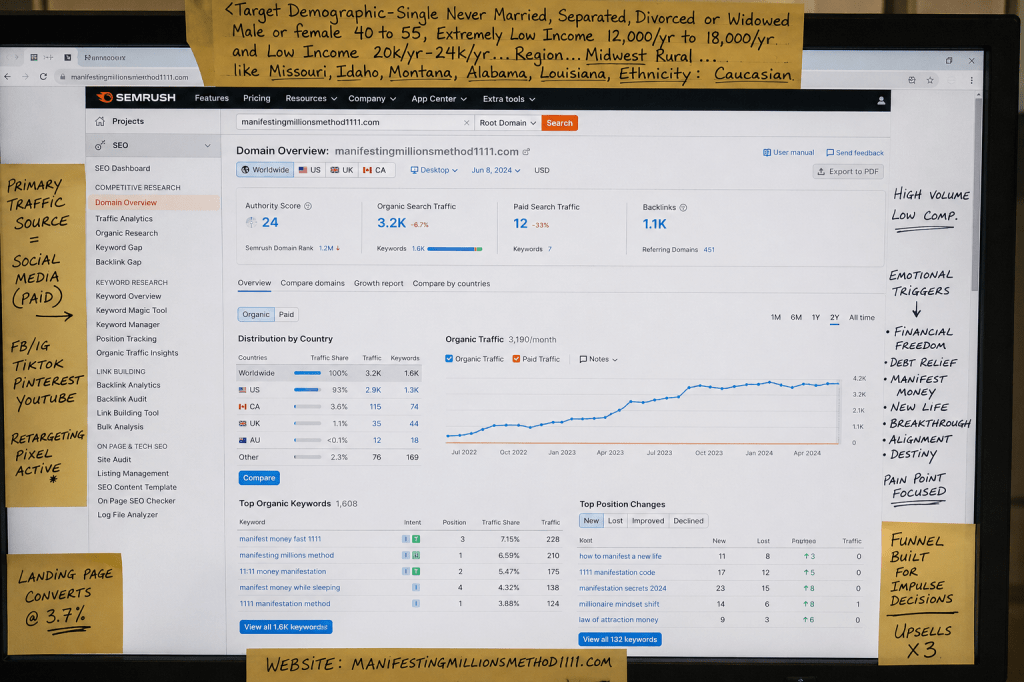
An illustration showing how marketers use website analytics, SEO tools, audience segmentation, and behavioral data to better understand who is interacting with their content. Demographics, interests, emotional triggers, search habits, and traffic sources can all help shape future marketing strategies. The technology itself is not the concern. The ethical question arises when this information is used to influence decisions without the audience fully understanding how targeted the content has become.

This blueprint demonstrates how AI and automation can transform audience research into a coordinated content strategy. Scheduled posts, platform specific optimization, engagement tracking, and performance analytics allow creators to reach audiences with remarkable precision. Automation has become an invaluable business tool, but it also raises important questions about transparency, authenticity, and whether trust is being earned through genuine value or engineered through increasingly sophisticated marketing systems.

And once trust erodes, it’s difficult to rebuild.

Audiences may not notice immediately.

At first, everything still feels helpful.

The advice still sounds reasonable.

The tone still feels supportive.

But over time, patterns emerge.

Recommendations begin to feel repetitive.

Solutions start to look suspiciously similar.

Every path seems to lead to the same destination.

That’s when people begin to question what they’re seeing.

Not just the content itself, but the intent behind it.

And intent definitely matters.

Because content isn’t just information.

It shapes decisions. It influences behavior.

It affects how people spend their time, their money, and their attention.

When someone is in a vulnerable position, those influences carry even more weight.

That’s why clarity is so important.

Clear intentions and disclosures.

Clear boundaries between education and promotion.

When those lines are visible, people can make informed choices.

They can decide what to trust.

They can decide what to ignore.

They can engage on their own terms.

Without clarity, the relationship becomes one-sided.

The creator understands the system.

The audience does not.

And that imbalance is where problems begin.

Because influence without transparency is manipulation.

If they are already aware of how it may appear, they’ll attempt to frame it as transparency. 

And while not every creator crosses that line, the structure of modern content platforms makes it easier than ever to do so.

Algorithms reward engagements.

Engagements drive an emotional response.

Those emotional responses drive clicks, shares, and conversions.

It becomes a cycle that shifts priorities over time behind the scenes.

Helping people becomes secondary.

Keeping them engaged becomes the goal.

And once that shift happens, everything else follows.

Content becomes optimized, not for truth, but for performance.

Advice becomes tailored, not for accuracy, but for appeal.

Trust becomes a tool rather than a responsibility.

That’s why awareness matters.


This awareness is intended to heighten discernment.

To remind people that behind every piece of content, there is a creator making choices.

What to include.

What to leave out.

What to emphasize.

What to promote.

Understanding that doesn’t mean rejecting everything.

It simply means paying attention.

Asking questions.

Looking beyond the surface.

Because the more you understand how these systems work, the easier it becomes to navigate them without losing your autonomy.

And that, ultimately, is the goal.

Now, before anyone misunderstands me, this isn’t an argument against creators making money.
People deserve to be compensated for their knowledge, their time, and the value they provide.
Writers should be paid.
Teachers should be paid.
Researchers should be paid.
Developers should be paid.
Content creators should be paid.
There is nothing inherently wrong with earning an income through honest work.
The concern isn’t monetization.
The concern is what happens when monetization quietly becomes the purpose instead of the result.
There is a difference.
One creator begins with the question, “What information would genuinely help someone today?”
Another begins with, “What content is most likely to convert?”
Those starting points may produce content that looks almost identical on the surface.
Underneath, however, they’re driven by entirely different motivations.
The first measures success by whether people leave better informed.
The second measures success by whether people click.
One builds trust because the information has value.
The other builds information because trust has value.
That distinction is easy to overlook, yet it changes everything.
It also explains why so much content has begun to feel strangely familiar.
You’ve probably noticed it yourself.
Different creators.
Different voices.
Different branding.
Yet somehow they’re all saying the same things.
Using the same hooks.
Making the same promises.
Recommending the same products.
Offering the same free guides.
Following the same content formulas.
That’s not because hundreds of creators suddenly became original thinkers who reached identical conclusions.
It’s because many of them are learning from the same courses.
Using the same AI tools.
Following the same marketing frameworks.
Studying the same analytics.
Optimizing for the same algorithms.
The result is an internet that increasingly rewards predictability over originality.
Content begins to sound manufactured.
Not because it lacks effort.
Because it lacks perspective.
When everyone is chasing the same metrics, creativity slowly gives way to conformity.
The algorithm doesn’t ask whether something is meaningful.
It asks whether people engage with it.
Those aren’t always the same thing.
That realization changed the way I look at social media.
It forced me to ask a different question.
Instead of asking whether something is popular, I started asking why it’s popular.
Instead of asking whether someone is successful, I started asking what system helped create that success.
Sometimes the answer is talent.
Sometimes it’s consistency.
Sometimes it’s expertise.
And sometimes it’s simply a deep understanding of how to capture and redirect attention.
Attention has become one of the most valuable currencies in the digital world.
Where attention goes, influence follows.
Where influence grows, money often follows.
The question each of us has to answer is simple.
Who is directing my attention?
And more importantly…
Why?

That question sits at the heart of everything I create.  Everything I write. 
Not because I believe I’m immune to these systems, because Im not.
I use technology.
I use AI.
I study marketing.
I understand automation.
Those tools aren’t the enemy.
There’s no vendetta they harbor.
Like any tool, their value depends on the intention of the person using them.
A hammer can build a home.
The same hammer can break a window.
Technology works much the same way.
Artificial intelligence can help someone organize information, discover patterns, summarize years of research, or make knowledge more accessible than ever before.
It can also be used to manufacture trust that hasn’t been earned.
To imitate expertise that doesn’t exist.
To produce endless amounts of content without adding anything of substance.
That’s the crossroads we’re approaching.
Not one where humans compete against AI.
One where authenticity competes against optimization.
One where discernment competes against convenience.
One where truth competes against performance.
I don’t believe the solution is abandoning technology.
I believe the solution is becoming more intentional about how we use it.
Technology should strengthen our ability to think.  It’s not meant to replace it.
It should expand our understanding, not narrow it.
It should help us ask better questions.
Not just deliver faster answers.
That’s the standard I’m trying to hold myself to.
If I recommend something, I want it to be because I’ve taken the time to examine it.
If I share an idea, I want it to challenge people to think, not simply persuade them to agree.
If I earn money from something, I want people to know exactly how and why.
Transparency shouldn’t be a marketing strategy.
It should be a principle.
I don’t expect everyone to agree with my conclusions.
In fact, I hope they don’t accept them blindly.
Question them. Research them. Challenge them.
Look for evidence that proves me wrong.
That’s how real understanding develops.
Not through blind agreement.


Instead, through thoughtful examination.
If this article accomplishes anything, I hope it encourages people to become more conscious consumers of information.
Pause before clicking. sharing. Before assuming that popularity equals credibility.
Ask who benefits and what is being sold.
Would their recommendation would still exist if there were no commissions attached to it?

They answer will always be Yes.


Being able to spot the truth from the falsehood is a skill.
A skill that is increasingly valuable in a world where artificial intelligence can produce persuasive content faster than any human ever could.
The future doesn’t belong to the people who consume the most information.
It belongs to the people who learn to recognize the difference between information and influence.

It also belongs to those who have developed wisdom from what they’ve learned. 

The information tells you what happened.
The influence tells you what to do about it.
The wisdom teaches you how to decide for yourself.
If we lose that distinction, we won’t just misunderstand the internet.


We’ll misunderstand each other.


And that’s a price no algorithm should ever be allowed to decide.

Maybe the answer isn’t to become more skeptical of everything.
Maybe the answer is to become more intentional.
To slow down and, more importantly, 
think before reacting.
To recognize that attention is one of the few resources we can never earn back once it’s spent.
Every notification asks for it.
Every headline competes for it.
Every advertisement purchases it.
Every creator hopes to capture it.
Some will honor it.
Some will exploit it.
Knowing the difference has become part of being digitally literate.
Perhaps that’s the real lesson here.
Not that algorithms exist.
Not that automation is advancing.
Not that artificial intelligence is changing the internet.
We already know those things.
The real lesson is that we still have a choice.
We choose what deserves our trust.
We choose whose voices we amplify.
We choose which ideas we carry forward.
Most importantly, we choose whether we become passive participants in these systems or conscious participants.
Technology will continue to evolve.
Marketing will become more sophisticated.
Artificial intelligence will become more convincing.
Automation will become more seamless.
None of those things are likely to change.
What can change is us.
Our awareness.
Our discernment.
Our willingness to ask one more question before accepting the first answer.
That isn’t fear.
That’s responsibility.
Maybe that’s what being prepared really means.
Preparedness isn’t only about storing supplies.
It isn’t only about emergency kits, generators, or backup plans.
Preparedness begins with awareness.
Understanding the systems that shape our decisions before those decisions quietly begins shaping us.
The first thing any system hopes to influence doesn’t begin at your wallet.
It’s to get your attention because your attention shapes your habits.
Your habits shape your decisions.
Your decisions shape your future.
Protecting that may be one of the most practical forms of preparedness there is.
If this article causes you to pause the next time you scroll, question the next recommendation you receive, or look a little deeper before accepting someone’s advice, then it has served its purpose.
Not because I  want it to lead you into trusting me.
I hope you become the kind of person who doesn’t need to look outwardly for trust
I hope you become someone who asks better questions, seeks better evidence, and arrives at better conclusions because you chose to think critically for yourself.
That’s worth more than any affiliate commission.
More than any viral post.
More than any algorithm could ever calculate.
Because in a world increasingly designed to influence how we think, the most valuable thing we can protect may be our ability to think independently.
That is what I write these blog posts for. That  has always been what I use this soapbox for.
I’m not telling you what to believe.
Inviting you to look beneath the surface.
To question what appears obvious.
To examine what others overlook.
To Xpose what matters.
And to burn away everything that doesn’t.
The Cash Catastrophe Chronicles: The Room to Recovery Method,Mission 001:2 (Master Bedroom)

The Master Bedroom.

My Room.

Aka The Mecca of a Clothing Catastrophe.

I will admit, the living room haul surprised me.

I didn’t plan for it to go the way that it did.

I think that I underestimated how much integrating AI in such a non-technical task.  I don’t know what made me even think of such a thing, but I’m glad I did. I mean, look how much I was able to stack in potential profits with just a few extra moments of my time!

If you missed it, stop everything you are doing and head there now to see it for yourself…

Click on Mission 001:01 The Room to Room Recovery Method, The Living Room.

I said it in that post but I’ll say it again here. 

I am fully aware of the criticism that AI gets. It’s a topic I find that I’m constantly needing to tip toe around. 

I mean, so many people were long overdue for a new nemesis, and AI arrived to live up to the task that was assigned and it packed enough to stay a bit.  It didn’t take its time to debut, and everyone couldn’t shut up about it.  Even those who never entertained conspiracy theory jargon before have found themselves buying into the  fear of a robot revolution recently. Because of the current sensitivities, I have made sure to approach the suggestion of using AI lightly and make it a challenge and a choice that is completely optionalnot required.

I didn’t want to skip past the parts where I knew it could really offer a clear advantage, especially during a disadvantage.

Think about how AI came through in the first mission for a second. 

The Pokémon Binder that I completely overlooked in the bookshelf.  After I did my own manual room recovery, I picked up my phone and snapped the few extra photos of the room and uploaded in ChatGPT and it not only fed me back the photo I sent them with the binder circled for me to zero in on but, it assisted me in the retrieval of cards of value and gave me a few options of whete to sell them and how to increase my chances of selling them by drafting a SEO friendly product description to extend the reach on those sites. 

It saved me a lot of time of Google searching, and it drafted my posts in a way that makes it seen by more collectors. Then I would have typically done because I am just not a skilled sales poster in general, no matter the site or platform.

But more importantly,  any help I could get was very much appreciated. 

Now remember, the estimated total of everything we recovered in the living room may have been over $1,000 but, that’s only hypothetically. It was about estimate based on the retail/asking price online.  It wasnt in physical cash yet. The haul might have some real potential, but it still needed to be resold.  The posting portion is coming soon. In an entire post that I will take multiple rooms of items recovered and post it all up at once. 

For now, we continue this mission and a few more afterward until I feel like I’m in more of a safe zone.

Both short and long term.


When we first started the Room to Room Recovery Method, we already knew there was more than just one step.  We knew it wasn’t an instant cash grab. We needed to proceed further, speed up our pace in the recovering so we could advance onto that next phase that converted the clutter into cash..

One thing I believe we all can agree on was that there is definitely value that exists within the four walls.

At the same time, I would be lying if I said i wasn’t dreading my bedroom, the master bedroom. I knew what would sell the fastest and what had potential, without AI needing to tell me ahead of time.

Hair Accessories.
Beauty products.
Accessories.
Purses.
Lotions.
Skin care.

Knowing ahead of time where I needed to focus my efforts.


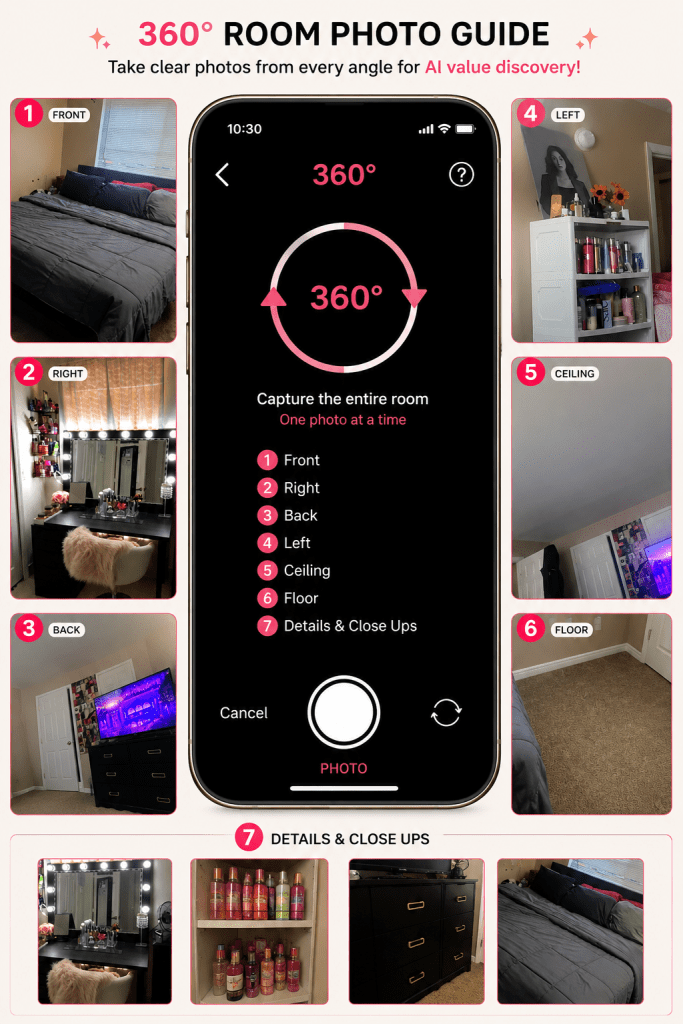
Then, take additional close ups of:
Brand labels
Size tags
Serial numbers
Style numbers
Unique details
Damage or flaws
Interior compartments
Zippers and hardware

The moment I stepped into the room, I immediately realized this wasn’t going to be a simple inventory mission.

So the only way to avoid a spiral was to set some ground rules immediately..

With myself. 
We dont have time to be distracted by an identity crisis.

Or a reminiscent session to different periods in my life that were revisited with every article of clothing that had a little nostalgia attached to it.
Because bedrooms are different.
Living rooms contain things.
Bedrooms contain versions of ourselves.
Every shirt hanging in a closet represents someone we once were.
Maybe even someone we wanted to become.
Or someone we’re still refusing to let go of.

The expensive outfit purchased for an event we never attended.
The jeans we’re saving for when we lose weight.
The dress we bought because we loved it on the mannequin but secretly hated it the second we got home.
The shoes we swore we’d wear more often.
The jacket that no longer fits our lifestyle.
The purse that made us feel successful.
The unopened beauty products purchased during a brief and ambitious phase where we were apparently becoming skincare influencers.
The bedroom is where good intentions go to retire.
I stood there staring at racks of clothing and immediately recognized the problem.
Nothing in this room was being stored because it lacked a home.
Everything had a home.
The problem was that too many things were still occupying space despite no longer serving a purpose.
That’s a very different problem.
Because now we aren’t evaluating usefulness.
We’re evaluating attachment.
Attachment is significantly more difficult to price.
Somewhere along the way, I realized I wasn’t looking at clothing.
I was looking at postponed decisions.
Every hanger represented a choice I never fully made.

Keep it?
Wear it?
Sell it?
Donate it?
Alter it?
Replace it?

I had simply chosen Option Six.
Ignore it.
For years.
The longer I looked around the room, the more obvious it became.
The bedroom wasn’t cluttered because I owned too much.
It was cluttered because I had accumulated too many future versions of myself.
Future Me Who Loses Weight.
Future Me Who Attends Fancy Events.
Future Me Who Starts Going Out More.
Future Me Who Becomes More Organized.
Future Me Who Finally Finds Somewhere To Wear Six Inch Heels.
Future Me apparently had the intention of having an incredible social life.
Current Me was exhausted.

The mission itself was simple.
Anything brand new with tags automatically entered the review pile.
Anything unworn.
Anything barely worn.
Anything purchased within a moment of optimism but abandoned shortly afterward.
Anything designer.
Anything collectible.
Anything that could realistically be replaced if I suddenly realized I missed it.
The objective was not to strip the room bare.
The objective was to identify what still actively contributed to my life and what was simply occupying real estate.


The hidden mistake people make during a cleanout is spending 3 hours listing a $12 sweater, while a $200 to $500 item is buried under a pile of laundry.

Because, after all, closet space is valuable.
Mental space is definitely valuable.
Physical space is definitely valuable.
And if something is consuming all three while contributing nothing in return, it deserves a second look.
As I worked through clothing categories, I began noticing patterns.
Some pieces carried memories.
Some carried guilt.
Some carried unrealistic expectations.
Others carried absolutely nothing except a price tag I had forgotten existed.
Those became easy decisions.
The difficult decisions were the things connected to identity.
The dress that reminded me of a different season of life.
The purse that once made me feel successful.
The shoes that represented a version of myself I wasn’t entirely ready to release.
Those required a different question.


Not “Could I sell this?”
But:
“If this disappeared tomorrow, would I genuinely miss it?


Or do I simply miss the person I was when I bought it?”
Those are very different answers.
And very different losses.

The deeper I moved through the room, the more I realized this mission has less to do about clothes.

Without making it look like I’m avoiding the task at hand, I couldn’t ignore my epiphany.
The bedroom recovery was about making peace with evolution.
Not everything is meant to come with us.
Some things serve their purpose and quietly expire.
Not because they failed us.
Because we outgrew them.
And if we’re being honest, some of these items stopped serving us years ago.
They’re just finally receiving their exit interview.
By the time I finished the first round of sorting, several piles had emerged. Keep.
Sell. Research. Maybe.
The “Maybe” pile was, unsurprisingly, the largest.
Because apparently I am still me.

But unlike yesterday, something felt different.
The room felt lighter.
Not because much had actually left yet.
Because decisions had finally started being made.
And sometimes that’s where recovery begins.
Not with selling.
Not with profit.
Not with money.
With movement.
Because stagnant things stay stagnant.
The moment something moves, change becomes possible.
Today, the master bedroom finally started moving.

Now onto the mission…

What I did is similar to the living room.

I pulled open my notes app in my phone (I lost my notebook somewhere between yesterday and today), as I dug through the closet, under the bed, in laundry piles…as I stumbled across things that l could feel comfortable parting with or ones I might not have necessarily wanted to get rid of but knew they were of value, I set them to the side so they could advance along in the process.

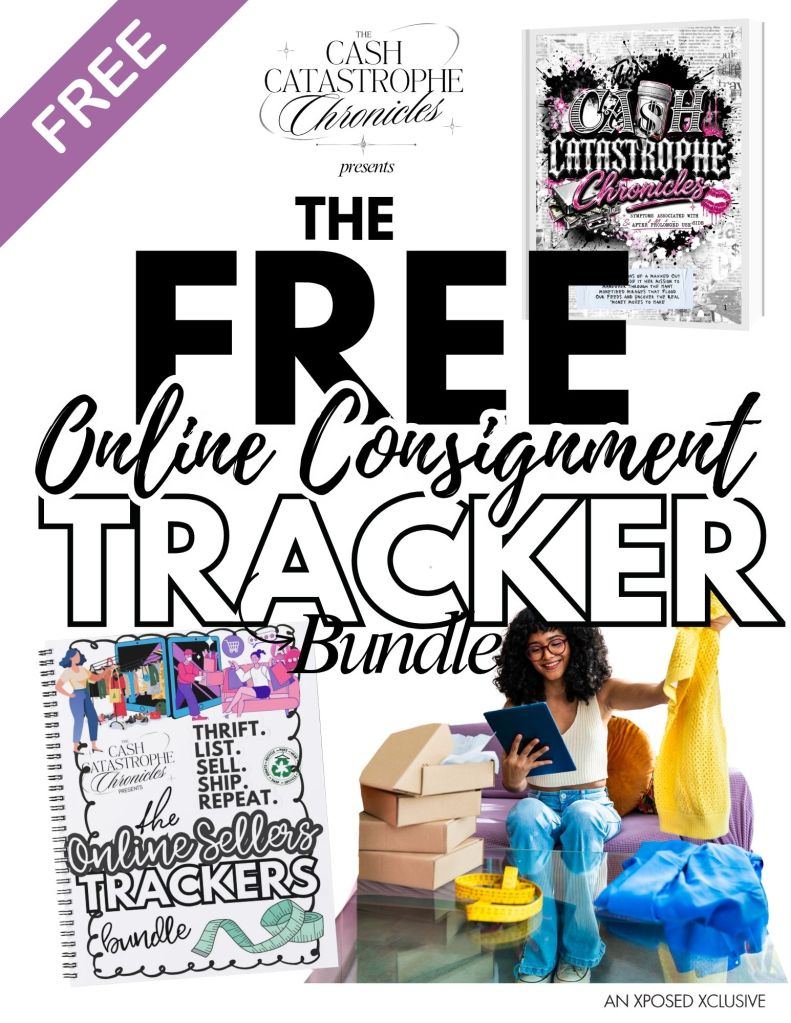
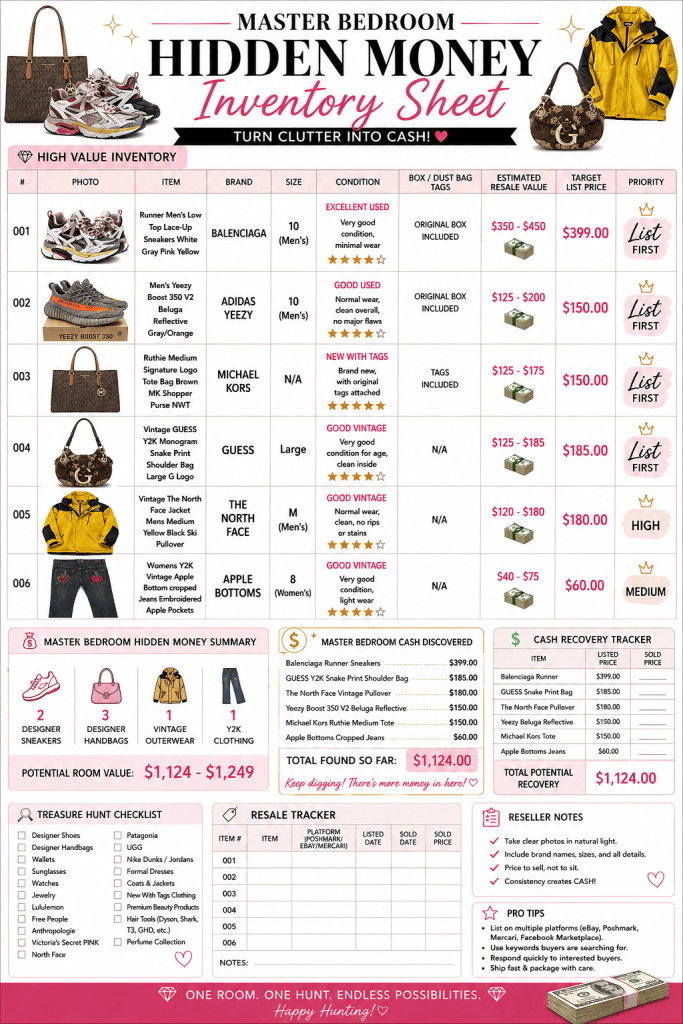
Just to simplify this process for you, you can access this free reseller tracker bundle that I so graciously created to compliment our First mission in the Cash Catastrophe Chronicles.

I thought it would make things a little easier for you, and I’ve also included a few more added bonuses in this free bundle tracker.

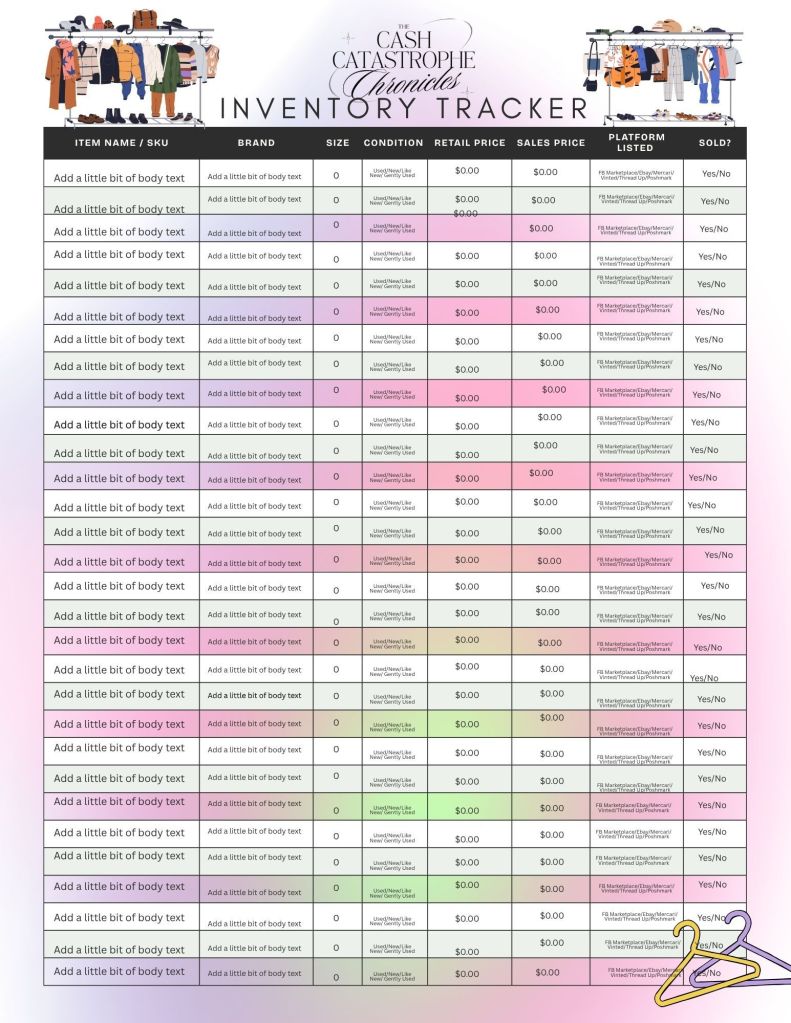
Here’s a photo of the inventory tracker.

Of course,  yours will be ready to fill out moments after being redirected to the template link. 

https://canva.link/om1igg8yujmiukf

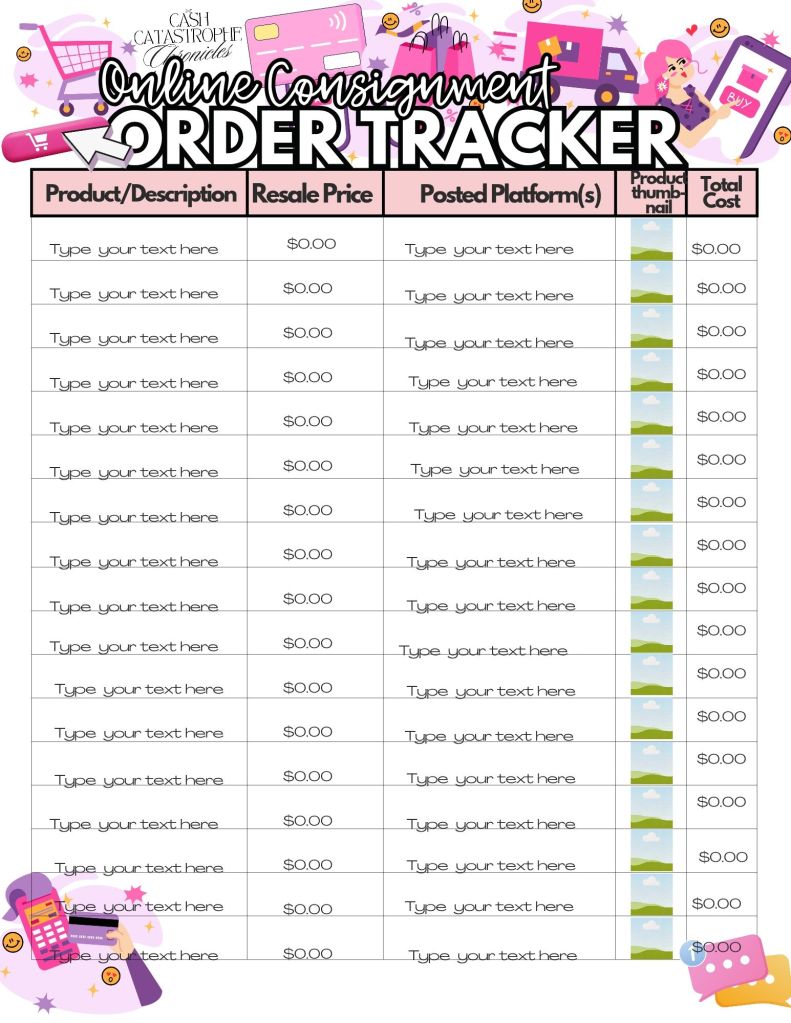
Here’s a snapshot of another free template included in the bundle!

This is kind of an alternative version to the first template that just lists the inventory.  Just an added bonus in the bundle to choose from.

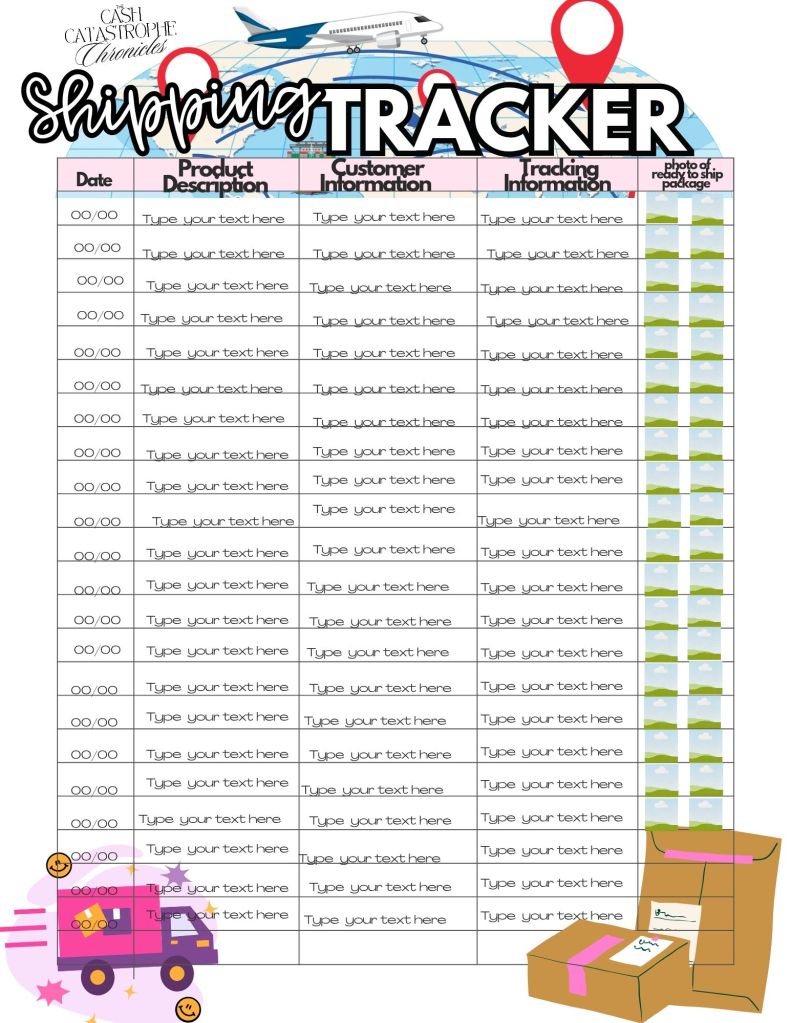
Heres another free tracker you’ll find in the bundle.  It’s reserved for when you have already sold your items online and need to track your shipping.

I created this bundle to support your mission so you didn’t have to pause to create an inventory list.

If for whatever reason you dont want to use the free trackers or you dont have the capabilities to print, Ill give you an idea of how to section off a paper in a notebook and make one on your own.

Here’s the format.

• Item • Brand • Size • Condition • Original Retail • Estimated Resale • Listed? • Sold?


The room isn’t clutter, remember?
It’s unprocessed inventory.


That’s the lens and the mindset you need to maintain for your entire recovery and especially during your master bedroom purge.

It can get overwhelming. 


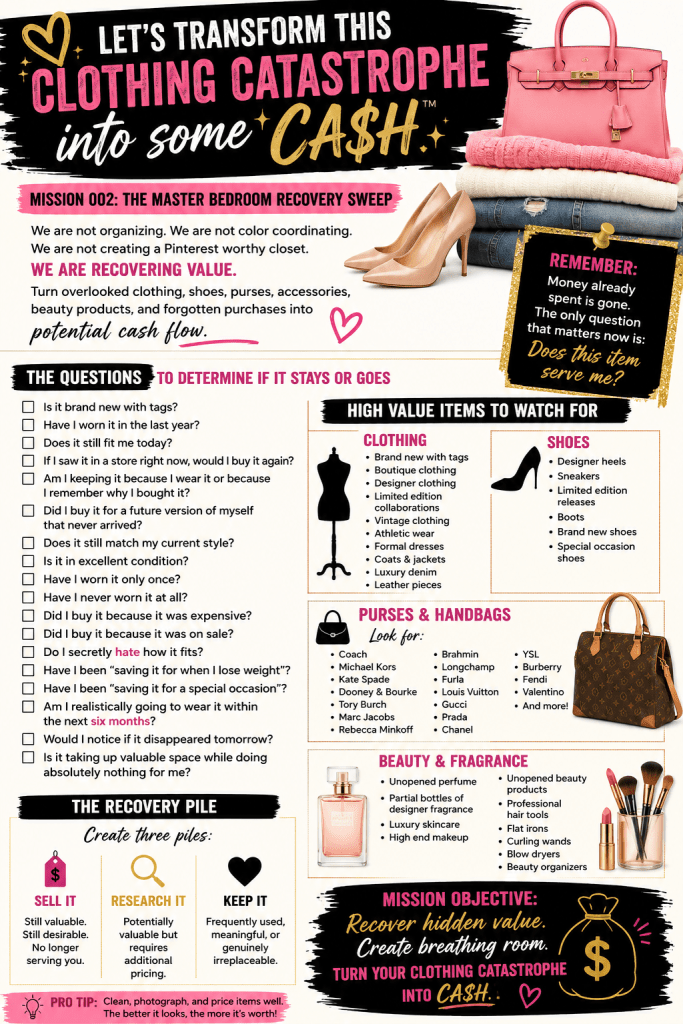
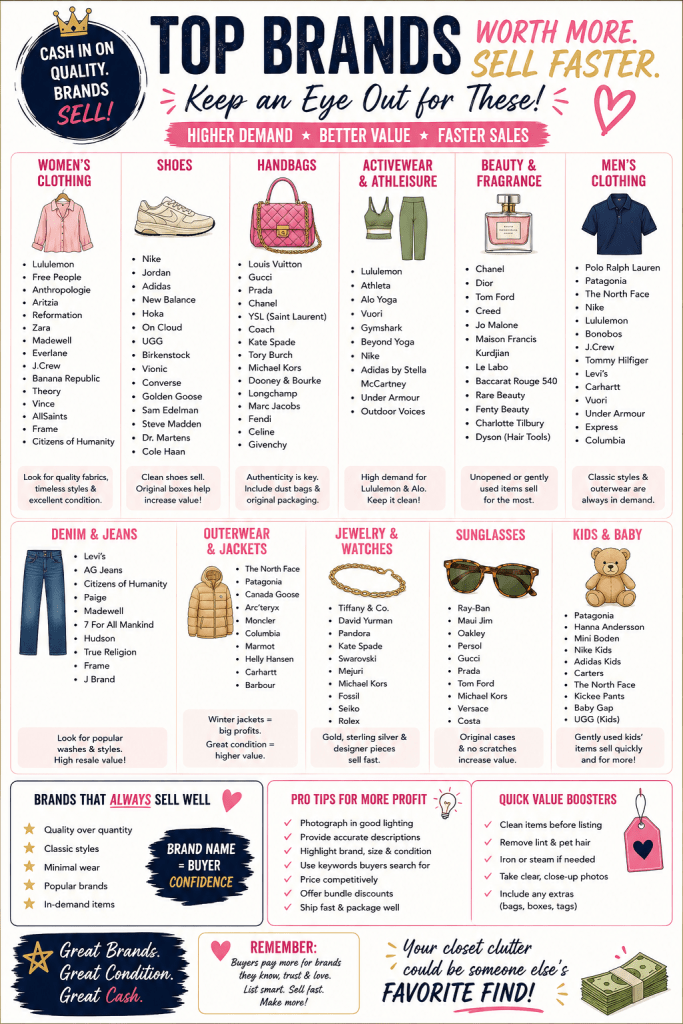
Now I’d start hunting for:


• Coach

• Kate Spade

• Tory Burch

• UGG

• Nike

• Jordans

• Lululemon

• Free People

• Anthropologie

• North Face

• Patagonia

• Columbia

• Michael Kors

• Victoria’s Secret PINK older collectibles

• High end makeup tools

• Dyson products

• Anything purchased for more than $100 originally


Now, you should have a decent pile to work with. 

Now for my haul…

First…

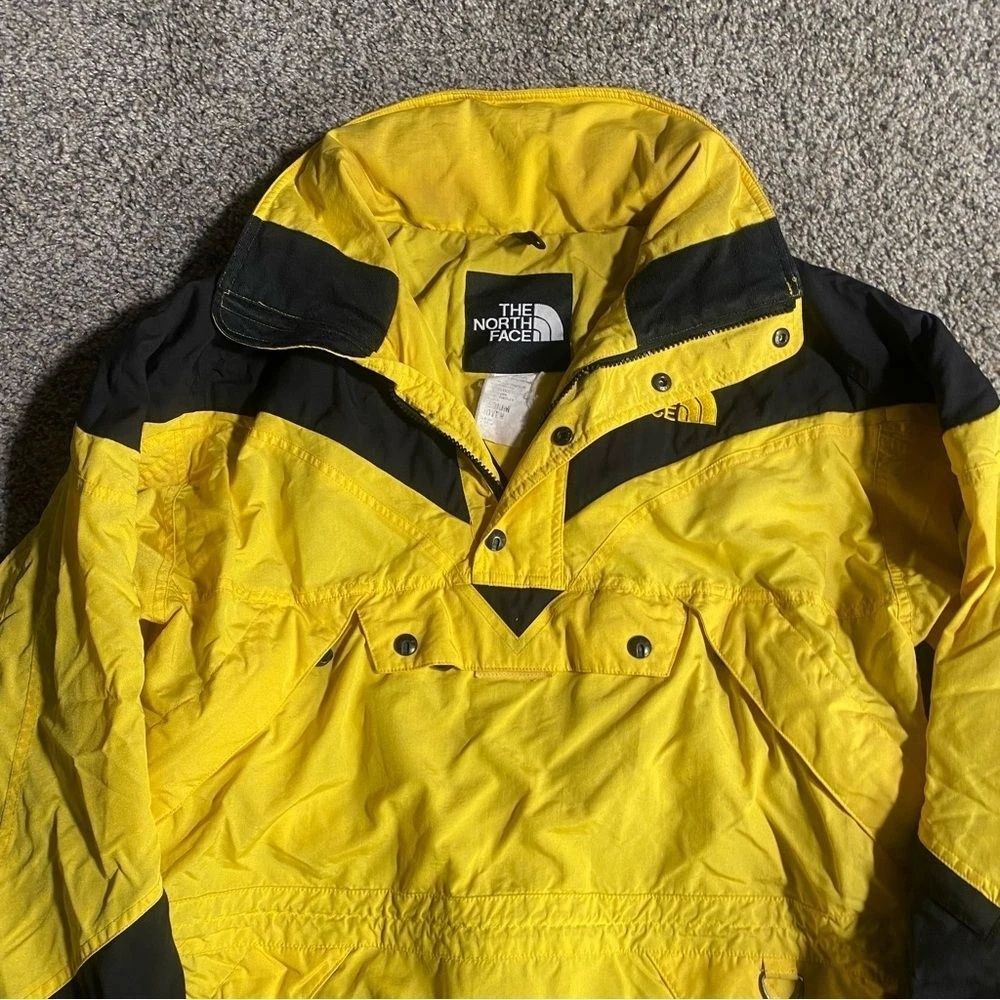
I found an ugly bright yellow & black North Face jacket that I won’t wear. It’s too big, and my two sons wouldn’t get caught dead in it. 

Second…

I pulled out a pair of these shoes that were sent to my daughters father. A pair of  Balenciagas, from one of these vendors he had an arrangement with.  I guess he spent so much money with them that when the tariffs were imposed and then lifted for a short period, they flooded us with free clothing just to try and keep our loyalty.  They are ugly.  I think he wears them to walk the dog because they are a size too big.  That’s crazy.  They are $1,000 brand new. Eff that. I’m selling them.

Third…

The other thing i found was a pair of apple bottom jeans I had from decades ago. I think a friend of mine gave them to me, and they were too big, but just having them for the pockets on the butt I guess, is why I got them from her.  They never quite fit. I am not able to fill in a pair of suze 8 apple bottoms, sadly, even today, 4 kids later and still too bony.  Now that Y2k is back in style, these should be worth something.

Fourth…

I found another Y2k item. This ugly purse.  I let my baby girl play with it typically.  Like, what even fit in here? Anyway,  it can go.

Fifth..

I’ve got 2 pairs of grey yeezys with the orange stripes. One can go.

Sixth…

This Michael Kors purse was the second one I ever owned, and I bought it with my first big girl paycheck.  But it’s too small inside, regardless of how spacious it seems, for the things I haul these days.  So let’s see what kind of magic I can make from these.

But I remember how much help ChatGPT was in the living room.

Is it so bad to admit that I need a little help.

Before those AI opposed haters come for me…

Yes, it is optional. 

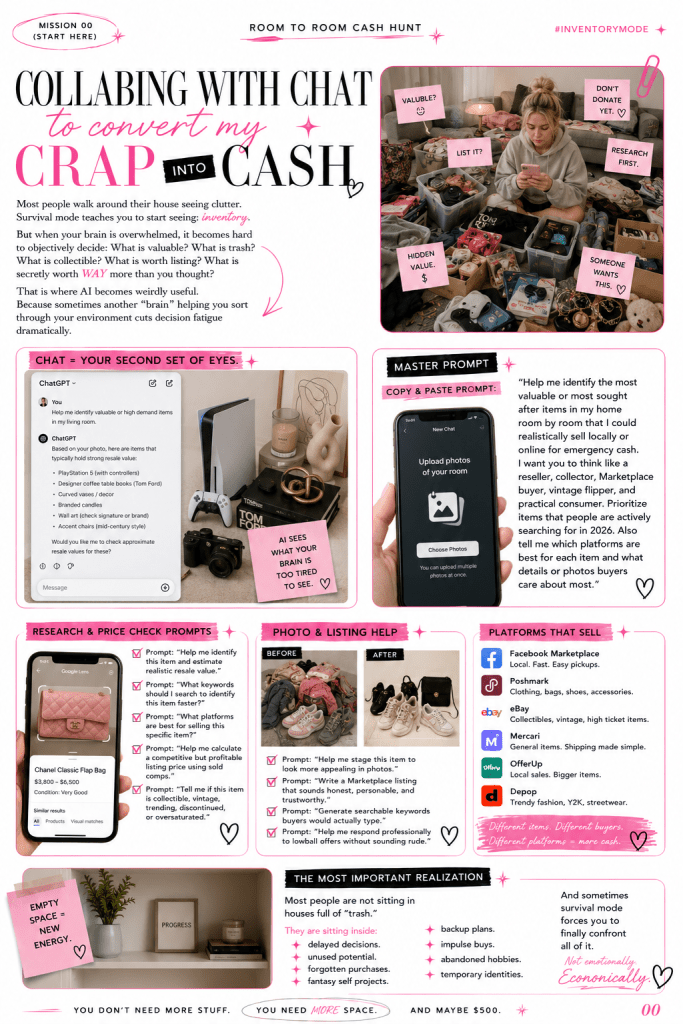
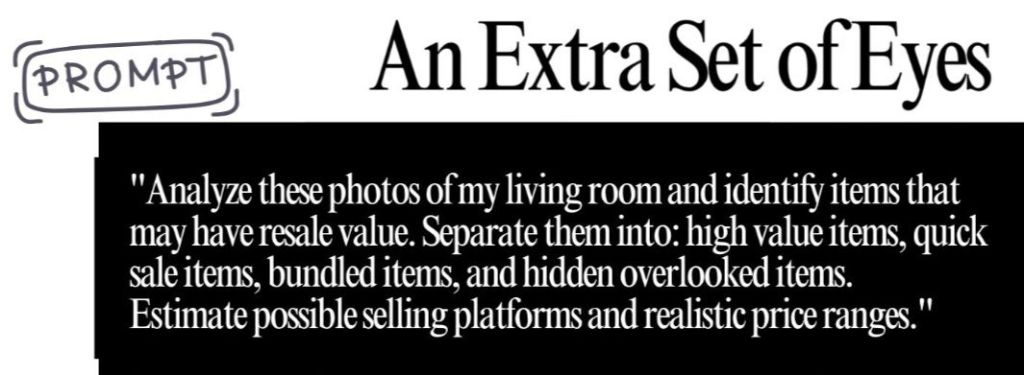
The Extra Set of Eyes Challenge we did in the living room can be done in your bedroom, too.

Save yourself the time and lean on ChatGPT to do the heavy lifting.

I do rely on ChatGPT often because I have a horrible case of ADHD. It’s not the kind that is only admitted because it became cool to be damaged.

Like actual clinical ADHD.

Probably disability check worthy.

If you knew me,  you would agree.

And baby, I need all the help I can get.

I mean, I technically could keep doing what most people do who aren’t familiar with this cheat.

They’d do the typical process by opening up eBay and Type the product info to compare other people’s words into a search bar. Get overwhelmed. Put the item in a pile and tell myself I’d deal with it later.
A pair of Balenciaga Runners.
Yeezy Belugas.
A Michael Kors tote.
A vintage Guess Y2K bag.
A vintage North Face pullover.
Apple Bottoms jeans straight out of the early 2000s.
The biggest mistake isn’t owning too much stuff.
The biggest mistake is having no idea what it’s worth.
Instead of spending twenty minutes researching every single item, I started taking multiple photos and letting AI help identify what I was looking at.
Front.
Back.
Sides.
The more information you provide, the better the results.
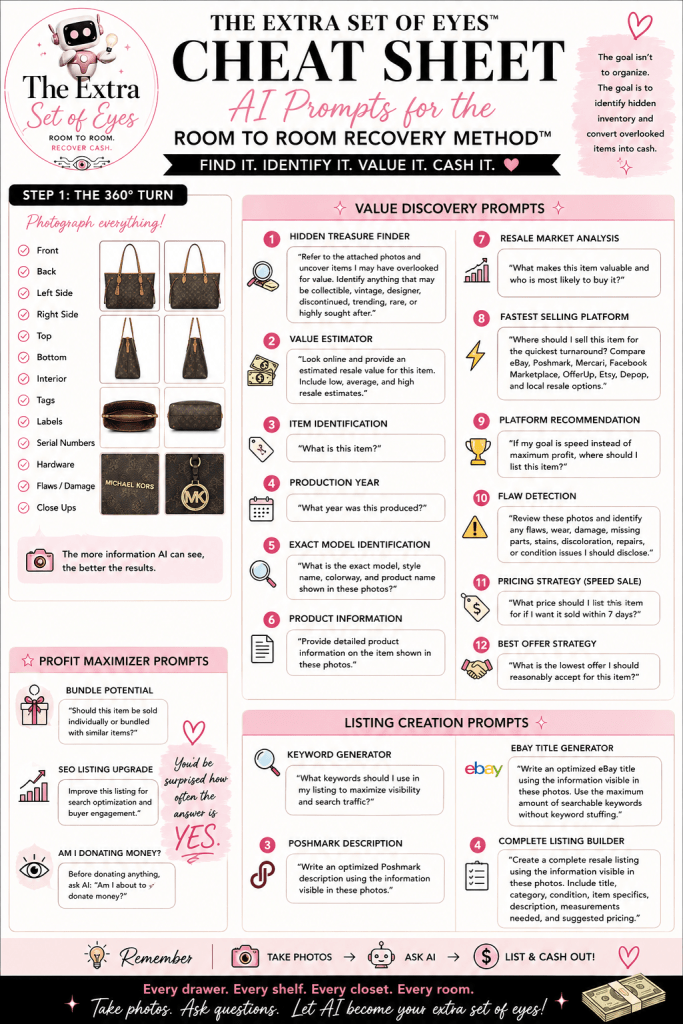
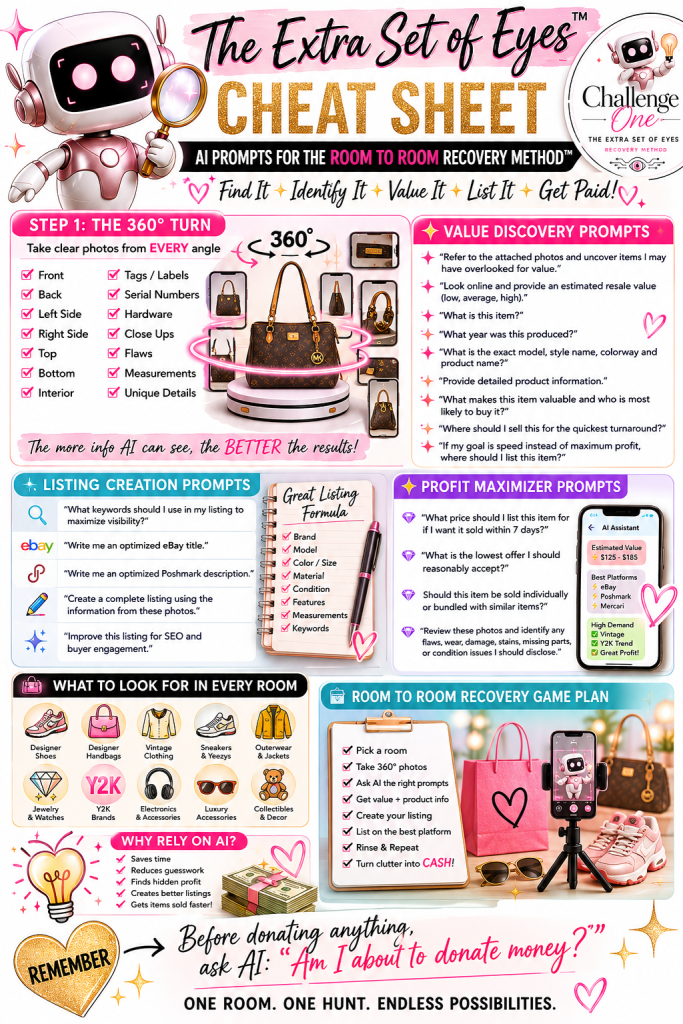
The real game changer is the 360° turn.


Now, feed the photos into AI and ask questions like:
“What is this item?”
“What year was this produced?”
“What is the exact model?”
“What is the average resale value?”
“What keywords should I use in my listing?”
“Write me an optimized eBay title.”
“Write me an optimized Poshmark description.”
“Create a listing using the information from these photos.”


The goal isn’t just identifying an item.
The goal is reducing friction.
Every minute spent wondering what something is becomes another reason the item sits in a pile for six more months.
Every minute spent researching manually is time that could have been spent recovering.
The faster you can move from discovery to listing, the faster clutter becomes cash.
And here’s the funny part.
The more I dug, the more the room looked like a disaster.
At the same time, every shelf became inventory.
Every drawer became potential profit.
Every forgotten purchase became a possible payday.

A few prompts to try out…


Hidden Treasure Finder


Prompt:
“Refer to the attached photos and uncover items I may have overlooked for value. Identify anything that may be collectible, vintage, designer, discontinued, trending, rare, or highly sought after.”


Value Estimator


Prompt:
“Look online and provide an estimated resale value for this item. Include low, average, and high resale estimates.”


Item Identification

Prompt:
“What is this item?”Attach a photo with promot


Production Year
Prompt:
“What year was this produced?”


Exact Model Identification


Prompt:
“What is the exact model, style name, colorway, and product name shown in these photos?”


Product Information
Prompt:
“Provide detailed product information on the item shown in these photos.”
Resale Market Analysis
Prompt:
“What makes this item valuable and who is most likely to buy it?”
Fastest Selling Platform
Prompt:
“Where should I sell this item for the quickest turnaround? Compare eBay, Poshmark, Mercari, Facebook Marketplace, OfferUp, Etsy, Depop, and local resale options.”
Platform Recommendation
Prompt:
“If my goal is speed instead of maximum profit, where should I list this item?”
LISTING CREATION PROMPTS
Keyword Generator
Prompt:
“What keywords should I use in my listing to maximize visibility and search traffic?”
eBay Title Generator
Prompt:
“Write an optimized eBay title using the information visible in these photos. Use the maximum amount of searchable keywords without keyword stuffing.”
Poshmark Listing Generator
Prompt:
“Write an optimized Poshmark description using the information visible in these photos.”
Complete Listing Builder
Prompt:
“Create a complete resale listing using the information visible in these photos. Include title, category, condition, item specifics, description, measurements needed, and suggested pricing.”
SEO Listing Upgrade
Prompt:
“Improve this listing for search optimization and buyer engagement.”
PROFIT MAXIMIZER PROMPTS
Pricing Strategy
Prompt:
“What price should I list this item for if I want it sold within 7 days?”
Best Offer Strategy
Prompt:
“What is the lowest offer I should reasonably accept for this item?”
Bundle Potential
Prompt:
“Should this item be sold individually or bundled with similar items?”
Flaw Detection
Prompt:
“Review these photos and identify any flaws, wear, damage, missing parts, stains, discoloration, repairs, or condition issues I should disclose.”
THE EXTRA SET OF EYES™ RULE
Before donating anything, ask AI:
“Am I about to donate money?”
You’d be surprised how often the answer is yes.
Every drawer.
Every shelf.
Every closet.
Every room.
Take photos.
Ask questions.
Let AI become the extra set of eyes that sees value where others only see clutter.

The goal was to identify hidden inventory and convert overlooked items into cash. Before donating, trashing, or stuffing anything back into another drawer, I needed AI to help me see what I might have missed.

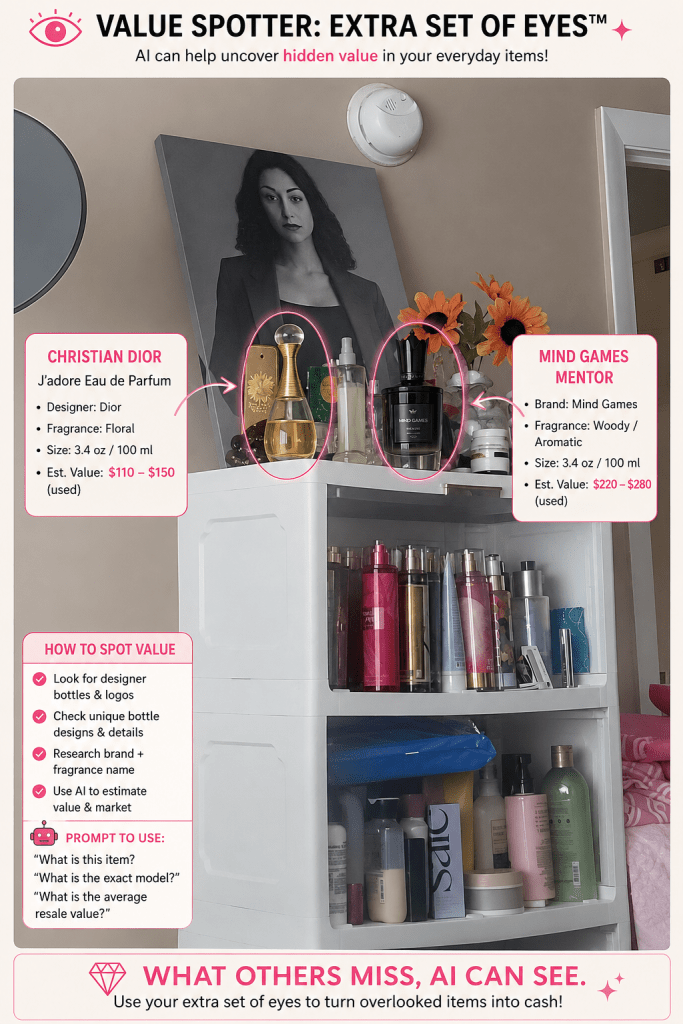
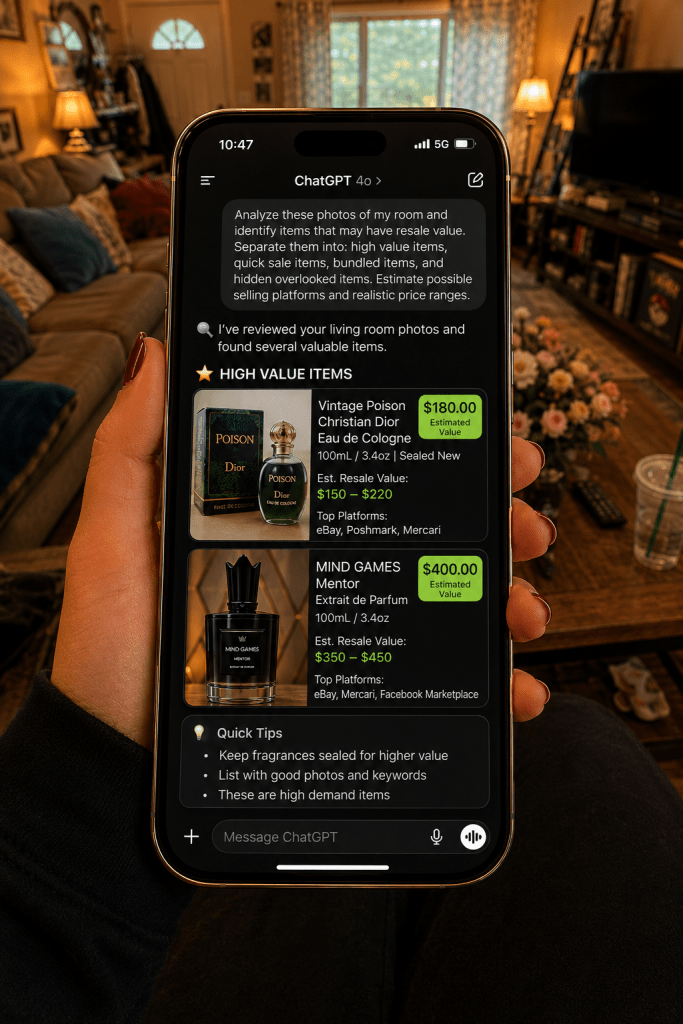
And then AI spotted the fragrances.


On top of my beauty cabinet were two bottles. One was a sealed vintage Christian Dior Poison Eau De Cologne, 100mL, 3.4oz, worth approximately $180. The other was Mind Games Mentor, worth even more.
But here is the part people miss.
I am not selling the My Mind Games.
That is my everyday scent.
That bottle stays.
The Dior became inventory.

The Mentor became a non-negotiable.
That is the real point of this method. The goal is not to sell everything you own. The goal is to know what you own.
Once you know the value of an item, you can make an actual decision.
Keep it.
Sell it.
Gift it.
Bundle it.
List it.
Store it with intention.
The power is not in selling everything. The power is in awareness.
Before AI, those bottles were just sitting on a shelf.
After AI, one became cash, and one became a choice.
By the end of the master bedroom sweep, the sell pile included…

Ok, now let’s sell them.

These aren’t marketplace finds, sorry.

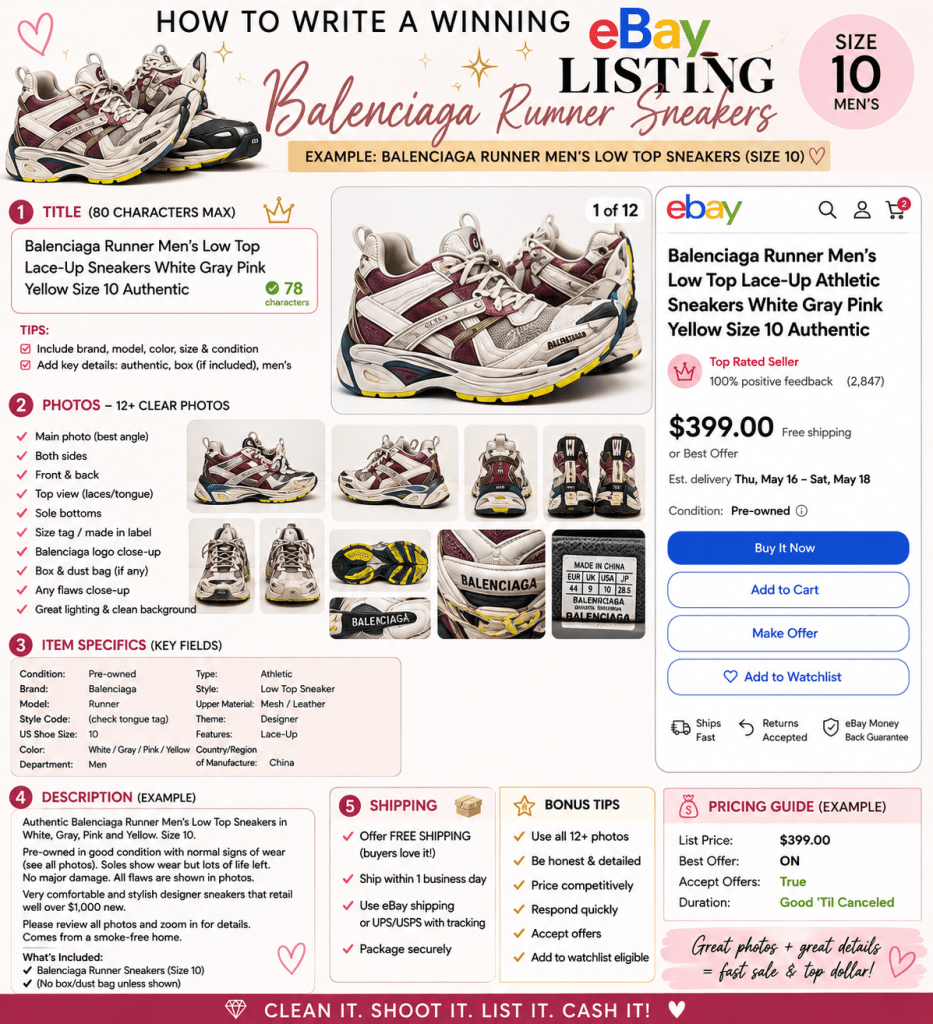
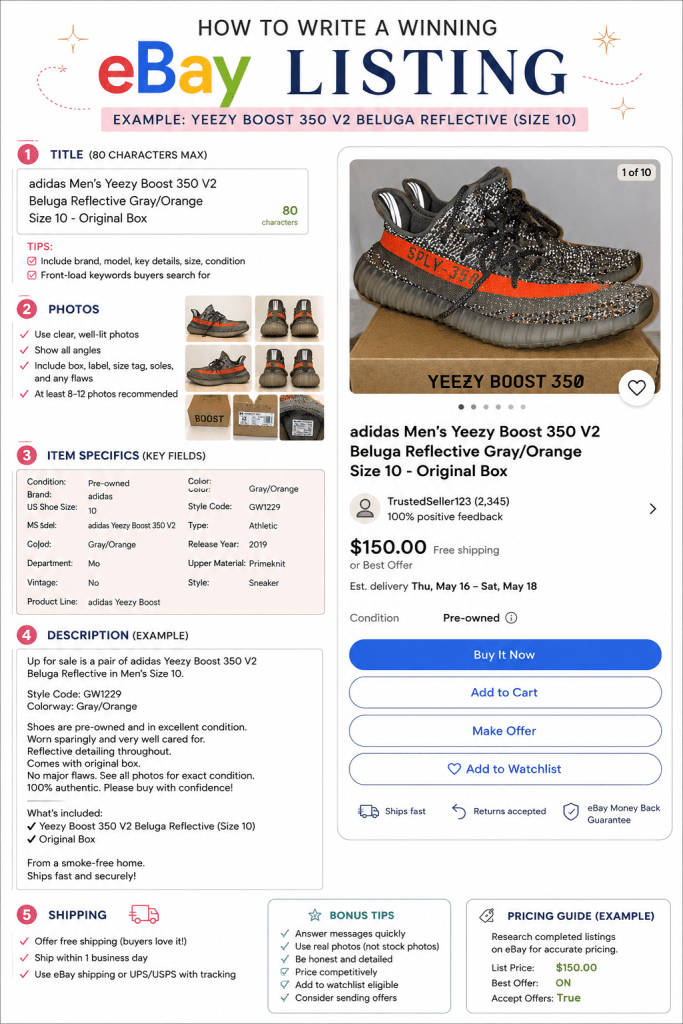
Here’s an example of what to post on Ebay for the Balenciagas.

And one for the  Yeezys

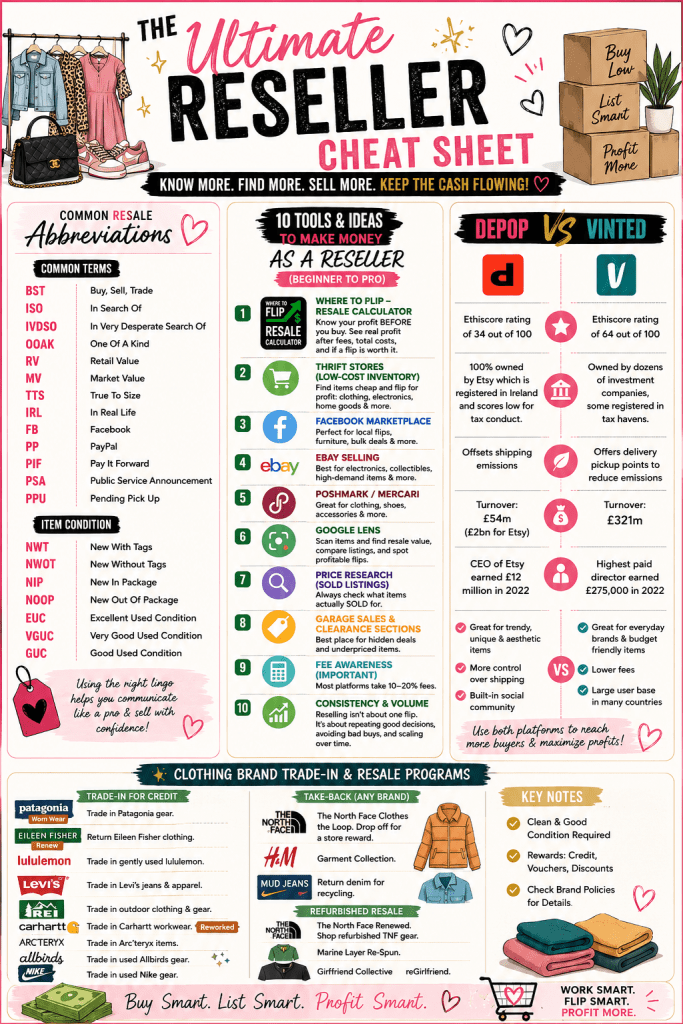
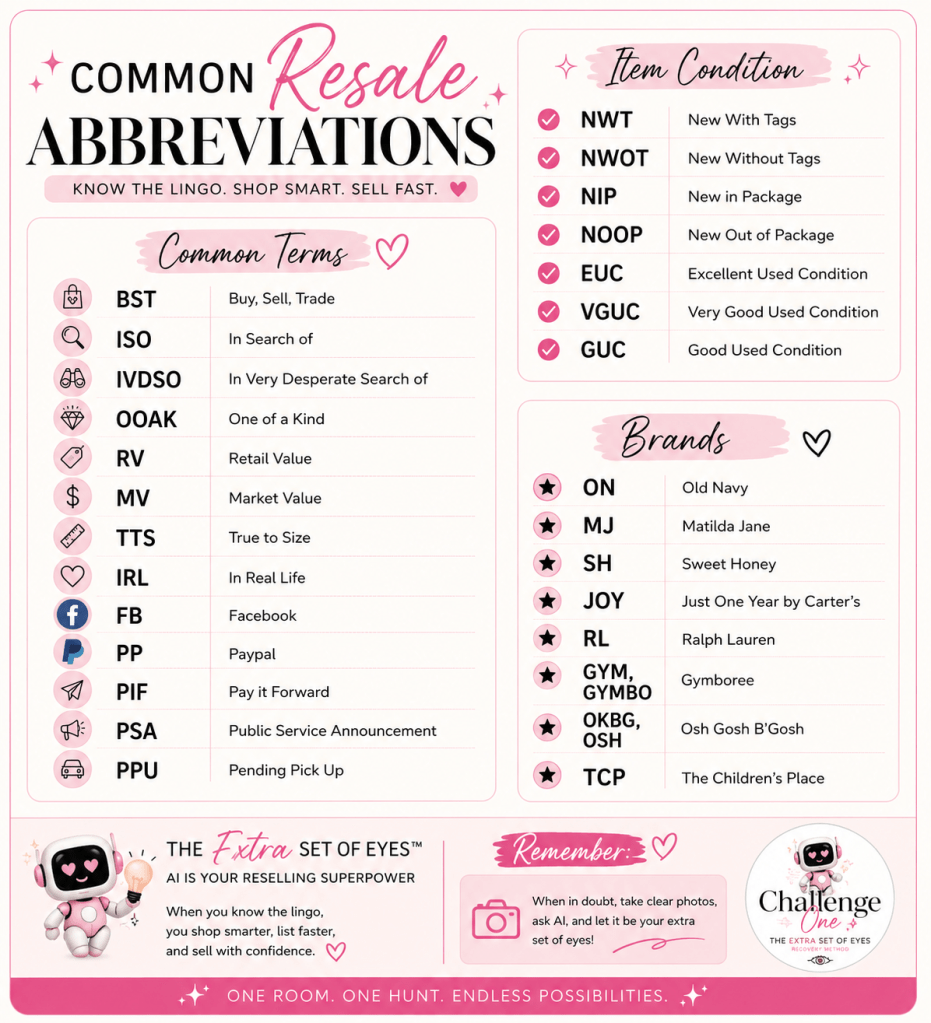
Now, here’s a little bit of help with wording these things for sale online. If you are not a pro at selling online, these will help make you seem more knowledgeable. 

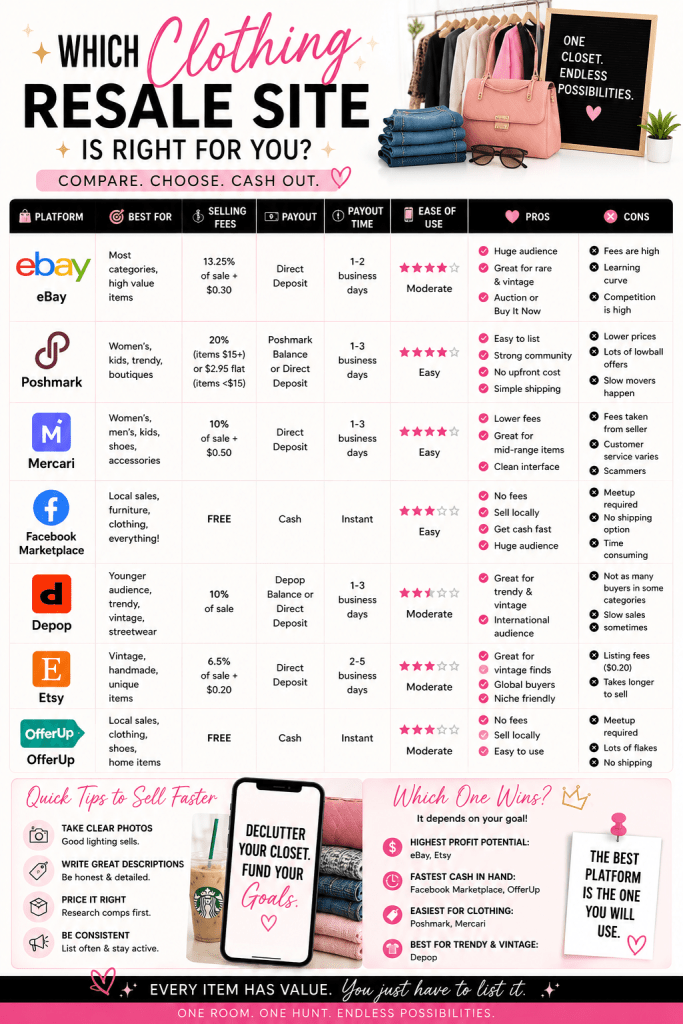
And here’s an honest comparison of different places to sell clothing online that isn’t bias because I am an affiliate that profits off of driving sales. I dont currently have any affiliate programs Im involved in.  This is just a one sheet breakdown of where to go and what platform is best for what you have to sell.

Now is the moment in Mission 001:2 that I stop taking up anymore of your time. I am going to leave you with this abundance of information and your free trackers and the rest of the day to get back to work. 

Since I’m doing thus right alongside of you, I got work to do too.

Don’t get distracted.

Get atleast 5 items.

Take your photos.

Lean on ChatGPT. 

Pick your Selling Platform.

Rely on Chat again with drafting your sales post and determining a fair price and post it.

Document your process and

You finished your Mission. 

This has developed into a choose your own adventure cash catastrophe..

Only the only choice is cash. 

And many avenues of obtaining clever cash.

Without you needing anything up front.

You don’t need to subscribe to anything.

You don’t need to do anything other than show up daily and have the intention to do something.

Anything to put you one dollar out of the hole.

And read my blog to get the newest, latest update on how to come up without having to do a whole bunch of extra shit that really is just not where you need to be bothered by now.

You got this!

Now get to work!

This is only 2 rooms!

We got more to go!

The Cash Catastrophe Chronicles, The Room to Room Recovery Method:Mission 001:01, The Living Room

Regardless of how cluttered you believe your home is, the things you think are junk might actually not be considered junk at all. 

Surprisingly enough, some of it might actually convert into cash.

Maybe it’s furniture that’s still tucked in your entryway closet.

Maybe it’s forgotten collectibles that are now quite valuable.

Older gaming consoles or electronics that are highly sought after.

Your childhood toys in a tote tucked away in your attic that you forgot were even up there.

Maybe it’s vintage décor, barely worn clothing or something that you didnt consider a hot commodity just because its no longer available to purchase in stores.  

These random belongings have quietly blended into the background of your everyday life and theres a good chance there are many that have become valuable right under your nose.

So, for Mission 001 being simple enough.  Grab some things we don’t want and sell them. 

I also know that it may be simple to someone else, but for me, well, I know myself well enough to understand exactly what would happen if I head into this mission with unrealistic expectations.

I wanted to be able to approach this constructively but also realistically.  Or I know what the end result would be.  Me, late at night after everyone else was asleep, still awake, just mentally walking myself through my motions earlier in the day.

Deconstructing every decision. Evaluating every distraction. Determining whether I deserved a pat on the back for making progress or a lecture for wandering off course somewhere along the way.
I knew I couldn’t pencil in time for that kind of lashing later so, instead, I decided to proceed into this mission fully aware of both my strengths and my weaknesses.
I know my tendency to overcomplicate things.
I know my obsessive need to analyze every angle.
I know how easily I can disappear down a rabbit hole chasing details that have very little to do with the actual objective.
But I also know something else.
Fighting against my nature rarely works.
So, instead of resisting it, I decided to use it.


If I was going to overanalyze something, it might as well be in service of the mission.


If I was going to obsess over details, those details might as well help me uncover opportunities I would have otherwise missed.


If my brain was determined to turn a simple room sweep into a full-scale investigation, then I was going to let that complicated nature work in my favor for once.

The moment I scribbled the last item’s information onto my notebook paper, I found my mind traveling elsewhere.

And I’d need help.  

But ultimately, the key is not losing sight of the primary objective.
Process not perfection.
Not organization.
Not creating the world’s most detailed inventory that’s exactly how I would want it assembled with perfectly designed labels for every drawer.
What this about is actual recovery.
The mission wasn’t to create more work.
The mission was to uncover value.
So I decided to come up with a method to prevent a meltdown later on or half the day gone and nothing to show for.

The Room to Room Recovery Method was born from the catastrophe.  Right now, the lack of cash was the cure.  We needed to recover some shit to resell for some revenue. 

This method was not created from my desk that sits in the middle of some perfectly curated lifestyle where every bin is labeled and every drawer contains exactly what it’s supposed to.

It was created because I found myself in a position where life demanded solutions faster than I could comfortably produce them.

My first instinct, like many people facing financial pressure, initially, was to look outward.
A quick side job. side hustle. An extra shift. A few freelance gig.

Really, I just need a miracle.

But before I could go chasing these kinds of opportunities somewhere else, I realized I hadn’t fully evaluated the resources already sitting around me.
The problem was that the process itself felt overwhelming.

The thought of sorting through an entire house while already carrying the weight of everything else felt like trying to solve a puzzle while someone continuously added more pieces.

I knew if I approached it as one giant project, I would eventually lose focus, get distracted, become overwhelmed, or abandon it altogether.

So I did what I often do when something feels too large to manage.

I broke it into smaller missions.

The Room to Room Recovery Method™ is a structured system designed to help uncover hidden value inside your own home without the pressure of tackling everything at once.

Whether you’re navigating financial hardship, unexpected setbacks, executive dysfunction, survival mode, or simply trying to regain control over an environment that feels heavier than it should, the objective remains the same:

Recover what has been overlooked.

Room by room.
Shelf by shelf.
Drawer by drawer.

As you move through each mission, you will perform a recovery audit of your environment.

Every room becomes a checkpoint.

Every cabinet, tote, closet, shelf, basket, and forgotten corner becomes an opportunity to reassess what is actually occupying your space.

The goal is not to become a minimalist.
The goal is not to throw everything away.
The goal is not to sell your cherished belongings.
The goal is to identify what still serves a purpose, what no longer does, and what may still hold value.

Throughout each mission, you will inventory potential resale items, separate high value opportunities from low value distractions, document your findings, and create a practical recovery plan based on what you uncover.

Because sometimes the answer is not finding more.

Sometimes, the answer is finally recognizing what you already have.


They may have been sitting beside you all along.


Mission 001 begins in the room where most forgotten belongings eventually end up.

The Living Room.


Unlike bedrooms and closets where things are intentionally stored, the living room is where objects slowly migrate when nobody knows where they belong anymore.

It is essentially the Ellis Island of household items.

I looked around and immediately realized this room was no longer functioning the way it had originally been intended.

It was overburdened.

Lost beneath the weight of multiple people existing inside it and leaving behind tiny remnants to prove they had passed through.

Evidence of life.

Tiny remnants that are left behind every person that lives within the four walls.

And occasionally announcing that someone apparently had no intention of picking up after themselves.

Then again, why would they? They have me.

The designated collector of abandoned belongings.
The unpaid curator of everyone’s misplaced possessions.
The person constantly followed behind them, gathering whatever they left in their wake.

Then there are the things actually intended to live there.

Remote controls. Chargers. Blankets left unraveled. Candles. Books. Throw pillows.
Decorative pieces that survive year-round.
Seasonal décor that somehow overstayed its welcome.
Random electronics balanced on end tables and slowly disappearing between couch cushions.
Bluetooth speakers with dead batteries.
Tablets. Video games. Gaming Accessories.
Small furniture. Lamps. Plants.

And if you have children, add a few articles of clothing draped over chair arms, empty water bottles, rogue snack wrappers, and random dishes they so graciously leave behind for you to collect during your daily rounds of picking up.
It is very similar to a correctional officer making rounds.

Except you can not reach for a taser to restore order because, first of all, they are not criminals.

And secondly…

That’s child abuse.

Still, it does not eliminate the similarities in positioning.

Another profession you quietly assume the moment that version of you is needed.

Because somehow being a parent means becoming everything.

Driver. Cook. Mediator. Therapist. Teacher.
Housekeeper. Security. Detective.

Professional finder of missing objects.

It becomes exhausting not only being everything for everyone  but also carrying the weight required to keep the entire machine functioning.

Then, somewhere between picking up the fifth empty cup and relocating somebody’s sock from a location that defies logic, you remember something.

The only way to get something different is to do something you have never done.

As cliché as that statement sounds, it still carries the same weight it did the first time you heard it.

Because growth requires movement.

Physical movement.
Mental movement.

The uncomfortable kind where you have to push beyond your usual patterns and approach things differently to create a different outcome.

It might take several attempts before you see results.

But there is one important detail people rarely mention.

Growth exists in the middle of discomfort.
So today’s mission is simple.

Find something worth money.
Something you are not sentimentally attached to.
Something you can part with.
Something complete.
Something in excellent condition.

Something quietly sitting in plain sight, pretending it has not been occupying space rent-free for years.

As you begin the recovery sweep, resist the urge to grab a ladder and start overexerting yourself this early in the process.
Instead, simply scan.
Wall to wall.
Corner to corner.

Inventory what immediately stands out as potentially valuable.
Gather those items together.
Wipe them down.
Dust them.
Polish them.
Disinfect them.

If glass or reflective surfaces are involved, remove fingerprints, smudges, and dust.
Presentation matters.

Now, create your Living Room Recovery Record.
If you prefer digital records, open the notes application on your phone.
Apple.
Android.
Doesn’t matter.

If you prefer writing things down, grab a notebook and pen.
We are beginning a room inventory.

Time is of the essence.
There is no designated window for emotional attachment audits.

If it is not an heirloom, a rare collectible, a handcrafted piece, or something with genuine historical, artistic, or sentimental significance, leave the emotions out of the evaluation.

The questions are simple.

Have you used it this month?

The last six months?

The last year?

If you got rid of it today, could you realistically replace it tomorrow?

Would your daily life become noticeably more difficult without it?

We are not inventing hypothetical future scenarios where a future version of ourselves suddenly needs the thing we haven’t touched in four years.

We are collecting evidence.
List the room.
List the item.
Record the condition.
Estimate the value after a Google Image Search.
Note whether it is complete.
Document anything that may matter later.

I completed the same process alongside you, exactly as promised.

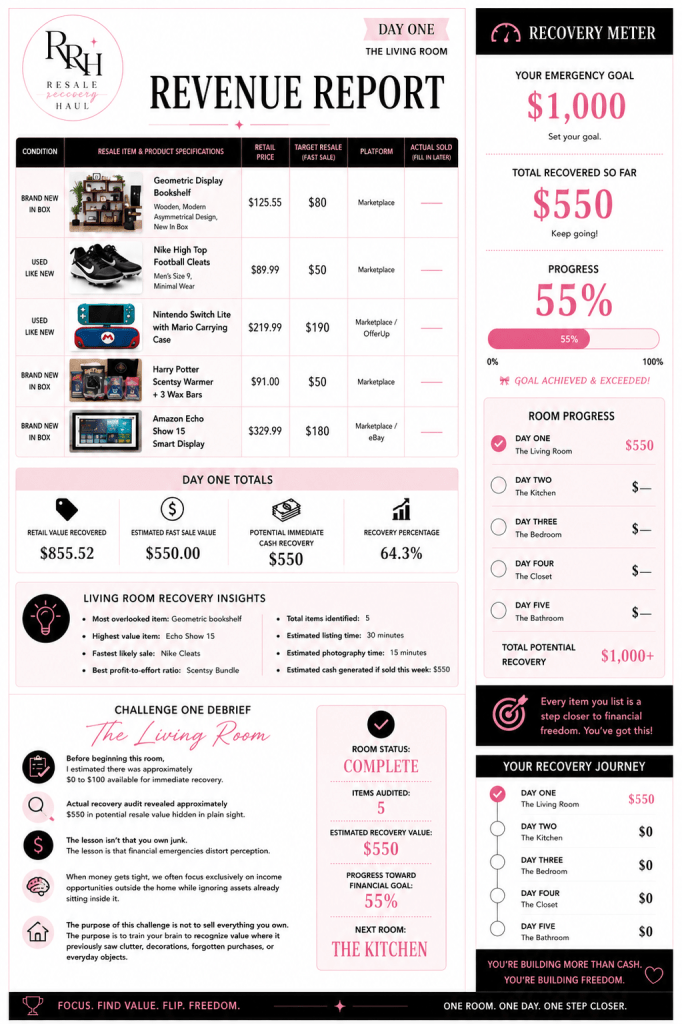
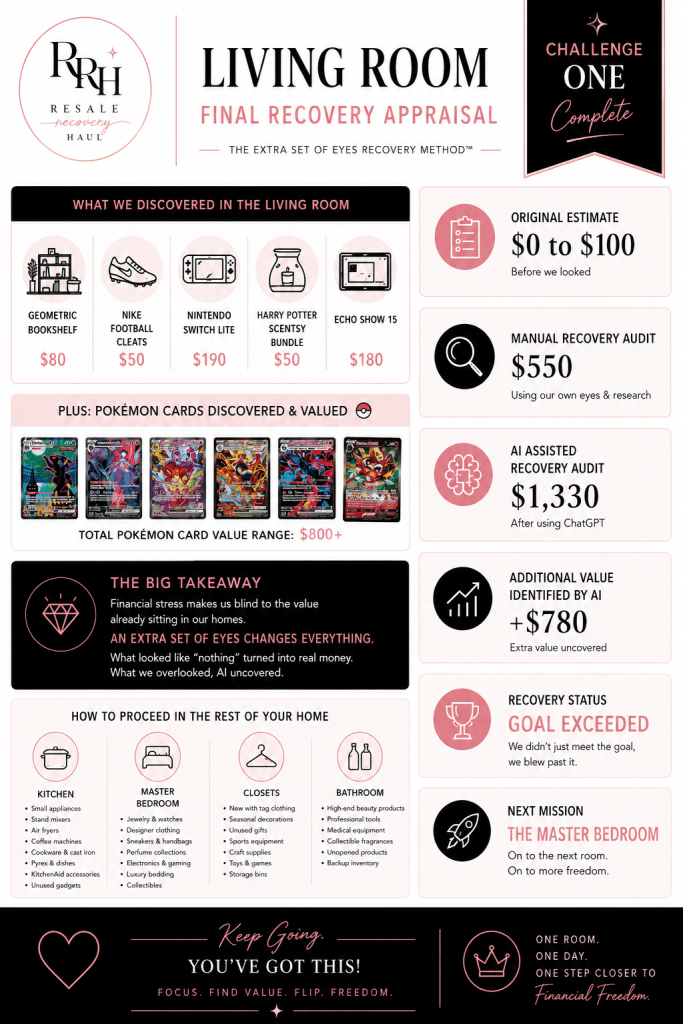
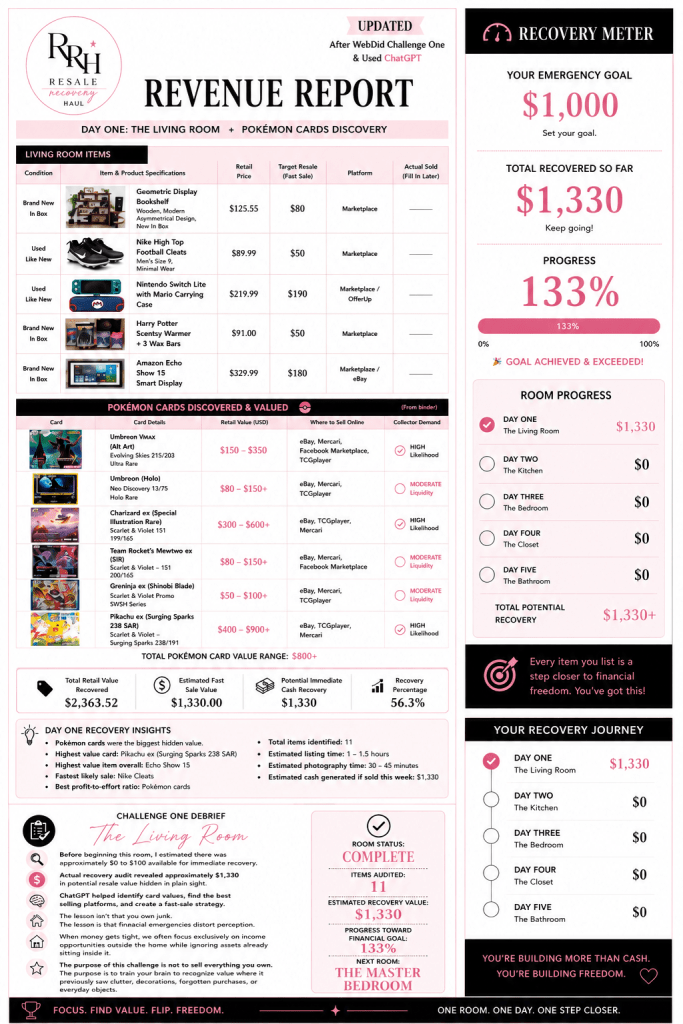
The inventory from the living room wasn’t substantial.  But, it was decent.  For a single room, at least.

My Living Room Recovery Looks Somewhat Decent!

1.A Scentsy Warmer and Wax Melts

2.A pair of Nike High Top Football Cleats

3. A Nintendo Switch & Carrying Case

4. A Geometric Bookshelf (in box)

5. A Echo Show 15 (In box)

As soon as I started feeling accomplished, a thought crossed my mind.

What if I’m overlooking something?

Not because it isn’t there.

Because I’m so distracted by my own problems that I can’t see it.

That possibility bothered me.

The more I thought about it, the more reasonable it seemed.

After all, I was conducting this entire recovery mission while carrying around enough stress to power a small city. My attention was divided between the room directly in front of me and the financial catastrophe looming overhead.

How many things had I already walked past?

How many opportunities had I unconsciously dismissed?

How many times had I looked directly at something without actually seeing it?

I wished I had an extra pair of eyes.

Unfortunately, I was home alone.

No second opinion.

No resale expert.

No friend to follow behind me, pointing out the obvious things I had missed.

Just me.

Then I got an idea.

Now, before I continue, this next part may not be for everyone.

Some people are going to love it.

Some people are going to hate it.

Some people are immediately going to start arguing about robots replacing humanity, artificial intelligence taking over the world, or whatever terrifying headline is currently circulating this week.

That’s fine.

This portion of the mission is completely optional.

Think of it as extra credit.

A side quest.

A bonus challenge.

If you’re the type of person who still refuses to use self checkout because it’s “taking somebody’s job,” feel free to skip ahead.


You’ll still complete the mission perfectly fine without it.

But if you’re willing to experiment, I’d like to propose an idea that might sound crazy. 

Its one of those things that sounds so crazy, it might end up really changing the game and helping out in ways I never thought possible. 

The fact Im experiencing a Cash Catastrophe makes it to where I need all the help ai can get. 

This only eliminates the uncomfortability that comes with asking someone for help and burdening another person witt yet another one of your many problems that seem to never end.

Let’s save ourselves the embarrassment today.  Let’s venture into a sort of Robot Recruitment Phase….

Heres the completely optional First Challenge.

The Extra Set of Eyes Challenge ™.

Whether we like it or not, artificial intelligence is here to stay.

Although this is not the type of thing I typically would rely on AI for, I thought to myself, ” Why not? What do I really have to lose? Not much.  What do I have to gain? I can only assume, possibility.”

Why did I even consider this?

Well,  it’s obvious I needed help, and it’s already widely known. I have a shortage of people available to me to have a wide open schedule that I can burden with my heavy load.

I also know enough about AI to know what its capable of.  My decision to intergrate it in my recovery method began with the obe thought. 

AI currently has one major advantage over human beings.

It isn’t emotionally attached to your situation.

AI also, is guaranteed to nor be attached emotionally on your material objects.

It isn’t invested in preserving a future version of you who may one day become a professional scrapbooker, candle maker, woodworker, reseller, crafter, baker, gardener, or whatever other identity your abandoned hobby supplies are still convinced you’re eventually becoming.

It simply evaluates what it sees.

And sometimes that’s exactly what you need.

Not because AI is smarter than you.

Because familiarity creates blindness.

The things we see every day eventually become invisible.

The bookshelf you’ve walked past a thousand times.

The storage bin you’ve moved three different times without opening.The longer something exists in your environment, the less attention your brain gives it.

That’s just how people work.

So, if you’re feeling adventurous, this challenge may be worth exploring.

Worst case scenario?

It finds nothing.

You lose a few minutes and move on with your day.

Best case scenario?

It identifies something valuable you’ve been walking past for years.

Considering the entire objective of this mission is recovery, I figured a second set of eyes couldn’t hurt.

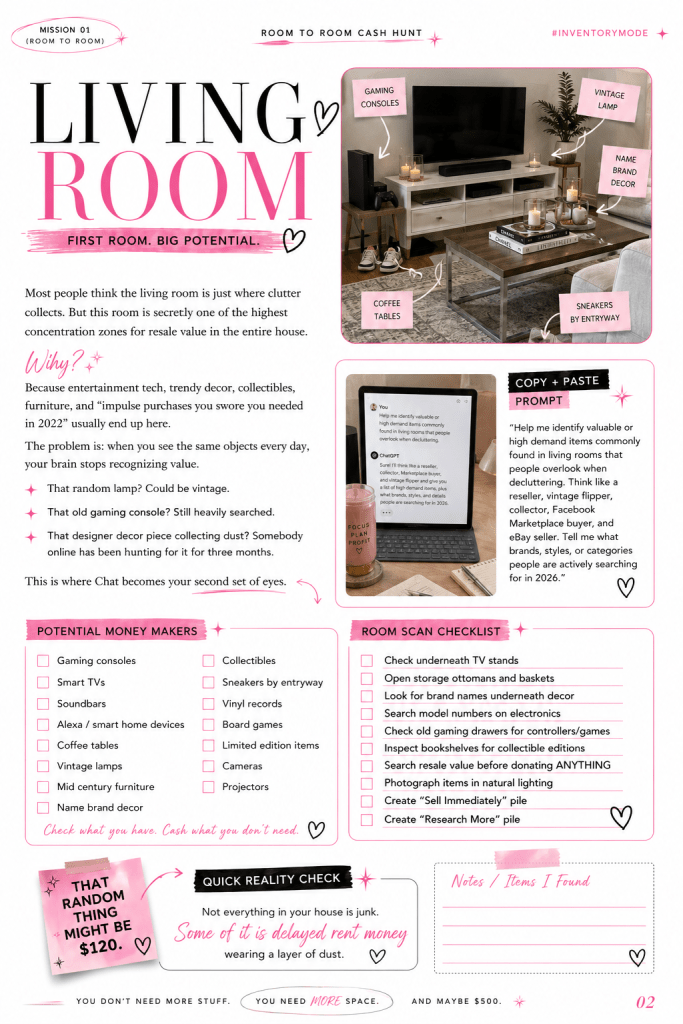
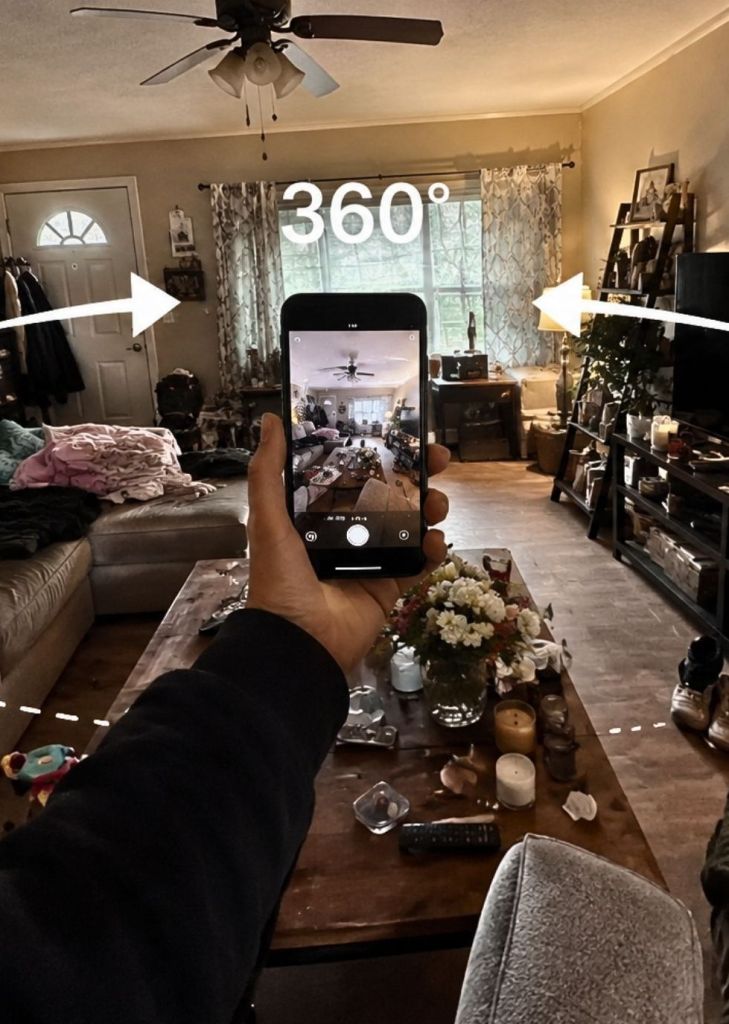
So, I opened up ChatGPT and started snapping photos of my living room. 

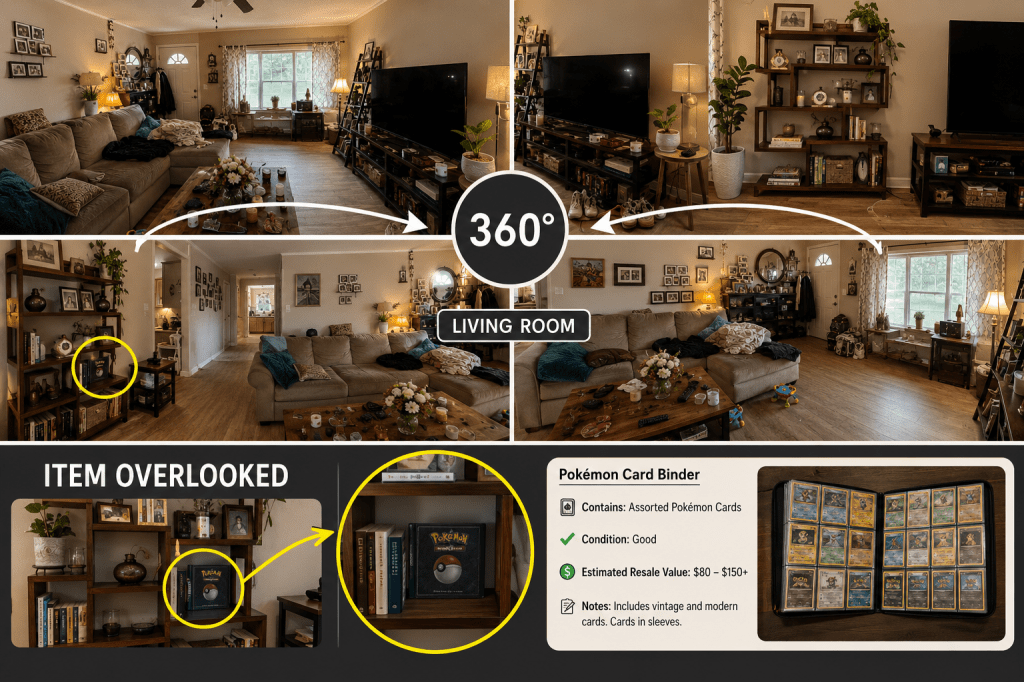
I made a full 360° Turn and took several shots I intended to go through and see the best idea that weren’t blurred and upload those. No more then 10 at a time.

It took about 30 seconds to a minute to get a response.  .

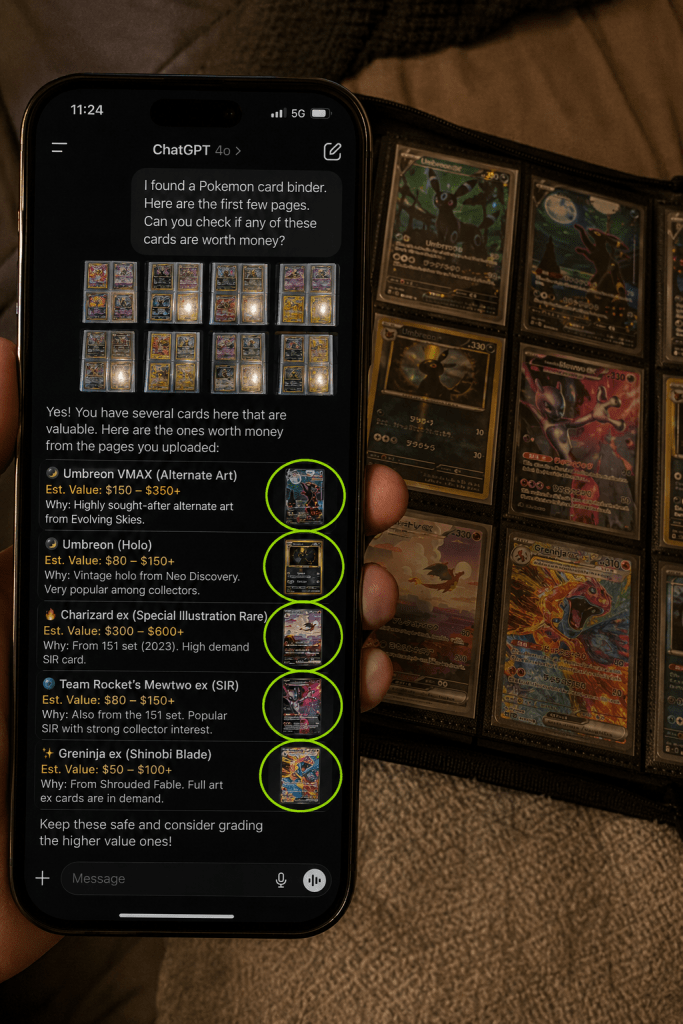
Apparently, some Pokémon Binder of my son’s was spotted, and Chat asked me to open it up and take a photo of a few pages inside to see if there were any cards of value. 

Out of the first several pages I uploaded, multiple cards were immediately flagged as potentially valuable.
Not “worth a couple of bucks” valuable.
Actual collector cards.
The kind of cards that make you pause, sit up a little straighter, and suddenly pay much closer attention to what you’re looking at.
The Umbreon VMAX Alternate Art was identified as one of the stronger finds due to its popularity among collectors and continued demand in the market. The Charizard Special Illustration Rare was immediately recognized as one of the most sought-after cards from its set. Pikachu EX from Surging Sparks surfaced as another card with unusually high collector interest and a reputation for moving quickly when priced appropriately.

Team Rocket’s Mewtwo, Greninja EX, and several Umbreon cards were also identified as cards worth taking a closer look at.
What exactly was sitting inside this binder remained to be seen, but it was becoming increasingly clear that there might be genuine value hiding behind those plastic sleeves.
At the same time, I knew enough about collectibles to understand an important distinction.
Potential value and immediate cash are not the same thing.
These weren’t everyday Facebook Marketplace flips.
They weren’t the type of items where you snap a few photos, post them online, and have somebody knocking on your door thirty minutes later with cash in hand.
Collectibles are a different animal entirely.
The right buyer matters.
Condition matters.
Presentation matters.
Timing matters.
And in some cases, patience matters more than anything.
I could have easily overlooked the binder altogether and never fully understood the value sitting inside it. Had I relied solely on my own observations, I probably would have walked right past it.
But I also wasn’t about to convince myself that one promising discovery in the living room had suddenly solved all my problems.
The mission wasn’t over.
The room had simply revealed its first surprise.
People often make the mistake of assuming that value automatically equals liquidity.
It doesn’t.
Something can be worth hundreds of dollars and still require effort, research, patience, and the right buyer before that value becomes real money.
The Pokémon binder was an unexpected win, but it was still going to require a conversation with my son.
He understands the politics of Pokémon far better than I do.
The grading.
The condition standards.
The collector culture.
The tiny details that can dramatically impact value.
A card might appear flawless to me and still lose a significant percentage of its worth because of a tiny scratch, slight whitening around an edge, a fingerprint smudge, or some microscopic imperfection that only becomes visible once collectors start examining it like forensic investigators.
Before making assumptions, I wanted his input.
Still, even without grading or deeper inspection, the binder had earned a spot on my Living Room Recovery List.
Not as guaranteed money.
As potential.
And that distinction matters.
What originally looked like a random binder shoved onto a bookshelf had quietly transformed into possible inventory.
More importantly, it reinforced the entire purpose behind Challenge One.
Not because every home secretly contains thousands of dollars.
Not because artificial intelligence is magically uncovering treasure.
But because familiarity creates blindness.
The things we walk past every day eventually become part of the background.
And once you train yourself to look differently, something interesting happens.
You stop seeing clutter.
You start seeing assets.

As promising as the Pokémon binder discovery was, I had to remind myself why I started this mission in the first place.

The objective wasn’t to become a professional card grader.

It wasn’t to spend six hours researching market trends.

It wasn’t to disappear into another rabbit hole and convince myself I was being productive while avoiding the larger task at hand.

The objective was recovery.


And recovery requires momentum.

At some point, you have to stop analyzing and keep moving.

The living room had already given me more than I expected.

Several electronics.

A few household items.

Some potential collectibles.

A handful of things that could realistically be converted into cash.

More importantly, it had given me proof.

Proof that I wasn’t surrounded by useless junk.

Proof that value still existed inside my home.

Proof that I wasn’t nearly as trapped as my stress had convinced me I was.

The funny thing about financial pressure is that it narrows your vision.

The heavier the burden becomes, the smaller your world gets.

You stop seeing opportunities.

You stop seeing options.

You stop seeing anything beyond the immediate problem demanding your attention.

For a little while, the living room forced me to look beyond the problem.

Not solve it.

Just look beyond it.

And honestly, that alone felt like progress.

By the time I finished documenting everything, gathering potential inventory, and completing the first mission, the room itself didn’t look dramatically different. Most people probably wouldn’t have noticed much of a change.

But I did.

Because I wasn’t looking at the room anymore.

I was looking at it differently.

The bookshelf wasn’t just a bookshelf.

The storage basket wasn’t just a storage basket.

The forgotten electronics weren’t just clutter.

The Pokémon binder wasn’t just something collecting dust.

Everything had shifted categories.

The room had transformed from a collection of objects into a collection of possibilities.

Some immediate.

Some long term.

Some still require more investigation.

But possibilities nonetheless.

And that was enough.

I wasn’t looking for a miracle.

I was looking for movement.

The living room gave me that.

So, with Mission 001:1 officially complete, I closed my notebook, gathered my recovery list, and resisted the temptation to immediately start posting listings before the rest of the house had been searched.

There would be time for that later.

The mission was never to sell one item.

The mission was to build momentum.

One room wasn’t going to solve everything.

But one room was enough to prove the concept.

Enough to prove that opportunities still exist.

Enough to prove that I wasn’t standing in an empty house hoping for a miracle.

I was standing inside a house filled with resources I had simply stopped noticing.

Tomorrow, another room.

Another sweep.

Another opportunity to uncover value hiding in plain sight.

Because if the living room taught me anything, it was this:

The problem isn’t always that we have nothing.

Sometimes, the problem is that we’ve stopped seeing what we already have.

Mission 001: The Living Room

Status: Complete.

Recovery Value: Better than expected.

Most Valuable Discovery: Perspective and Optimism for Mission 001:2. 

Tomorrow, though, I can sleep a little easier now knowing the potential of tomorrow’s recovery might produce.

Stay tuned for the next room!

Coming to You Live From Ground Zero of My Own Catastrophe

I’d be lying if I told you I had figured out the secret to financial freedom.


In fact, I’m currently writing this from somewhere most people go out of their way to avoid documenting from entirely.
I’ll spoil it now to save you the time.

I don’t have a glow up story waiting at the end of this article to inspire you.


You aren’t going to keep reading and suddenly stumble across:


“I was broke and on the verge of losing my house a year ago. Fast forward to today, and I’m making six figures a year!

“Do you wanna know how I transformed my life? Comment “financially free” down below in the comments section to sign up for my masterclass OR  if you don’t need any convincing and your ready to start your journey today, click the link in my bio to purchase my workbook!

Take advantage of this limited time offer to not only pay a few dollars for million dollar secrets but, to completely transform your life by my proven method of unlocking a super simple path to success that they dont want you knowing!”

Let’s translate this post so that when you see these kinds of posts, you know what it really means.

“I was broke a year ago and now I’m making six figures!”
Translation:
“I need you emotionally invested in my struggle story before I try to sell you something because I know desperation is a huge market!”

“Want to know how I did it?”
Translation:
“I’m not actually going to tell you in this post or the masterclass because if I did, there would be nothing left to trick you into buying!”


“Comment ‘financially free’ below.”

Translation:

“Be so blinded by desperation that even if you don’t get suckered into my book, at the very least, your comment will boost my engagement so the algorithm shows this to more gullible people I can potentially fool all while collecting even more leads in the process to boost my sales funnel.”

When they say “they don’t want you to know this,” what I really mean is:
“There is no mysterious group hiding success from you. That’s just a convenient villain that makes my sales pitch sound more dramatic AND valuable.”

The biggest question nobody is asking is if the method made them so rich then why are they spending so much time trying to give their secrets away?

Oh, all of a sudden they feel compelled to pay it forward?

Well, maybe.  It does happens.

It typically doesn’t happen in this way though.

Typically, people who just arrived at a state of financial stability don’t turn around and do something that could jeprodize it. 

They wait for the exact moment they finally feel relief, and turn around and decide that their first order of business is to start recruiting others into the very system that changed their situation?

Wouldn’t that,  instead, create more competition for them?

That’s how it seems to me anyway.

They do a decent job at engineering this belief that you have access to the same success.

I’ll give them that.

But it all is quickly revealed for what it’s really about.

They make sure to cleverly word it that your success is accessible through them.

Only, its just sitting behind a checkout button.

The product is the sale.


They want you to think you were special.

That you were handpicked for some elite mentorship that not everyone has access to. 

They need you to believe the information is rare.

They want to dress it up so well and trademark with some clever AI generated title to not have it recognizable from the versions of it can be found for free across books, podcasts, YouTube channels, libraries, and thousands of other websites because it all began from a PLR ebook.


There is never a mention of what is required from you up front.

They don’t reveal the money that had to be spent for this “method”  before a dollar came in from it.


The hours that are necessary for troubleshooting.

How long it actually takes to get the first sale.

Your reoccurring payouts to keep up online storefronts, add on fees for payment intergration, the separate cost for website hosting and domain ownership, the social media marketing to promote, the small business startup costs to make it all legal and official. 
The refunds, mistakes, and the losses.

You don’t start adding it up once you arrive st these points in the process because by now,  you are too far in at this point.

You are supposed to keep your eye on the long-term rewards. 

They will assume that you are committed to the pay off and that you should already know ahead of time that it’s going to cost a few dollars here and there.

They don’t say it though.

They are only trying to keep you focused on
the montage and ignore what it really is.

Now, dont go assuming im mad about this method that has taken off lately.

I’m no hater.

I’m not criticizing their strategies because I didnt think of it first either.

I’ve actually been one of the ones dumb enough to fall for it. 

I mean, how do you think I am able to pick it apart so accurately and explain it to you in such detail?

I admit, I’m guilty of believing some of these stories. Because it provided me with hope initially.
But, what they are doing is something deeply unsettling.

Making money by intentionally misleading people who are already struggling is not admirable.
Creating a manufactured success story, packaging it as a low effort solution, and marketing it to people facing genuine financial hardship shouldn’t be mistaken for entrepreneurial success.

Its actually exploitation.


When entire systems are built around selling something that isnt legitimate to begin with but painting it up as a something its not, with overwhelmingly low success rates, just to turnaround and funnel in the direction of desperate people…is DISGUSTING.

That target demographic you are aiming towards happens to be someone who can’t afford another disappointment.


Maybe that is an unpopular opinion, but I find it far more unethical than many of the things people spend their time criticizing online these days that really doesn’t deserve the time it gets.
Personally, I’d rather stand on the busiest corner in my city with a cardboard sign and ask for help doing something that I consider one of the last resorts, for me, than Id ever consider becoming wealthy by profiting from another person’s misfortune while faking it as I was trying to help them escape it.

Most people only offer you the before and after.
They tell their story once they’ve already escaped it.
They share the lessons after they’ve already learned them.
They reveal the transformation after they’ve gained enough distance from the struggle to make it look intentional.
What rarely gets shown is the middle.
The middle of uncertainty.
The mid-point setbacks.
The constant flow of panic.
The feeling of never quite being able to catch your breath before the next problem arrives.
If you know it, you know exactly what I’m talking about.
In those very brief moments when you finally reach a temporary point of stability and all the bills are paid, your threat level of emergency  is no longer elevated. You allow yourself one brief exhale.
Then it’s knock. Knock. Knock.
Another unexpected expense you literally just paid less than a month ago.

Now it’s double the last amount you paid that you already thought was off, and you can’t understand where they come up with these numbers. These phantom fees they itemize on  a  bill to appear legitimate, but none of the fees you can personally account for.

You unfortunately dont have time for a back and forth now. You only have 24 hours or less to get creative to prevent this catastrophe from going cataclysmic. 

I can honestly admit that my success story hasn’t happened long enough to write about yet.
In fact, some of the same blind spots that brought me here still exist.
Not because I lack intelligence.
Not because I lack work ethic.
Not because I don’t understand budgeting, business, marketing, or survival.
Because none of those things eliminate my biggest obstacle.

Executive dysfunction.
There is no aesthetic for a chemical imbalance. 
No motivational quote is powerful enough to override it.
No vision board is capable of magically converting intention into execution.
No amount of intelligence that makes you immune to occasionally being dragged back into the ditch.
For a while, I had almost forgotten what that ditch looked like.
I managed nearly two and a half years of relatively stable living.
For me, that was a record.
But, a financial cushion doesn’t eliminate executive dysfunction.
It simply makes the consequences sting less.
Until a few unexpected catastrophes arrived in rapid succession, and suddenly, I found myself face to face with a version of survival I hadn’t seen in years.
Not because I stopped caring OR trying.
Because progress can be both real and fragile at the exact same time.

The difference now is that I have something I didn’t have before.
Perspective.
And a place to document it.
In the past, even when people could see I was struggling, I wasn’t ready to openly admit just how much.
We live in a time where authenticity is becoming increasingly difficult to find.
Everything is filtered.
Everything is curated.
Everything is optimized.

Even our words can now be polished, rewritten, and refined before anyone ever sees them.
Meanwhile, real life remains stubbornly unedited.
So I’ve decided to stop hiding the messy parts.
No censoring for embarrassment.
No waiting until the story has a happy ending.
No pretending I have everything figured out.
I’m going to document the catastrophe while I’m still standing in the middle of it.
Turn hardship into hardcover, so to speak.
This is not a blog about becoming rich.
This is not a blog about pretending everything happens for a reason.
This is not a blog filled with affiliate links, miracle systems, or promises that you’ll make ten thousand dollars before next Tuesday.
This is a field journal, a chronicle of recovering from financial catastrophe while still living inside it.
I will be testing the advice.
Questioning the methods of influencers.
Investigating the shortcuts.
Exploring local opportunities.
Digging through online opportunities.
Using AI where it genuinely helps.
Ignoring it where it doesn’t.
Most importantly, I’ll be documenting what works, what doesn’t, and what people conveniently leave out when they’re selling a dream.
There is nothing aesthetic here.
It’s just me.
An internet connection.
A series of catastrophes.
And a decision to stop pretending that struggle only deserves to be documented once it’s over.
Welcome to The Cash Catastrophe Chronicles.
Reporting live from ground zero.

Let’s See What our First Mission is….