Being Financially Responsible doesnt mean you have to deprive yourself of the things you enjoy.The two can actually coexist.

Just so you all know, budgeting your money isn’t just something reserved for older generations anymore.
In fact, even you, can starf budgeting today, and you don’t need to sacrifice anything start.
There are several perks that come with budgeting, too.
The best part is that those perks show up a lot sooner than you’d probably expect.
Unlike a job, you don’t have to work for a company three to six months before you’re eligible to enjoy the benefits.
After you first get hired, you enter that probationary period of employment purgatory. You’re working, showing up consistently, proving your reliability, and putting in the hours, but you’re still waiting to become eligible for the benefits that come with the job.
Health insurance, paid time off, retirement benefits, and other employment perks often require you to work for a certain period before you qualify. In other words, your consistency and performance become the prerequisite for unlocking the additional benefits attached to your employment.
You’re technically in, but you haven’t unlocked everything yet.
Budgeting has perks too.
The difference is, nobody hands them to you.
They come from you.
You’re the one managing the money. You’re the one negotiating with yourself. You’re the one deciding where every dollar goes.
So you’re also the one who gets to decide what the rewards look like.
Maybe it’s finally booking the pedicure you’ve been putting off for years.
Maybe it’s giving yourself guilt free spending money every month because you intentionally built it into the plan.
Maybe it’s watching your emergency fund grow until a flat tire, unexpected bill, or minor crisis no longer sends your entire financial life into panic mode.
Those are the perks of budgeting.
They aren’t employee benefits waiting for someone else to approve you.
They’re benefits you create for yourself by deciding what matters, assigning your money a purpose, and actually following through.
And unlike most workplace benefits, there’s no probationary period.
You don’t have to wait six months.
You don’t have to prove yourself to a manager.
You can start unlocking the benefits almost immediately.
In fact, if you started budgeting today, you’d be surprised how much you could learn about your spending habits in just 30 days.
After reviewing only one month’s worth of expenses, you can begin diagnosing your own financial patterns without ever sitting down with a financial advisor.
You’ll quickly identify the areas that need adjusting.
Then, you simply adjust your budget accordingly.
Where there’s a little excess in one category, you trim it back and reallocate those dollars somewhere they’ll serve you better.
For example, maybe you signed up for HBO because you wanted to binge watch The Sopranos during one snowy weekend.
The weekend came and went.
Life moved on.
Six months later, you’re still paying $14.99 every month.
You see the charge come up through a text alert to your phone.
You automatically dismissed it as a subscription or app.
And then you disregard it.
You don’t confirm which one it is.
No deeper analysis.
It gives your money a map instead of letting it wander aimlessly.
It doesn’t control your life.
There is no realization that you’ve spent nearly $90 on something you completely forgot you were paying for.
That’s exactly what budgeting helps you uncover.
Not because a $14.99 subscription is enough to collapse your life.
It’s the 120 days you’ve been paying it.
How much money do you have available today?
Which bills are absolutely essential and must be paid first?
What financial damage needs immediate attention?
What expenses can be delayed, reduced, or eliminated?
What items could you sell to generate quick cash?
What opportunities do you have to earn additional income immediately?
What is your action plan for tomorrow, next week, and beyond?
Back to Back.
6 months worth of $14.99 charges you’ve paid, that went into the void.
These forgotten charges absolutely can add up and be a major contributing factor to your consistent struggle to pay your bills on time.
You figure out how to navigate one financial emergency after another.
That’s admirable in a sense.
But it’s also exhausting.
Living in a constant state of reaction doesn’t just drain your bank account. It drains your nervous system.
You never truly relax because you’re already anticipating the next consequence before the current one has even been resolved.
The frustrating part is that much of that cycle is predictable.
Not every emergency can be prevented, but many of the financial crises we experience aren’t random at all.
This doesn’t necessarily mean you’re irresponsible.
Life happens.
Things slip through the cracks.
You fully intended to cancel that subscription. You meant to make the phone call. You meant to log in and update it.
So you finally cancel it.
Unfortunately, not before paying for another month of something you haven’t used or benefited from.
We’re not pointing this out to make you feel bad.
Quite the opposite.
We’re writing this because we’ve been there too.
For a long time, we believed budgeting was for…well… a certain caliber of people.
We shrugged it off.
“I’ll make it back.”
“It’s only a few dollars.”
“I’m not about to sit in my house like some old hobbit guarding a vault full of money that I accumulated by denying myself every ounce of joy for the last thirty years.”
That’s never been the goal.
And it’s certainly not who I am.
As I write this, I have about ten dollars in cash in my wallet. If the banking industry collapsed tomorrow, I’d be in trouble because nearly all of my money exists as digital currency.
I’m nowhere near where I ultimately want to be financially.
Neither are many people in my generation.
That’s exactly why I believe this budgeting conversation needs to happen.
We don’t overcome financial hardship by pretending it doesn’t exist.
We overcome it by getting out of our own way and becoming more intentional with what we already have.
Now, maybe none of this describes you.
Maybe you don’t splurge.
Maybe you don’t online shop.
Maybe every dollar you spend goes toward necessities, bills, groceries, and keeping the lights on.
You don’t need anyone to tell you where your money is going because you already know.
The problem isn’t that you’re careless.
The problem is that there’s simply not much leftover.
Even then, there is still a version of budgeting that can benefit you.
Instead of tracking unnecessary spending, your focus becomes optimization.
You review your monthly expenses and ask yourself where small adjustments could create a little breathing room.
Could you switch to the ad-supported version of your streaming service?
Could you negotiate a better internet plan?
Could you reexamine your cell phone plan and eliminate features you no longer use?
Could you enroll in your utility company’s budget billing program, where available, to spread seasonal spikes into predictable monthly payments?
Most of the utility companies offer these programs after you’ve established a good payment history. Some require recent bank statements or pay stubs to qualify.
Here in the Washington, DC metropolitan area, where electricity costs have climbed dramatically in recent years, largely because of increasing energy demand, those kinds of programs can make a meaningful difference in managing a household budget.
The point is this.
There isn’t just one kind of budget.
There are dozens.
The best budget isn’t the one someone else tells you to use.
It’s the one built around your actual life, your real goals, and the financial reality you’re living in right now. Not the life a spreadsheet assumes you have. The life you actually have.
That’s just one example of how a budget can free up money that was quietly disappearing anyway.
Money that wasn’t truly improving your life. Money that can instead be set aside for the moments you never see coming.
Or…
The moments you intentionally want to enjoy.
Take something as simple as a pedicure.
For years, I was a regular at the nail salon before I had my youngest three kids.
After my two boys came along, there’s no way in hell I could have imagined bringing those extremely hyper little boys into a quiet establishment.
I laugh about it now when I think back to some of the things they had divulged to complete strangers in the past.
They loved announcing my business to anyone who would listen.
Now that they are teenagers and the only little one I hsve is my 5 year old girl, I do hope to take her one day soon.
Maybe her and I could start a mommy and daughter tradition, like I used to have with my oldest daughter when she was little.
The truth is, I haven’t had a professional pedicure since around 2010.
Not because I physically couldn’t.
Because I couldn’t justify it.
I know how to give myself one.
I worked at a spa for years.
I cut my own hair.
I color my own hair.
In fact, whenever something can be done at home to save money, I usually choose that option.
Somewhere along the way, I stopped allowing myself to be pampered because I convinced myself it wasn’t necessary.
But what kind of life is that?
Financial responsibility shouldn’t require you to eliminate every small pleasure that helps you decompress.
That’s one of the biggest advantages of having a budget.
It gives you permission to enjoy those moments because you planned for them.
Instead of feeling guilty afterward, you know the money was already set aside.
That’s the difference. It’s not splurging on myself. I’m quick to dismiss anything I might want to do for myself sim
mply because I can do it myself.
A budget is not something that is designed to remind you of what you cant do.
In fact, it’s actually there to let you say “yes” without regret.
Have you had the same thing communicated to you about budgeting? Did it influence your opinion and led to you developing a negative perspective of managing money?
How Did We Allow Our Perception of Budgeting, Something So Conscientious, Proactive, and Practical, to Become So Warped That We Started Seeing It as a Sign of Failure?
Why Have We Developed This Impression?
Where Did This Idea Come From?
Why Were So Many of Us Set Up to Struggle Financially as Adults?
More Importantly, How Do We Get Out?
The moment we’re old enough to get our first job and earn our own paycheck is usually when something shifts inside us that changes our opinion of budgeting.
Once you’re no longer a financial burden to your parents, they naturally become less involved in how you spend your money.
You’re working more, home less, and gradually spending less time around your family.
With that comes something many of us have never really had before.
Financial freedom.
For some, that freedom comes with responsibilities, like paying rent if you’re still living at home but no longer in school.
As long as you pay what you’re expected to pay, most parents aren’t overly concerned with what you do with the rest of your paycheck.
That’s often where financial irresponsibility quietly makes its entrance.
Not because you’re reckless.
Because nobody has ever shown you a better system.
Little by little, a pattern develops.
Fast food becomes a convenience instead of an occasional treat.
Online shopping becomes entertainment.
A “want” slowly disguises itself as a “need.”
After years of repeating those same habits, they become normal. By the time your direct deposit hits, you’ve already mentally spent most of it. You open the bookmarked tabs on your phone, revisit the shopping carts you’ve been patiently waiting to check out, and give yourself permission to spend the money because, after all…
“I worked hard for it.”
Then, the chain reaction begins.
Maybe it’s a disconnect notice.
A dead car battery.
A flat tire.
The phone you’re only two months away from paying off slips out of your back pocket and spends two minutes submerged in the bathtub before you find it.
Your everyday glasses break, and your insurance doesn’t cover a replacement.
The inconvenience might change each time, but the pattern remains the same.
The pattern doesn’t.
After a while, you become so accustomed to living this way that you build an entire survival system around it.
You become incredibly good at reacting to emergencies instead of preventing them.
The Broke & Bougie Budgeting Worlsheets are designed for the kind of individual that I just described above. The kind of person who isn’t irresponsible but simply tries to survive while juggling everyday life. Sometimes, all it takes is one unexpected expense to send everything into chaos.
These worksheets are meant to help prevent that from happening again.
Inside, you’ll find several worksheets, each serving a different purpose depending on where you are financially.
You know who to call, which bill can wait, which payment can be pushed back a few days, and how to stretch what little you have left.
You have been operating in survival mode for so long that you’ve learned how to become incredibly resourceful.
Unfortunately, these conversations don’t happen until the damage has already been done.
For many, you might associate budgeting with restrictions.
You aren’t prone to a string of bad luck. Nobody has cursed you either. You’re just unintentionally creating conditions where chaos has more opportunities to show up. You’ve simply just lost sight of where your money goes. Years ago. Sure, you aren’t at that advanced stage of recklessness that has you gambling all your money away in five minutes. But, you definitely do need some help.
That’s exactly what a budget is designed to help you find.
You know that one saying about getting your life in order?
The one that goes like…
“I’m just trying to get my ducks in a row”
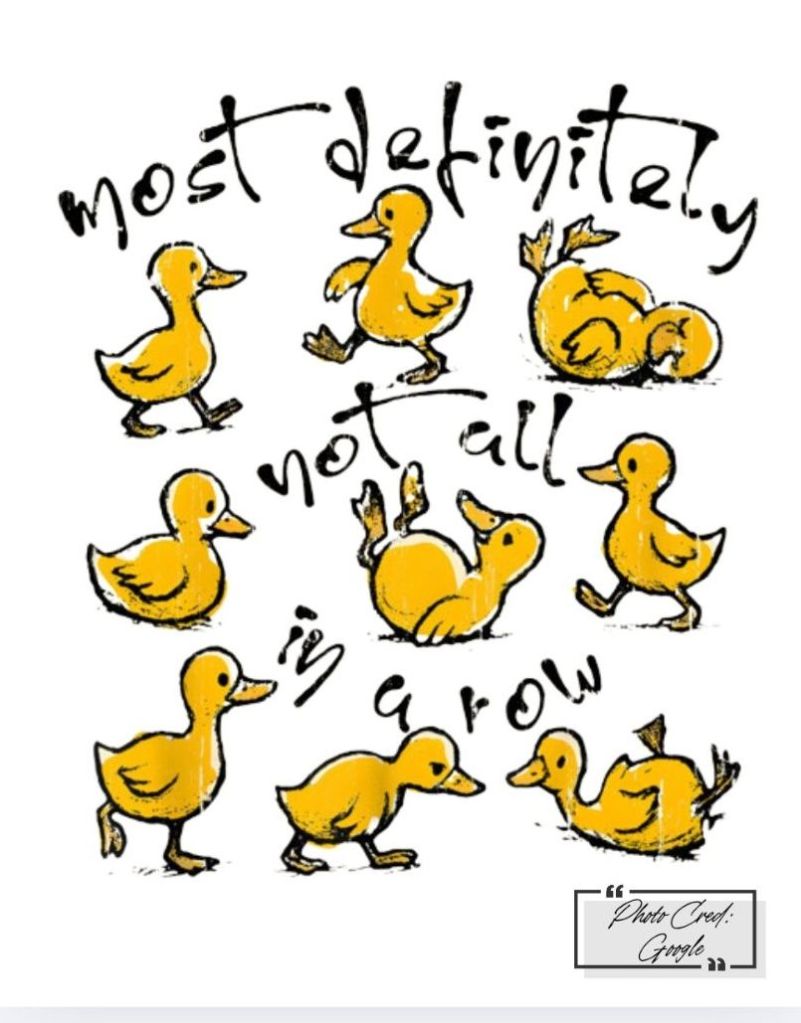
We all have heard it.
So much in fact, there’s dozens of comics that discuss these ducks and their long-standing inability to act right.
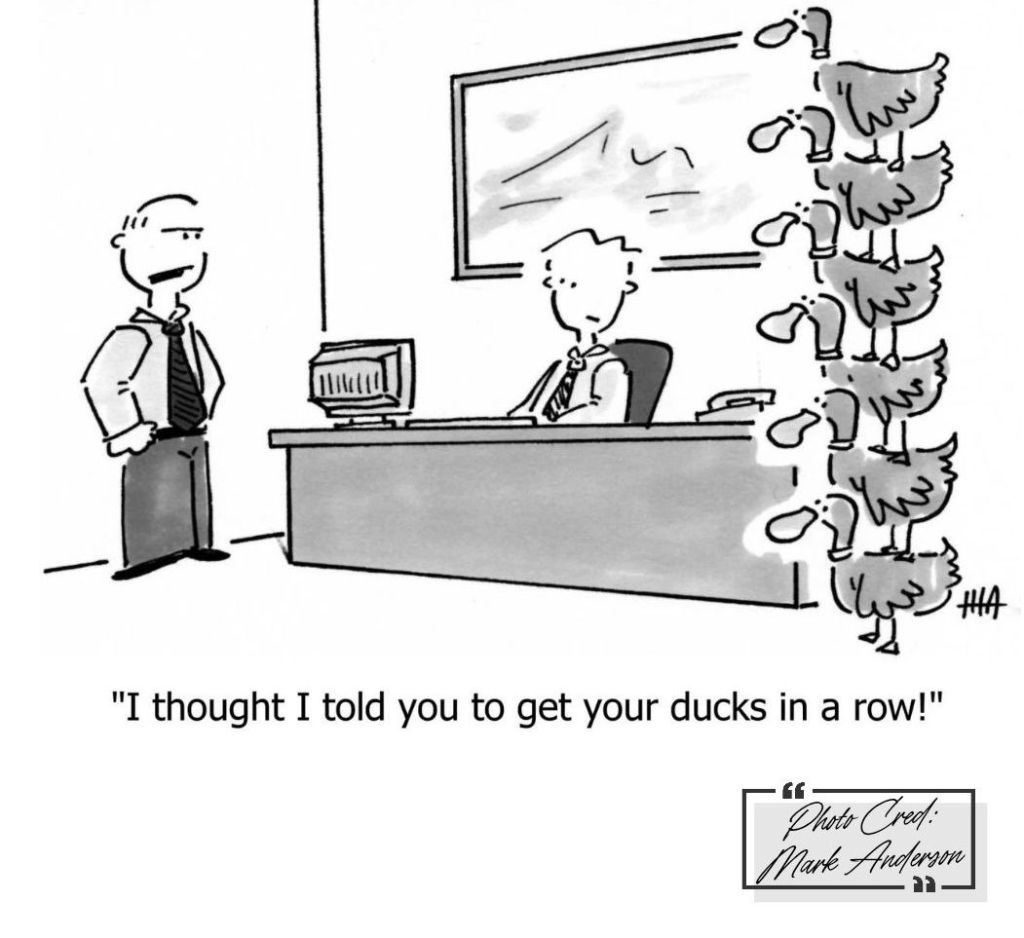
The ducks in question for this Broke & Bougie Budgeting Strategy article I don’t have to lease from anyone.
I have a decent size group of ducks already in my possession that already are long overdue for some disciplinary action.
My ducks are infamous for bumping heads and refusing to follow any directions.
Thats how we got this brilliant idea to keep them from straying too far and also keep them safe.
This ingenious piece of technology is intended to not only keep track of them but also.collectively provide better care for them in the long run.
Your ducks are long overdue for some attention.
You’ve spent years chasing those ducks in every direction, trying to convince them to cooperate.
But really, your invention is suitable for anybodys ducks, no matter the size or degree of aggression.
We all know how they respond when you attempt to contain them.
You knew this already so your approach would need to be more than just a tracking system.
And then the day comes and you get the delivery.
The prototype of your invention has arrived, finally.
You sent your sketches and all the schematics weeks ago, over to a contact overseas, so they made a physical copy of your invention.
Your prototype.
You pull out a small cylindrical box.
Inside is a tiny digital screen and nine miniature tracking bands.
Think somewhere between an AirTag, a house arrest ankle monitor, and one of those wildlife tracking collars scientists use to monitor endangered animals.
This is only the mechanism fot tracking.
As i said before, its only one piece of the puzzle.
The first phase is the gps system inside the box.
Instead of trying to manually control your ducks & fuss with them, the gps allows you to track them from afar.
At this point, those ducks have spent years wandering off in every direction.
You couldn’t even begin to guess where they go.
Anywhere except where you need them.
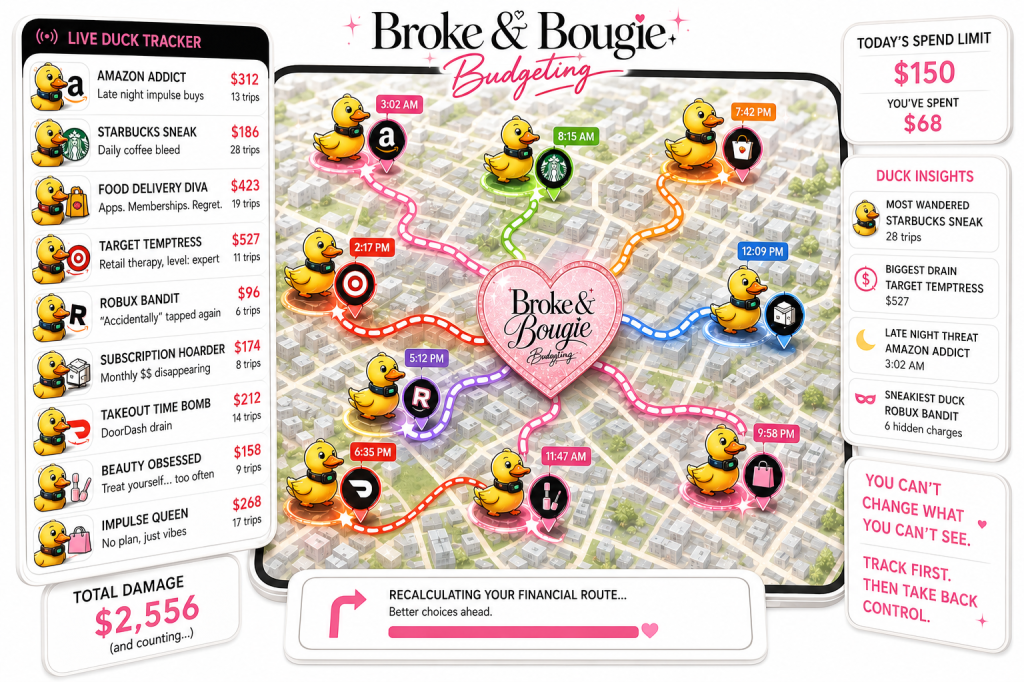
Now imagine each duck represents one of your spending habits.
One duck has a tendency to sneak onto Amazon at three in the morning and purchase unnecessary things just because they are on sale.
Another duck can’t waddle past Starbucks without somehow turning a single coffee into an almost twenty-dollar purchase.
One has developed an unhealthy relationship with food delivery apps and quietly signed you up for multiple monthly memberships that you barely even use.
Another has a Target addiction that has never once resulted in a receipt under $100.
One is secretly buying Robux six times a month because someone “accidentally” tapped the purchase button mid-game.
Individually, none of these ducks’ behaviors scream bankruptcy.
If you combine them all together, thats a different story.
Collectively, they are the reason your paycheck disappears before you even understand what happened.
A budgeting system doesn’t chain the ducks to the wall, restricting their movement and depriving them of food.
It simply just puts a tracker on each of them.
For the first time, you can see where they’ve been, how often they wander off, and which ones are causing the most trouble.
Once you can actually see the pattern, you finally have something useful to work with.
The ducks were never impossible to manage.
You just couldn’t see where they were going.
The Broke & Bougie Budgeting Bundle is basically a GPS tracking system for your ducks.
Think of it as a set of tiny tags attached to every duck in the flock.
It tells you who wandered off, where they went, how often they went there, what they came back with, and how much they took with them.
Once you can actually see the patterns, you stop chasing the ducks blindly.
You can take what you’ve observed and start managing the environment to be better equipped to manage some of these ducks’ irrational spending behaviors.
You build up a cozy pen to house them all at night, safe and secure. Install some heaters. Outside perimeter protection to warden off predators so they can sleep soundly.
Instead of spending all your time and exhausting yourself in chasing after them, you have already observed where the vulnerabilities are with each duck and you’ve thought ahead to help combat any future incidences of them roaming free and getting lost or worse, injured.
You also ceate a safer space for them to roam during the day.
What you’ve learned from tracking them closely is that you also need to design the landscape differently and more effectively.
You decide to use natural barriers instead of the obvious fences because you already know what happens when your ducks realize they’re being contained. Like any animal, they start looking for a way around it. Your ducks, in particular, can fly and would do just that the moment they came up to a fence.
You work hard to create boundaries that don’t feel like boundaries. You position things in a way that naturally discourages them from wandering into dangerous territory without making them feel trapped or controlled.
That’s the real strategy.
You aren’t following every duck around with a clipboard.
You’re observing from a distance.
You’re learning their patterns.
You’re quietly removing the dangers from the areas they naturally gravitate toward.
With your finances, the Broke & Bougie Budgeting Worksheets help you track your money more closely, so you can finally see where those little dollars are actually going.
You start noticing the expenses that used to slip under the radar, the subscriptions you forgot about, the impulse purchases that quietly add up, and the money that somehow disappears without ever having a clear assignment.
Once you can see it, you can make a decision about it.
You can reallocate that money toward bills, savings, debt, or other priorities. Or, better yet, you can give some of it a designated place in a special fund that you contribute to regularly.
That fund can be for something you actually want.
A trip. A pedicure. A new outfit. A night out. Something bougie. Something completely unnecessary and completely worth it to you.
And when the time comes to spend it, you don’t have to feel guilty.
You don’t have to justify it.
You don’t have to convince yourself that you should have been more responsible.
You already were.
You planned for it. You funded it. You gave that money a purpose.
Now you get to enjoy exactly what you designated it for.
That’s the difference between restricting your spending and intentionally creating room for the things you love.
You’ve created an environment where your money can move freely yet securely since the system around it is doing the protection.
It’s passive management.
A strategic kind of protection.
Its low visibility AND high awareness.
Because none of this is about punishing the ducks.
It’s about knowing your ducks well enough to protect them without making them feel like they’re being protected.

The goal with the B&B Budget isn’t designed to eliminate every spending habit you have.
The goal is to create healthier boundaries so your money naturally stays where you intended it to go.
Many people think that the moment a budget is suggested, it’s because you’ve proven yourself to be irresponsible, impulsive, or incapable of managing your own money.
It’s been thought by those same people that creating a budget is kind of like a financial probation that’s designed to keep you from making bad decisions.
That couldn’t be further from the truth.
What most people fail to realize is that budgeting isn’t a one-size-fits-all kind of thing.
People with millions of dollars even budget their money.
In fact, there are countless types of budgets because there are countless reasons to create one.
Some budgets might be built around a single goal.
Some are designed for a special occasion.
Others are created for an important life milestone, like preparing for a new baby, buying a car, planning a wedding, taking a vacation, or saving for a down payment on a home.
A budget is simply a plan with your money that has a purpose attached to it.
You most certainly don’t have to be bad with money to benefit from one.
And you certainly don’t have to wait until you’re in such deep doo doo that one unexpected expense has the power to wipe out the fragile sense of stability you’ve been tiptoeing across.
Budgeting isn’t just about surviving financial hardship.
It’s about preparing for opportunities, protecting your peace of mind, and giving every dollar a job before life decides to assign it one for you.
It’s a way of telling your money where to go instead of wondering where it went.
Somehow, we’ve allowed it to become associated with the struggle and living in survival mode when the real purpose has always been the exact opposite.
That’s just as incorrect as believing someone with six figures in their checking account don’t need a financial plan.
The amount of money you have in your account shouldn’t eliminate the need to manage it.
It simply changes the scale.
People don’t get into financial trouble because of one massive purchase.
They get there through hundreds of tiny decisions they barely remember making.
Those are the numbers that deserve your attention.
If your spending habits have been running around like free-range ducks for years, don’t you think it’s time to figure out which one keeps emptying your wallet?
Because ignoring it doesn’t make the problem disappear.
It simply makes you an unwilling accomplice to your own financial chaos.
So tell me now, is budgeting really the villain here?
Or is it simply shining the light on where you need to look?
Budgeting is meant to reveal to you exactly where everything has been going and how you can go about correcting it.
Maybe you think a budget will be too restrictive, overwhelming, and a little depressing.
You are allowed to feel the way you feel, of course.
We aren’t expecting you to change your mind just because we told you to.
The only thing we ask of you to do is do something different today.
All we ask of you is to put all your previous opinions and assumptions about budgeting to the side.
I mean, honestly, what is the risk of trying something different?
Nothing.
What could you possibly gain from budgeting?
There’s no telling just how beneficial it could be or how much it can complement your life.
There really is no downside to incorporating a budget in your life.
Even if you’re not ready to start today, that’s okay. We’re not mad at you for not jumping right into it.
Like we said before, all we’re asking after you read this article is that you keep an open mind.
Don’t let what you’ve previously believed about budgeting automatically convince you that this isn’t for you.
Maybe you’re not ready today.
Maybe you won’t be ready next month.
That’s fine.
Just leave the door open.
Because one day, when you’re ready to take a closer look at your money, we want you to remember that budgeting doesn’t have to mean restriction, deprivation, or feeling guilty every time you spend.
Maybe it can look different than what you thought.
And maybe it’s worth exploring when you’re ready.
It could really bring you the exact structure & organization you need to allow more flexibility.
Included in this article, we have included the Broke & Bougie Budgeting Worksheets free for you to download, save, and print. Print right after you finish reading or bookmark and save for later to do.
There are a few different budgeting options below, and I’ll break down each worksheet so you can see exactly who it’s designed for, what it helps you accomplish, and when you might want to use it.
And honestly, if I were you, I’d print the whole bundle.
You don’t have to implement every worksheet at once. Keep the entire bundle somewhere you can easily access it, because different financial situations call for different tools.
You might not need a particular worksheet today, but six months from now, it could be exactly what you need.
Think of the bundle as having a financial toolbox available before you actually need the tool.
When the right opportunity, goal, expense, or financial situation comes up, you already have the worksheet ready to put into action.
No scrambling. No starting from scratch.
Just pick the one that fits what you’re trying to accomplish and start there.
What provoked me to write this article was simply paying attention.
I kept seeing people from my generation and the generations after us becoming increasingly vocal about their financial struggles, especially online. And the people I know personally have expressed their frustrations with money to me repeatedly over the past several years.
Eventually, I started asking myself, “Okay, what can I actually do about this?”
I wanted to help in the best way I knew how.
But I didn’t want to create another generic budgeting system built around the assumption that everyone lives the same kind of life, earns the same kind of money, or has the same financial priorities.
I also didn’t want to create something that intimidated people who were already unsure about budgeting.
Because if your budgeting system is so restrictive that every purchase outside of a basic necessity makes you feel guilty, eventually you’re going to stop using the system altogether.
And honestly, I think that’s where a lot of budgeting advice misses the mark.
People are constantly told what they shouldn’t spend money on, what they need to cut, what they need to sacrifice, and what they should be willing to live without.
But very rarely do we talk about what happens when you work hard, make responsible choices, and still want to enjoy some of the money you earned.
I wanted to create something different.
I wanted to create a budgeting system that felt empowering instead of punishing.
Something that helped you understand where your money was actually going without making you feel ashamed for wanting to spend some of it on things that aren’t technically considered “needs.”
Because people need to see something beyond simply paying bills and surviving.
There needs to be room for enjoyment.
There needs to be room for the things that make working this hard feel worth it.
You shouldn’t have to deprive yourself of every little thing that brings you joy simply because it doesn’t qualify as a mandatory expense.
The goal isn’t to convince you that you shouldn’t want anything.
The goal is to understand your money well enough to make room for what you want without sabotaging what you need.
That distinction matters.
Financial responsibility and quality of life are not opposites.
They can absolutely coexist.
You can be responsible with your money and still buy the damn pedicure.
You can build your emergency fund and still save for a vacation.
You can pay your bills, plan for the future, and still have money set aside for the things that make you happy.
The trick is making those choices intentionally instead of accidentally.
That’s exactly what I set out to create with the Broke & Bougie Budget.
A system that helps you get honest about your money without making you miserable about having it.
Because budgeting shouldn’t make you feel like you’re being punished for wanting a life.
It should help you build one you can actually afford to enjoy.
That’s where I came up with the idea of Broke & Bougie Budgeting.
Only someone who’s been broke can fully understand how easy it is to be both broke and bougie.
Because being broke doesn’t automatically mean you don’t have expensive taste, big desires, or a love for the finer things.
Sometimes you can be financially struggling and still want the pedicure, the nice dinner, the cute outfit, the vacation, or whatever little luxury makes life feel less like an endless cycle of bills.
That’s the whole point of being Broke & Bougie.
It’s not about pretending you have money you don’t have.
It’s about learning how to make room for the things you enjoy, even when your financial reality requires you to be strategic about it.
You can’t even fully explain it in a way that makes sense to someone who has never experienced it.
But if you know, you know.
And believe me, there’s no shame in liking nice things.
There’s no shame in having certain brands you trust, knowing exactly what works for you, and refusing to spend your hard earned money on something you already know you won’t be satisfied with.
Sometimes it isn’t even about being flashy or trying to impress anybody.
You simply know what you like.
You know what fits better, lasts longer, performs better, feels better, or gives you the experience you actually want.
And when you’ve learned that lesson the hard way, you’d rather go without than spend money settling for something you already know isn’t going to work for you.
That’s the part people don’t always understand about being Broke & Bougie.
You can be financially conscious and still have standards.
You can be broke and still know the difference between what you want and what you’re willing to settle for.
Sometimes, the bougie part isn’t about having money.
It’s about knowing what you value.
The worksheets included in this download were created with different people, financial situations, and income levels in mind.
Some are for people who are no strangers to the occasional financial catastrophe. You know who you are. The unexpected bill shows up, the emergency happens, something breaks, and suddenly the budget you thought you had is fighting for its life.
Others were created for people who have spent years putting off budgeting because it always felt overwhelming, restrictive, confusing, or maybe even like it was too late to make a difference.
It isn’t.
In just a moment, I’ll walk you through each budgeting system, explain how it works, what it’s designed to accomplish, and help you figure out which one makes the most sense for the season of life you’re currently in.
You may find that one worksheet is exactly what you need right now. You may find that another becomes useful later. And that’s completely fine.
Although each worksheet serves a different purpose, they all share the same philosophy.
This isn’t about sitting down with a calculator and punishing yourself for every financial mistake you’ve ever made.
It isn’t about dwelling on the money you lost, the decisions you wish you had made differently, the debt you accumulated, or the years you spent avoiding your finances.
You can acknowledge all of that without allowing it to become the identity of your financial future.
This is about giving yourself permission to start fresh.
Every budget you create is another opportunity to take control, make intentional decisions, and redirect your money toward the life you’re actually trying to build.
Your past financial decisions can explain how you got here.
They don’t get to decide where you go next.
The goal is to create a financial future that reflects where you’re going, not where you’ve been.
Over the next 30 days, no matter the budgeting plan that you choose, you’ll track your dollars closely after payday, identify unnecessary spending, reallocate money toward higher priorities, and, if possible, begin building an emergency fund that provides real peace of mind.
These worksheets aren’t designed to make you feel bad, nor are we judging you.
In fact, we use them ourselves!
I don’t know if it is something that resonates with you or not.
Only you do.
It can absolutely stay that way, too.
I say that because literally no one else has to know you’re budgeting!
You don’t need to pick up a second job just to afford a financial advisor anymore.
You can start taking a more active role in managing your money yourself, with tools designed to help you understand what’s coming in, where it’s going, and what you can realistically do with what you have.
The goal isn’t to replace professional financial advice when you genuinely need it. It’s to give you a practical starting point so you aren’t completely dependent on someone else to tell you what’s happening with your own money.
You also don’t need to announce your goals or explain your spending habits to anyone else.
This is your journey, and you can quietly take back control of your finances without inviting opinions from people who won’t experience the consequences of your decisions.
As you familiarize yourself with how to budget, you sort of become your own financial advisor.
You’ll begin developing skills that extend far beyond paying bills.
You’ll learn how to create budgets for vacations, holidays, home improvements, vehicle purchases, moving expenses, investments, birthdays, and every other milestone that once felt financially out of reach.
Eventually, budgeting stops feeling like restriction and starts creating freedom.
You’ll know exactly what you can spend money on because you have already made the decision ahead of time.
When it’s finally time to take that trip, buy something you’ve wanted, or enjoy a night out, you won’t feel guilty anymore.
You’ll enjoy it so much more because it was part of the plan all along.
The best part is that getting started costs you absolutely nothing.
These worksheets, like so many in my blog, are completely free.
Ask yourself this.
What does it cost you not to do it?
Nothing, it’s free!
Every month that goes by that you delay is another month of wondering whether one unexpected bill could derail everything.
It’s another month of carrying unnecessary stress, second-guessing purchases, and hoping nothing goes wrong.
This is your opportunity to change that.
Once you begin seeing progress, something unexpected happens.
The financial stress that once consumed your thoughts begins to disappear.
You make decisions with confidence.
You move through life with less anxiety because you’re no longer one unexpected expense away from disaster.
That peace of mind spreads into every part of your life.
If you discover that these worksheets helped you build the financial foundation you once hoped you’d have, then don’t keep that feeling to yourself.
You’re permitted to share the budgeting bundle with as many people as you want.
If you know someone who has been struggling with their finances, avoiding budgeting, or simply wishing they had a better system in place, pass it along.
Sometimes, the thing that helps someone finally get their money together isn’t another lecture about financial responsibility.
It’s simply having the right tools in front of them when they’re finally ready to use them.
Sometimes, all it takes is one small decision to completely change the direction of someone’s future.
Maybe today, that someone is you.
It was designed for people who want to get their finances together without sacrificing their personality.
Whether you’re paying off debt, building savings, surviving paycheck to paycheck, or simply trying to figure out where your money disappears every month, these printables are here to make budgeting feel less like punishment and more like self care.
Now, for the worksheets.
Below, is an image of what the bundle will look like in its entirety once you download it
(The download for the whole bundle is at the bottom of the post)
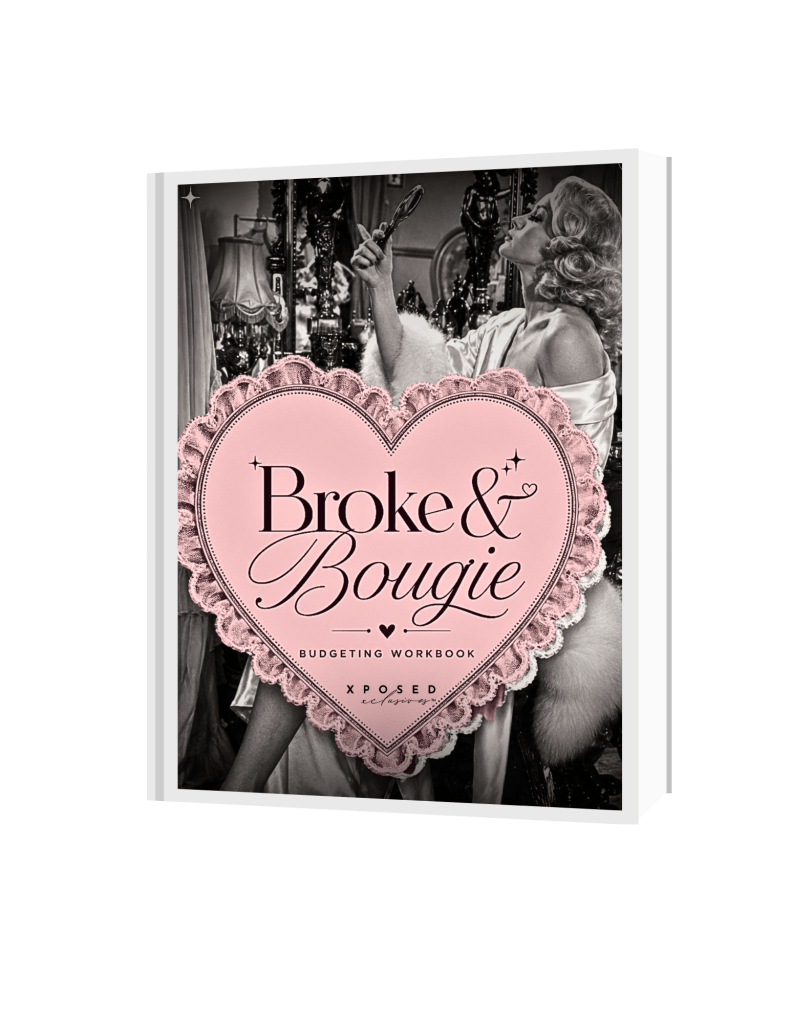
Now, let’s begin breaking down each worksheet bundle so you are able to determine which one is best suited for you and your current financial goals.
The first worksheet in the bundle is called
The Budget Creator Spending Plan & Tracker (Monthly)
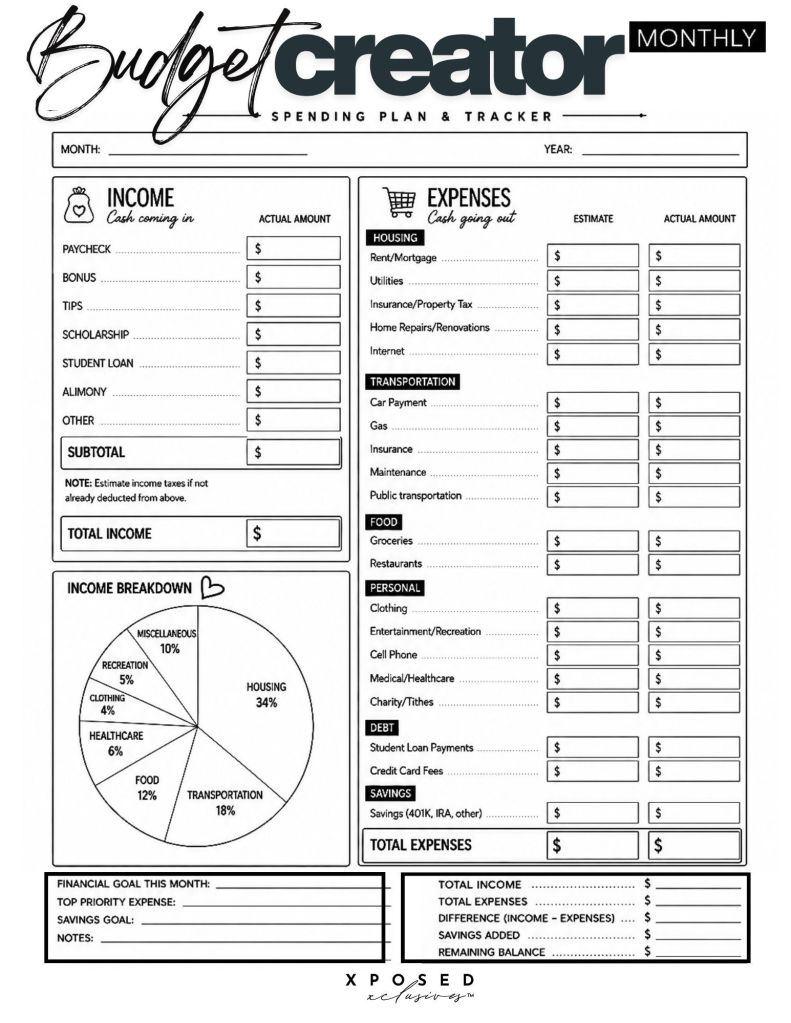
This is for the person who wants to stop reacting to their finances after the bills arrive and start deciding where their money is going before the month has a chance to spend it for them.
The Monthly Budget Creator helps you build a realistic financial plan around your actual income, expenses, priorities, and goals. Whether you’re creating a budget from scratch for the first time, managing a household, dealing with fluctuating expenses, or simply tired of wondering where your paycheck disappeared to, this worksheet gives you a structured place to figure it out.
You’ll map out your income from multiple sources, organize your expected expenses, establish your monthly financial priorities, and assign your money a purpose before you spend it. Then, as the month unfolds, you can compare what you planned to what actually happened.
That estimated versus actual comparison is where this worksheet becomes especially useful.
Instead of simply recording what you spent after the fact, you begin learning how accurately you can predict your own financial behavior. You’ll start seeing where you consistently underestimate expenses, where you tend to overspend, where you have more flexibility than you realized, and which categories may need to be adjusted.
Over time, your budget becomes less about guessing and more about knowing.
The worksheet also includes organized spending categories for your major expenses, monthly financial goals and priorities, a spending percentage chart that helps you visualize how your income is being distributed, and a monthly summary that allows you to see where your money ultimately went.
That makes the Monthly Budget Creator different from a basic expense tracker.
An expense tracker tells you where your money went.
The Budget Creator asks you where you want it to go first.
That small distinction changes the entire mindset.
Instead of waiting until the end of the month to discover that you spent more than you intended, you have the opportunity to make intentional decisions before the spending happens. You can identify potential problems ahead of time, make adjustments, create room for your priorities, and reduce the amount of money that disappears through impulse spending or unplanned expenses.
And if you’ve ever said, “I make enough money, but I have absolutely no idea where it goes,” this is probably the worksheet you want to start with.
It’s especially useful for planners, goal oriented budgeters, first time budgeters, families, individuals with inconsistent or fluctuating expenses, and anyone who wants to stop hoping their money will somehow work itself out and start giving it an actual assignment.
The goal isn’t to control every penny just for the sake of controlling it.
The goal is to understand your money well enough that you can make decisions with it instead of constantly wondering where it went.
The next worksheet in the bundle is called
Broke & Bougie Budgeting Worksheet
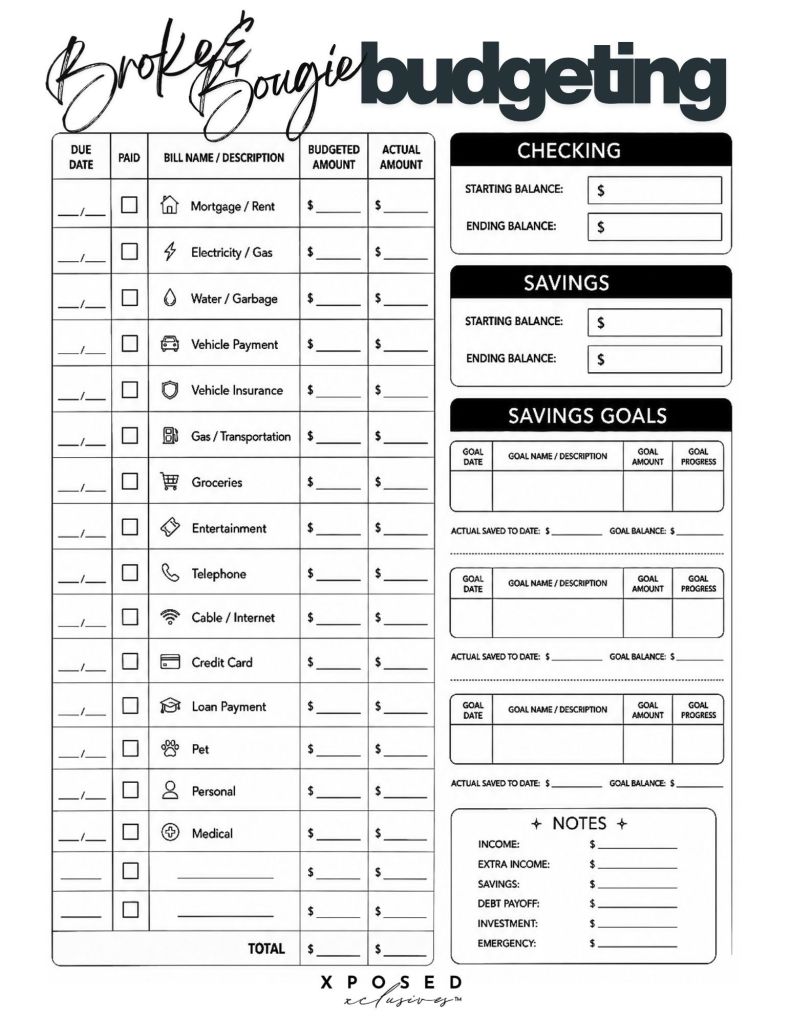
This is the worksheet for people who are ready to stop wondering where their paycheck went and start knowing exactly where every dollar is going.
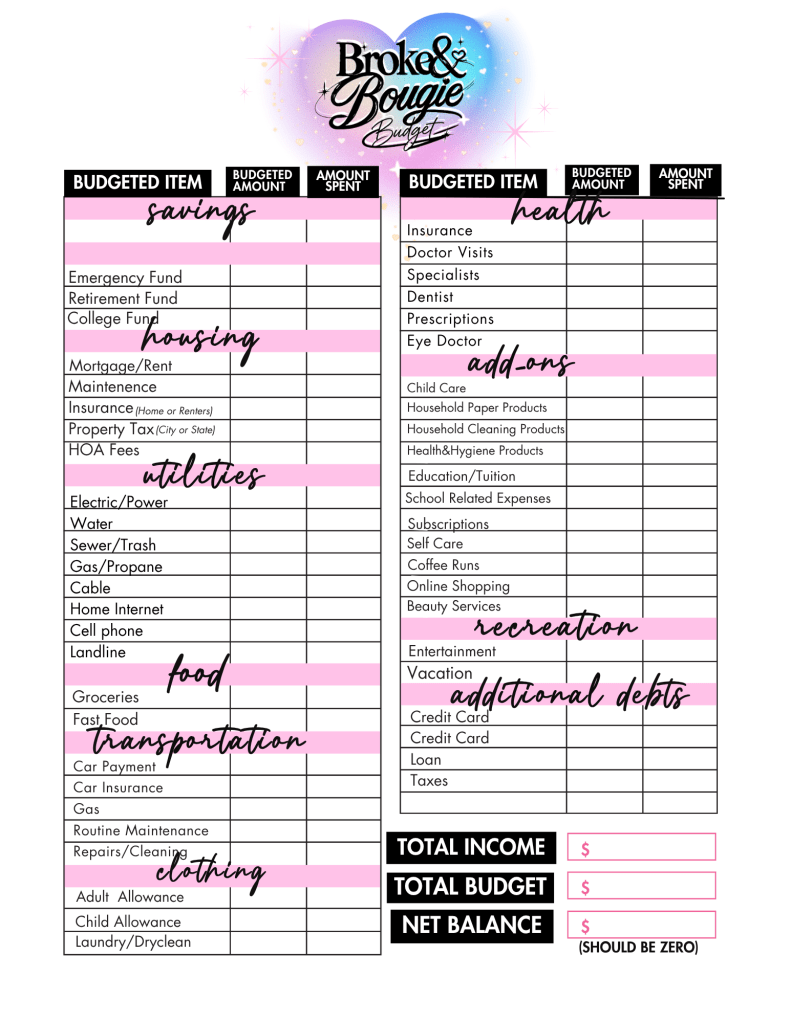
The Broke & Bougie Budgeting Worksheet takes the idea of intentional spending a step further by using a true zero based budgeting approach. Every dollar of your expected income is assigned a purpose before it leaves your bank account.
That doesn’t mean every dollar has to go toward a bill, debt, or some traditionally “responsible” expense.
This is where the Broke & Bougie philosophy comes in.
Your money should have a job, but that job can include enjoying your life.
The worksheet breaks your finances into detailed lifestyle categories so you can see the entire picture in one organized layout. You can account for savings, housing, utilities, transportation, food, clothing, healthcare, child related expenses, personal care, entertainment, debt payments, and the everyday expenses that tend to get forgotten when you’re trying to create a budget from memory.
It gives those expenses somewhere to go before they have the opportunity to sneak up on you.
You’ll be able to see exactly how much income you have available, how much you’re assigning to each category, and whether your planned spending actually adds up to the money you have coming in.
That visibility matters.
Because sometimes the problem isn’t that you’re spending money on the wrong things.
You simply haven’t been able to see the whole picture at once.
Once everything is laid out in front of you, spending patterns become easier to recognize. You can identify spending leaks, notice categories that consistently consume more money than expected, adjust your priorities, and redirect money toward the areas that matter most to you.
Maybe you need to save more.
Maybe you’re trying to pay down debt.
Maybe you need to prepare for an upcoming expense.
Maybe you’re trying to build an emergency fund.
Or maybe you simply want to know that there is money intentionally set aside for the things you enjoy instead of feeling guilty every time you spend it.
That’s what makes this worksheet different.
It isn’t designed to make you afraid of spending.
It’s designed to make your spending visible.
When every dollar has a purpose, you can spend with more confidence because you know what that money was intended to do.
And when you notice that you’re making progress in a category, you get to actually see it.
This worksheet is especially useful for people who enjoy organization, like planning ahead, want greater visibility into their finances, or are serious about building healthier financial habits.
It’s also for anyone who has ever looked at their bank account and thought, “Where the hell did all my money go?”
The Broke & Bougie Budgeting Worksheet helps answer that question.
Not by telling you that you can’t have the things you want, but by helping you figure out how to afford them intentionally.
Because every dollar should have a job.
And sometimes, that job is paying the light bill.
Sometimes it’s building your savings.
And sometimes, it’s making sure you have enough money set aside to enjoy the damn pedicure without feeling guilty about it.
The next worksheet in the bundle is Financial Triage, an in-depth financial assessment designed to give you a complete picture of the money coming into and going out of your household each month.
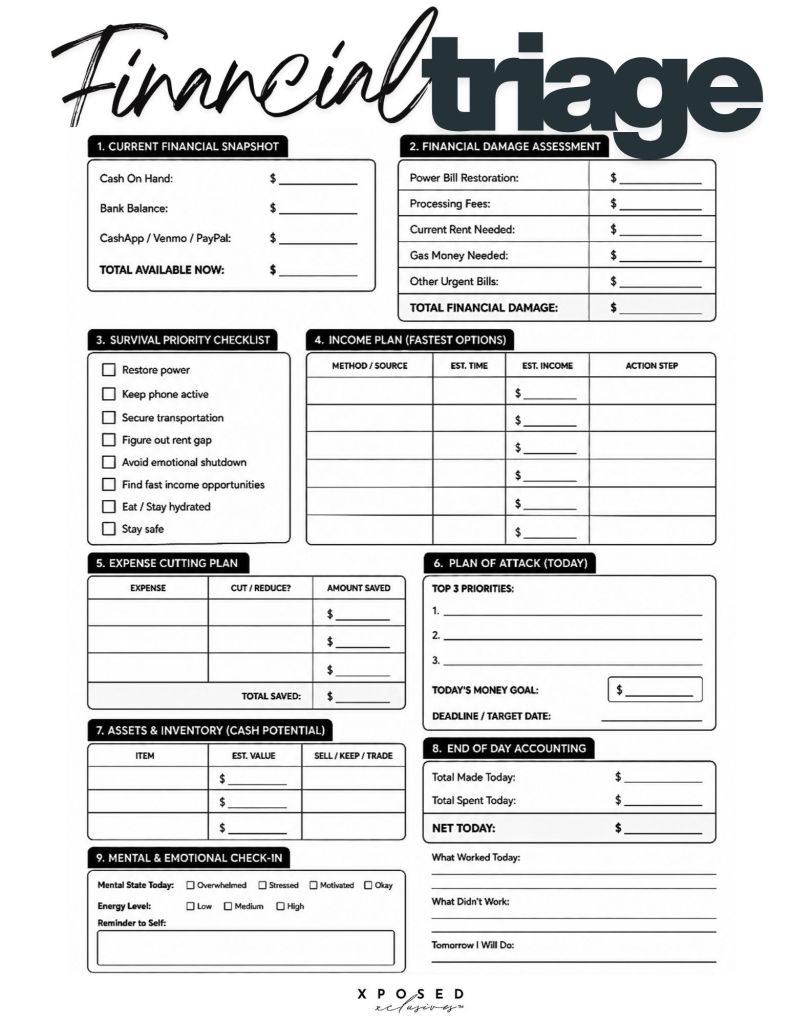
This worksheet is for financial emergencies, job loss, unexpected expenses, reduced income, overwhelming debt, or anyone who feels like they’re constantly trying to survive from one paycheck to the next.
Financial Triage is different from a traditional budgeting worksheet because it wasn’t created for people whose finances are running smoothly.
It was created for the moments when life throws everything off course and simply making a budget isn’t enough.
When you’re in financial crisis, your priorities change.
You aren’t necessarily thinking about retirement contributions, long term savings goals, or optimizing your spending percentages.
You’re thinking, “What do I need to do right now?”
Financial Triage helps you answer that question.
Instead of spending your energy analyzing where your money went last month, this worksheet helps you assess your current situation and determine what needs your attention first.
It gives you a structured way to slow down, take inventory, and make thoughtful decisions instead of reacting from fear, panic, or financial exhaustion.
You’ll assess how much money you actually have available right now, identify which bills and expenses are truly essential, determine what financial damage needs immediate attention, and look for expenses that can be delayed, reduced, negotiated, or eliminated.
You’ll also examine what resources you already have available.
Are there items you could sell to generate quick cash?
Are there opportunities to bring in additional income?
Are there expenses you can temporarily pause?
What needs to happen tomorrow?
What needs to happen next week?
And what can wait until you’ve stabilized?
Those questions matter because when everything feels urgent, it becomes incredibly difficult to determine what is actually urgent.
Financial Triage helps you separate the two.
One of the most important parts of this worksheet is the emotional check-in.
Financial stress doesn’t just affect your bank account. It can affect your judgment.
When you’re overwhelmed, you may avoid opening your bills, make impulsive decisions, spend money for temporary relief, shut down completely, or convince yourself that there’s no point trying because the situation already feels too far gone.
The emotional check-in gives you a moment to acknowledge where your head is before making decisions that could affect your finances.
You’re not being asked to ignore your emotions.
You’re being asked to recognize them so they don’t quietly make the decisions for you.
Financial Triage is designed to bring structure to financial chaos.
It helps you prioritize limited resources, identify the problems that require immediate action, create a realistic short-term action plan, and begin rebuilding your sense of control.
This isn’t the worksheet you pull out when everything is going perfectly.
This is the one you reach for when everything has gone sideways.
It’s for the person thinking, “I’m not trying to build wealth right now. I’m just trying to stop the bleeding long enough to get back on my feet.”
And there’s nothing wrong with that.
Sometimes, the first financial goal isn’t growth.
It’s stabilization.
Financial Triage meets you exactly where you are and helps you create a practical roadmap for getting through the immediate crisis so you can eventually move from surviving to planning and from planning to building.
One of the most important features of this worksheet is emotional check-in. Financial stress often leads to impulsive decisions, avoidance, shame, or complete paralysis. Before making important financial choices, you’ll have an opportunity to acknowledge your emotional state, recognize how it may be influencing your judgment, and approach your next steps with greater clarity and confidence.
The next part in the bundle isnt a sungle worksheet but a mini sort of bundle within the bundle that provides yet another approach to budgeting still separate from the worksheets above.
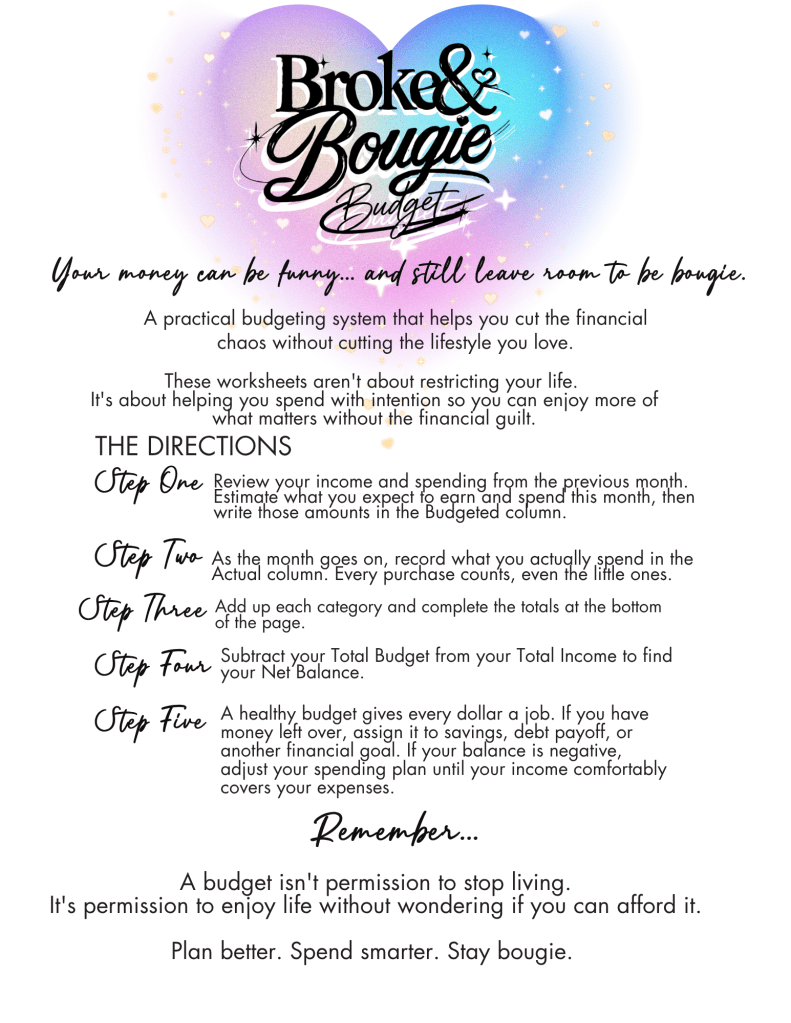
Broke & Bougie Budget Workbook
(Pages One & Two)
Best for:
The next resource in the bundle is the Broke & Bougie Budget Workbook, a comprehensive monthly budgeting system designed for people who are ready to understand and manage every area of their financial life.
This workbook is ideal for individuals, couples, and families who are ready to move beyond simply paying bills and start managing their money with intention.
The philosophy behind the workbook is simple.
Every dollar should have a destination before it’s ever spent.
Instead of reaching the end of the month wondering where your paycheck disappeared to, you’ll have a complete picture of where your money is supposed to go before you spend it.
This creates a true zero based budget, giving every dollar a purpose while giving you greater visibility into your overall financial picture.
Unlike basic budgeting worksheets that throw expenses into a handful of broad categories, the Broke & Bougie Budget Workbook breaks your finances down into detailed sections that actually reflect real life.
Your mortgage has a place.
Your morning coffee has a place.
Your emergency fund has a place.
Your online shopping habit has a place.
Even the expenses you might normally forget about have somewhere to be accounted for.
That level of detail makes it much easier to recognize patterns that might otherwise stay hidden.
You may discover that one small expense isn’t really the problem, but several small expenses happening repeatedly are quietly draining hundreds of dollars each month.
You may realize that you’re spending more than you thought in one category while consistently underspending in another.
You may even discover that you have more financial flexibility than you realized.
The workbook includes dedicated categories for savings, emergency funds, retirement contributions, housing, utilities, transportation, food, clothing, healthcare, child related expenses, household supplies, subscriptions, personal care, recreation, vacations, debt payments, taxes, and adjustable expenses.
There’s also space to create your own categories based on your lifestyle, priorities, and financial goals.
Because your budget should reflect your actual life, not somebody else’s version of what your life is supposed to look like.
Throughout the month, you’ll record both what you planned to spend and what you actually spent.
That comparison is important.
Your budget tells you what you intended to do.
Your actual spending tells you what really happened.
When you compare the two, you begin learning your own financial patterns. You can see where you consistently overspend, where you’re saving more than expected, where your estimates need adjusting, and which habits may be quietly affecting your financial goals.
At the end of the worksheet, you’ll total your income, total your budgeted expenses, and calculate your remaining balance.
The goal is for that balance to reach zero.
But zero does not mean you spent every dollar.
It means every dollar was intentionally assigned somewhere.
Maybe it went toward your mortgage.
Maybe it went into savings.
Maybe it went toward retirement.
Maybe it went toward paying off debt.
Maybe it was intentionally set aside for a vacation, personal care, entertainment, or something else you value.
The point is that your money shouldn’t disappear without explanation.
It should be working toward something.
And this workbook isn’t built around restrictive spending.
It’s built around mindful spending.
It doesn’t tell you that you need to eliminate everything you enjoy in order to become financially responsible.
If shopping, beauty services, vacations, coffee runs, restaurants, hobbies, or entertainment matter to you, those things can have a place in your budget too.
Because the goal isn’t to create a life where you’re financially responsible but miserable.
The goal is to create enough awareness and intention around your money that you can enjoy the things you love without constantly wondering whether you can actually afford them.
Financial freedom isn’t about never spending money on anything fun.
It’s about knowing what you can afford, planning for it, and spending without the guilt and uncertainty that comes from having no idea where your money went.
If you’ve ever reached the end of the month staring at your bank account thinking, “Where the hell did my paycheck go?”
This workbook is designed to give you the answer.
It transforms your finances from a collection of random transactions into an organized financial plan that accounts for your responsibilities, your goals, your priorities, and yes, even the life you actually want to live.
Because being financially responsible shouldn’t require you to stop being Broke & Bougie.
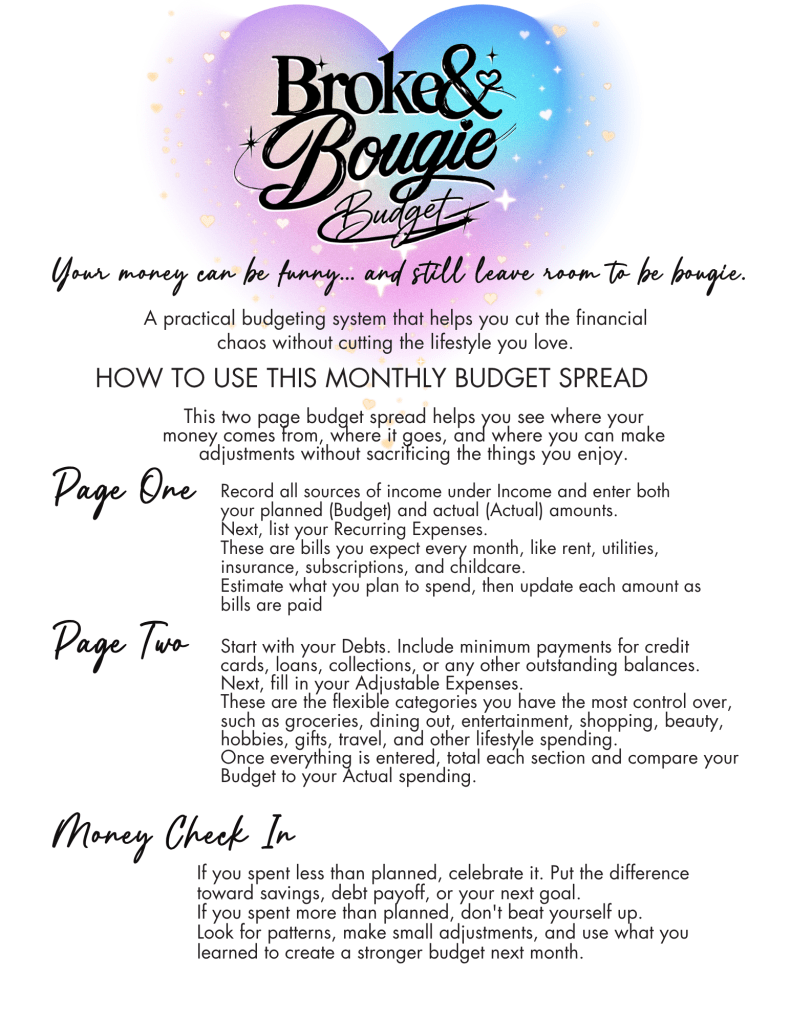
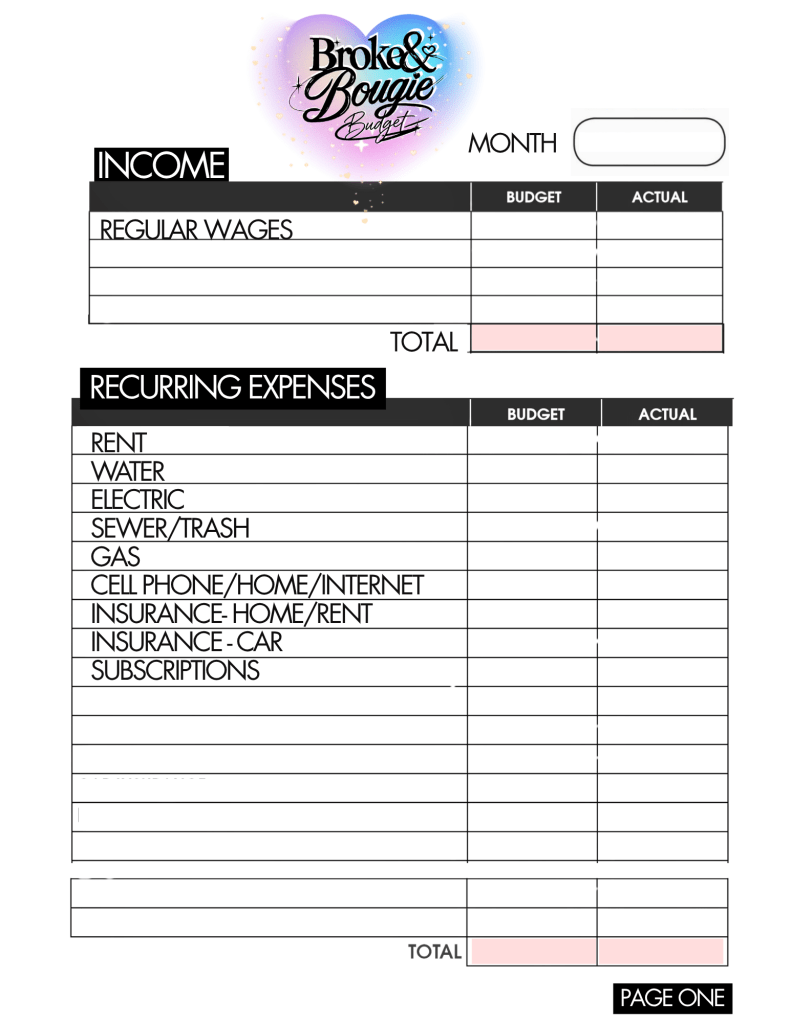
Then last but not least, the bundle within a bundle, The Broke & Bougie Budget Plan.
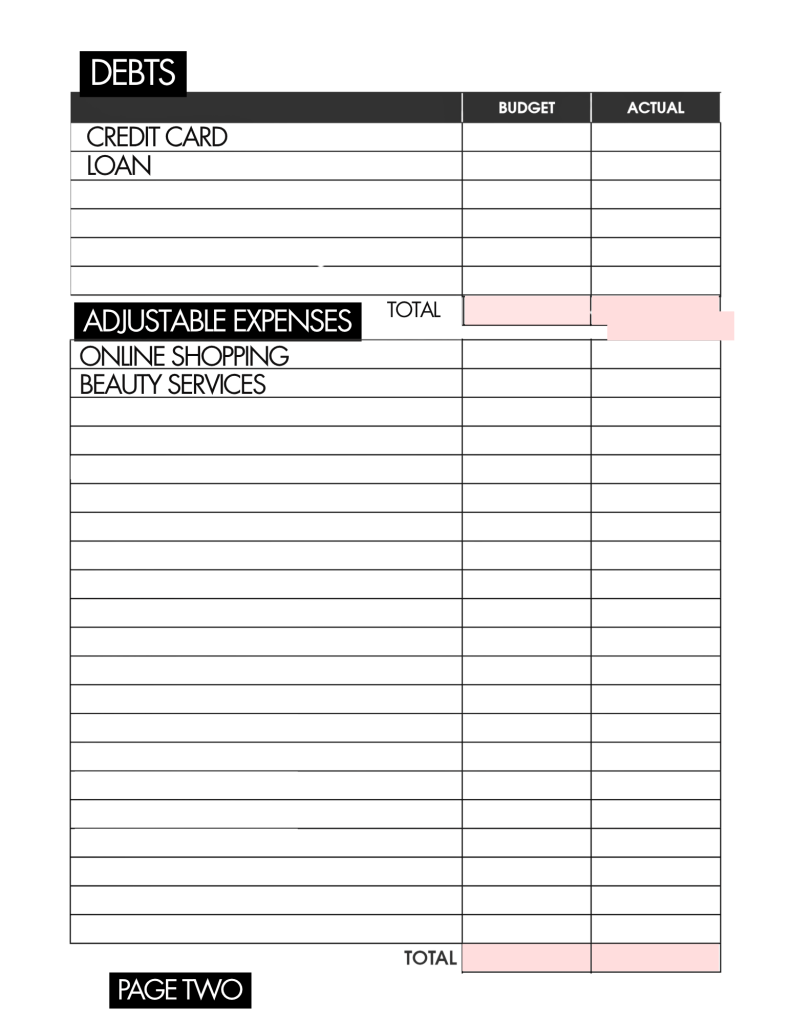
The next resource in the bundle is the Broke & Bougie Budget Workbook, a comprehensive monthly budgeting system designed for people who are ready to understand and manage every area of their financial life.
This workbook is ideal for individuals, couples, and families who are ready to move beyond simply paying bills and start managing their money with intention.
The philosophy behind the workbook is simple.
Every dollar should have a destination before it’s ever spent.
Instead of reaching the end of the month wondering where your paycheck disappeared to, you’ll have a complete picture of where your money is supposed to go before you spend it.
This creates a true zero based budget, giving every dollar a purpose while giving you greater visibility into your overall financial picture.
Unlike basic budgeting worksheets that throw expenses into a handful of broad categories, the Broke & Bougie Budget Workbook breaks your finances down into detailed sections that actually reflect real life.
Your mortgage has a place.
Your morning coffee has a place.
Your emergency fund has a place.
Your online shopping habit has a place.
Even the expenses you might normally forget about have somewhere to be accounted for.
That level of detail makes it much easier to recognize patterns that might otherwise stay hidden.
You may discover that one small expense isn’t really the problem, but several small expenses happening repeatedly are quietly draining hundreds of dollars each month.
You may realize that you’re spending more than you thought in one category while consistently underspending in another.
You may even discover that you have more financial flexibility than you realized.
The workbook includes dedicated categories for savings, emergency funds, retirement contributions, housing, utilities, transportation, food, clothing, healthcare, child related expenses, household supplies, subscriptions, personal care, recreation, vacations, debt payments, taxes, and adjustable expenses.
There’s also space to create your own categories based on your lifestyle, priorities, and financial goals.
Because your budget should reflect your actual life, not somebody else’s version of what your life is supposed to look like.
Throughout the month, you’ll record both what you planned to spend and what you actually spent.
That comparison is important.
Your budget tells you what you intended to do.
Your actual spending tells you what really happened.
When you compare the two, you begin learning your own financial patterns. You can see where you consistently overspend, where you’re saving more than expected, where your estimates need adjusting, and which habits may be quietly affecting your financial goals.
At the end of the worksheet, you’ll total your income, total your budgeted expenses, and calculate your remaining balance.
The goal is for that balance to reach zero.
But zero does not mean you spent every dollar.
It means every dollar was intentionally assigned somewhere.
Maybe it went toward your mortgage.
Maybe it went into savings.
Maybe it went toward retirement.
Maybe it went toward paying off debt.
Maybe it was intentionally set aside for a vacation, personal care, entertainment, or something else you value.
The point is that your money shouldn’t disappear without explanation.
It should be working toward something.
And this workbook isn’t built around restrictive spending.
It’s built around mindful spending.
It doesn’t tell you that you need to eliminate everything you enjoy in order to become financially responsible.
If shopping, beauty services, vacations, coffee runs, restaurants, hobbies, or entertainment matter to you, those things can have a place in your budget too.
Because the goal isn’t to create a life where you’re financially responsible but miserable.
The goal is to create enough awareness and intention around your money that you can enjoy the things you love without constantly wondering whether you can actually afford them.
Financial freedom isn’t about never spending money on anything fun.
It’s about knowing what you can afford, planning for it, and spending without the guilt and uncertainty that comes from having no idea where your money went.
If you’ve ever reached the end of the month staring at your bank account thinking, “Where the hell did my paycheck go?”
This workbook is designed to give you the answer.
It transforms your finances from a collection of random transactions into an organized financial plan that accounts for your responsibilities, your goals, your priorities, and yes, even the life you actually want to live.
Because being financially responsible shouldn’t require you to stop being Broke & Bougie.
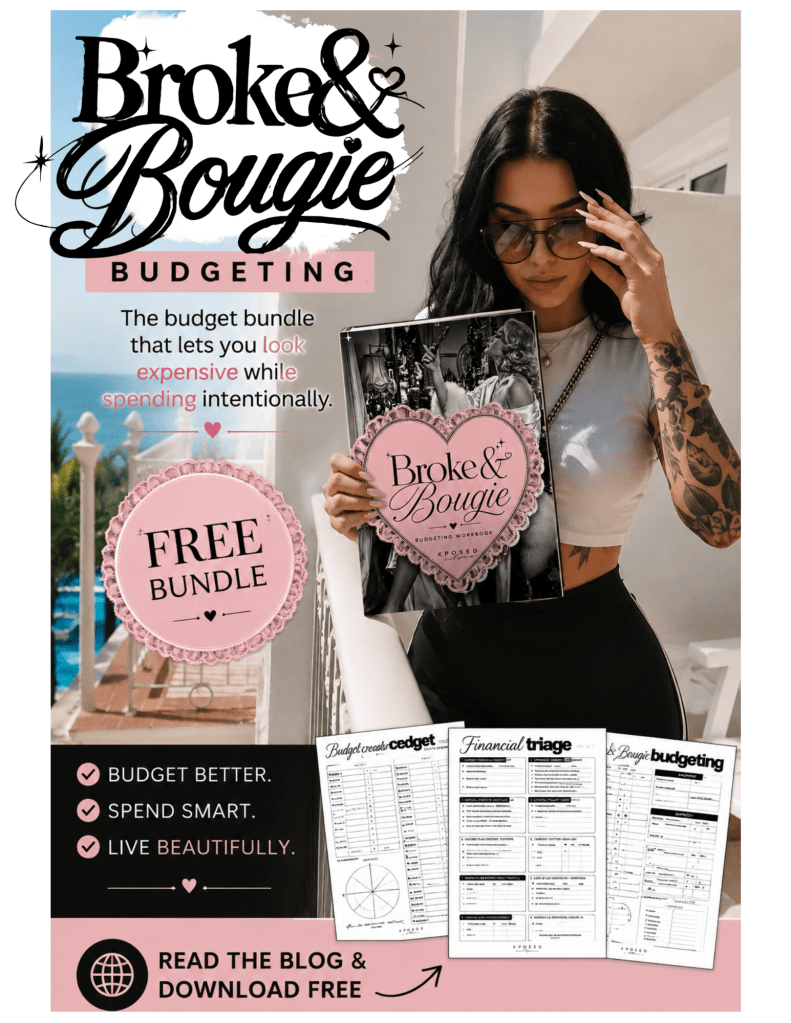
Our Broke & Bougie Budgeting Bundle provides you with multiple ways to budget, all for free, too! It would honestly be crazy to pass this up.
If you aren’t convinced yet, let me keep going.
I’ll go ahead and list the perks, with all the worksheets combined, what they could do for you. You can:
• Gain complete clarity on where every dollar is actually going.
• Stop guessing and start making intentional financial decisions.
• Catch wasteful spending before it becomes a habit.
• Create a realistic budget that works with your life instead of against it.
• Keep your bills organized so fewer due dates slip through the cracks.
• Track your savings progress and stay motivated with visible goals.
• Build healthier money habits one small decision at a time.
• Reduce financial stress by having a plan before problems happen.
• Identify financial emergencies before they become full blown crisis’
• Prioritize expenses based on urgency instead of panic.
• Develop a same day action plan when money gets tight.
• Find quick ways to generate extra income when you need it most.
• Discover expenses you can reduce without sacrificing what matters.
• Keep track of checking and savings balances in one place.
• Monitor your monthly income, spending, and overall financial health.
• Turn overwhelming finances into simple, manageable steps.
• Reflect on both your financial progress and your mindset because money is emotional too.
• Create consistency even if you’ve never successfully stuck to a budget before.
• Spend with confidence instead of wondering if you’ll regret it later.
• Have a complete budgeting system that grows with you month after month.
Then close with something like:
The best part about this bundle is that even though all the budgeting worksheets are different, every one of the worksheets are designed to work together, so instead of downloading random budgeting printables that don’t connect, you’ll have one complete system that helps you budget smarter, recover faster, and finally feel in control of your money, through every financial phase you are in. And, it’s all yours completely free.
No redirects to sign up necessary for you to get thid bundle.
No subscriptions
No pay walls.
No email marketing to sign up for to clog up your inbox.
Just practical resources designed to help you take one small step toward financial peace.
Without any strings attached.
Money management shouldn’t be looked at in a negative light.
It’s about making intentional decisions with what you already have.
Being “Broke & Bougie”, despite the obvious title suggesting otherwise, isn’t about appearances.
It’s about finding beauty in progress, celebrating small wins, and proving that financial responsibility doesn’t have to look dull.
“You can still wear designer. Just order from DHgate and retire your daily McDonald’s habit.“
Download your free budget printables below.
Print what you need.
Print an extra page for a friend.
Even though your bank account may still be a work in progress… You can start today and make your first investment in becoming someone who has their finances in order. ❤️

XX