

Regardless of how cluttered you believe your home is, the things you think are junk might actually not be considered junk at all.
Surprisingly enough, some of it might actually convert into cash.
Maybe it’s furniture that’s still tucked in your entryway closet.
Maybe it’s forgotten collectibles that are now quite valuable.
Older gaming consoles or electronics that are highly sought after.
Your childhood toys in a tote tucked away in your attic that you forgot were even up there.
Maybe it’s vintage décor, barely worn clothing or something that you didnt consider a hot commodity just because its no longer available to purchase in stores.
These random belongings have quietly blended into the background of your everyday life and theres a good chance there are many that have become valuable right under your nose.
So, for Mission 001 being simple enough. Grab some things we don’t want and sell them.
I also know that it may be simple to someone else, but for me, well, I know myself well enough to understand exactly what would happen if I head into this mission with unrealistic expectations.
I wanted to be able to approach this constructively but also realistically. Or I know what the end result would be. Me, late at night after everyone else was asleep, still awake, just mentally walking myself through my motions earlier in the day.
Deconstructing every decision. Evaluating every distraction. Determining whether I deserved a pat on the back for making progress or a lecture for wandering off course somewhere along the way.
I knew I couldn’t pencil in time for that kind of lashing later so, instead, I decided to proceed into this mission fully aware of both my strengths and my weaknesses.
I know my tendency to overcomplicate things.
I know my obsessive need to analyze every angle.
I know how easily I can disappear down a rabbit hole chasing details that have very little to do with the actual objective.
But I also know something else.
Fighting against my nature rarely works.
So, instead of resisting it, I decided to use it.
If I was going to overanalyze something, it might as well be in service of the mission.
If I was going to obsess over details, those details might as well help me uncover opportunities I would have otherwise missed.
If my brain was determined to turn a simple room sweep into a full-scale investigation, then I was going to let that complicated nature work in my favor for once.
The moment I scribbled the last item’s information onto my notebook paper, I found my mind traveling elsewhere.
And I’d need help.
But ultimately, the key is not losing sight of the primary objective.
Process not perfection.
Not organization.
Not creating the world’s most detailed inventory that’s exactly how I would want it assembled with perfectly designed labels for every drawer.
What this about is actual recovery.
The mission wasn’t to create more work.
The mission was to uncover value.
So I decided to come up with a method to prevent a meltdown later on or half the day gone and nothing to show for.
The Room to Room Recovery Method was born from the catastrophe. Right now, the lack of cash was the cure. We needed to recover some shit to resell for some revenue.
This method was not created from my desk that sits in the middle of some perfectly curated lifestyle where every bin is labeled and every drawer contains exactly what it’s supposed to.
It was created because I found myself in a position where life demanded solutions faster than I could comfortably produce them.
My first instinct, like many people facing financial pressure, initially, was to look outward.
A quick side job. side hustle. An extra shift. A few freelance gig.
Really, I just need a miracle.
But before I could go chasing these kinds of opportunities somewhere else, I realized I hadn’t fully evaluated the resources already sitting around me.
The problem was that the process itself felt overwhelming.
The thought of sorting through an entire house while already carrying the weight of everything else felt like trying to solve a puzzle while someone continuously added more pieces.
I knew if I approached it as one giant project, I would eventually lose focus, get distracted, become overwhelmed, or abandon it altogether.
So I did what I often do when something feels too large to manage.
I broke it into smaller missions.
The Room to Room Recovery Method™ is a structured system designed to help uncover hidden value inside your own home without the pressure of tackling everything at once.
Whether you’re navigating financial hardship, unexpected setbacks, executive dysfunction, survival mode, or simply trying to regain control over an environment that feels heavier than it should, the objective remains the same:
Recover what has been overlooked.
Room by room.
Shelf by shelf.
Drawer by drawer.
As you move through each mission, you will perform a recovery audit of your environment.
Every room becomes a checkpoint.
Every cabinet, tote, closet, shelf, basket, and forgotten corner becomes an opportunity to reassess what is actually occupying your space.
The goal is not to become a minimalist.
The goal is not to throw everything away.
The goal is not to sell your cherished belongings.
The goal is to identify what still serves a purpose, what no longer does, and what may still hold value.
Throughout each mission, you will inventory potential resale items, separate high value opportunities from low value distractions, document your findings, and create a practical recovery plan based on what you uncover.
Because sometimes the answer is not finding more.
Sometimes, the answer is finally recognizing what you already have.
They may have been sitting beside you all along.

Mission 001 begins in the room where most forgotten belongings eventually end up.
The Living Room.
Unlike bedrooms and closets where things are intentionally stored, the living room is where objects slowly migrate when nobody knows where they belong anymore.
It is essentially the Ellis Island of household items.
I looked around and immediately realized this room was no longer functioning the way it had originally been intended.
It was overburdened.
Lost beneath the weight of multiple people existing inside it and leaving behind tiny remnants to prove they had passed through.
Evidence of life.
Tiny remnants that are left behind every person that lives within the four walls.
And occasionally announcing that someone apparently had no intention of picking up after themselves.
Then again, why would they? They have me.
The designated collector of abandoned belongings.
The unpaid curator of everyone’s misplaced possessions.
The person constantly followed behind them, gathering whatever they left in their wake.
Then there are the things actually intended to live there.
Remote controls. Chargers. Blankets left unraveled. Candles. Books. Throw pillows.
Decorative pieces that survive year-round.
Seasonal décor that somehow overstayed its welcome.
Random electronics balanced on end tables and slowly disappearing between couch cushions.
Bluetooth speakers with dead batteries.
Tablets. Video games. Gaming Accessories.
Small furniture. Lamps. Plants.
And if you have children, add a few articles of clothing draped over chair arms, empty water bottles, rogue snack wrappers, and random dishes they so graciously leave behind for you to collect during your daily rounds of picking up.
It is very similar to a correctional officer making rounds.
Except you can not reach for a taser to restore order because, first of all, they are not criminals.
And secondly…
That’s child abuse.
Still, it does not eliminate the similarities in positioning.
Another profession you quietly assume the moment that version of you is needed.
Because somehow being a parent means becoming everything.
Driver. Cook. Mediator. Therapist. Teacher.
Housekeeper. Security. Detective.
Professional finder of missing objects.
It becomes exhausting not only being everything for everyone but also carrying the weight required to keep the entire machine functioning.
Then, somewhere between picking up the fifth empty cup and relocating somebody’s sock from a location that defies logic, you remember something.
The only way to get something different is to do something you have never done.
As cliché as that statement sounds, it still carries the same weight it did the first time you heard it.
Because growth requires movement.
Physical movement.
Mental movement.
The uncomfortable kind where you have to push beyond your usual patterns and approach things differently to create a different outcome.
It might take several attempts before you see results.
But there is one important detail people rarely mention.
Growth exists in the middle of discomfort.
So today’s mission is simple.
Find something worth money.
Something you are not sentimentally attached to.
Something you can part with.
Something complete.
Something in excellent condition.
Something quietly sitting in plain sight, pretending it has not been occupying space rent-free for years.
As you begin the recovery sweep, resist the urge to grab a ladder and start overexerting yourself this early in the process.
Instead, simply scan.
Wall to wall.
Corner to corner.
Inventory what immediately stands out as potentially valuable.
Gather those items together.
Wipe them down.
Dust them.
Polish them.
Disinfect them.
If glass or reflective surfaces are involved, remove fingerprints, smudges, and dust.
Presentation matters.
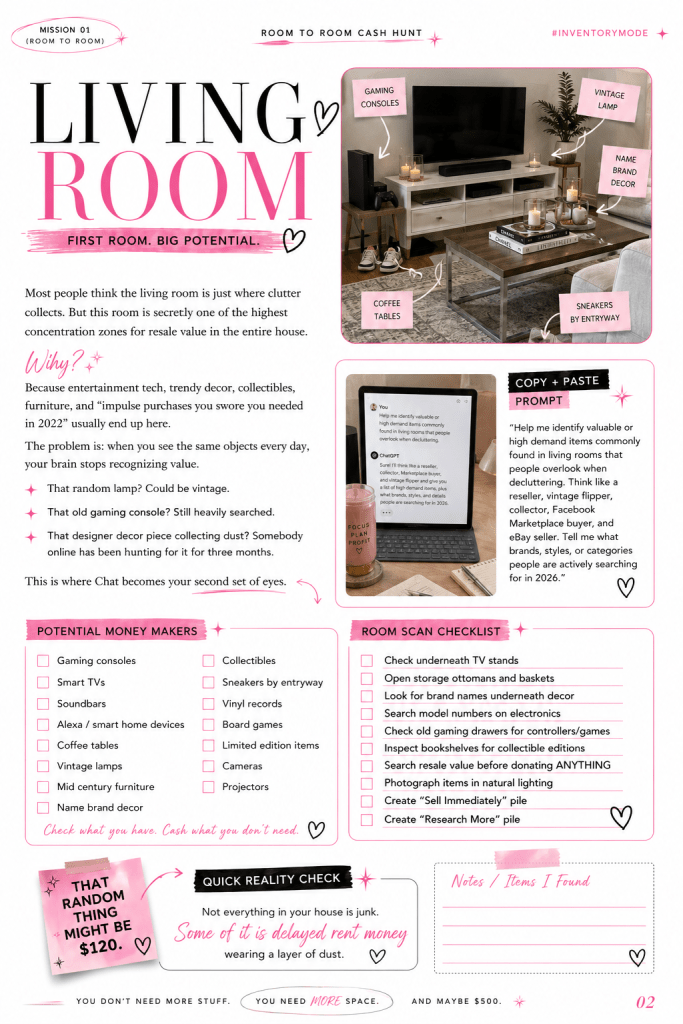
Now, create your Living Room Recovery Record.
If you prefer digital records, open the notes application on your phone.
Apple.
Android.
Doesn’t matter.
If you prefer writing things down, grab a notebook and pen.
We are beginning a room inventory.
Time is of the essence.
There is no designated window for emotional attachment audits.
If it is not an heirloom, a rare collectible, a handcrafted piece, or something with genuine historical, artistic, or sentimental significance, leave the emotions out of the evaluation.
The questions are simple.
Have you used it this month?
The last six months?
The last year?
If you got rid of it today, could you realistically replace it tomorrow?
Would your daily life become noticeably more difficult without it?
We are not inventing hypothetical future scenarios where a future version of ourselves suddenly needs the thing we haven’t touched in four years.
We are collecting evidence.
List the room.
List the item.
Record the condition.
Estimate the value after a Google Image Search.
Note whether it is complete.
Document anything that may matter later.
I completed the same process alongside you, exactly as promised.
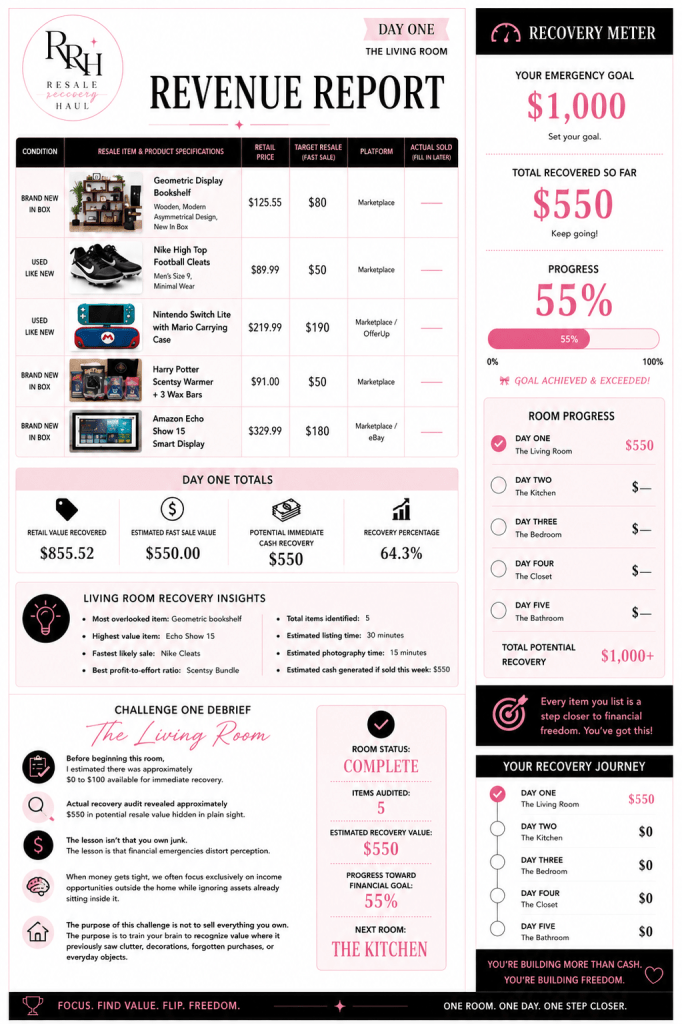
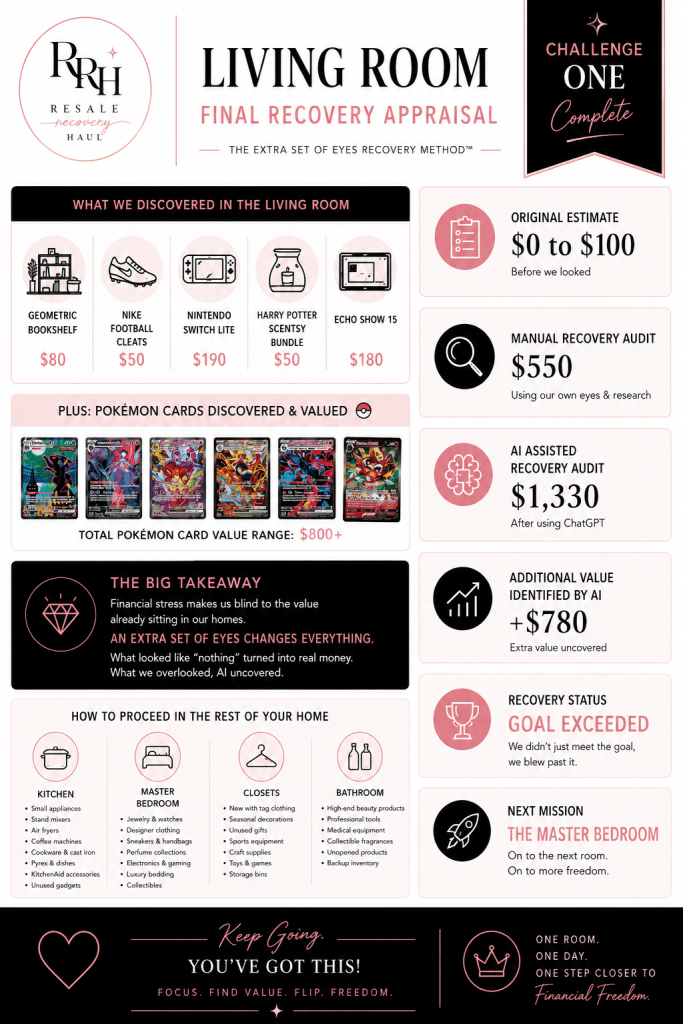
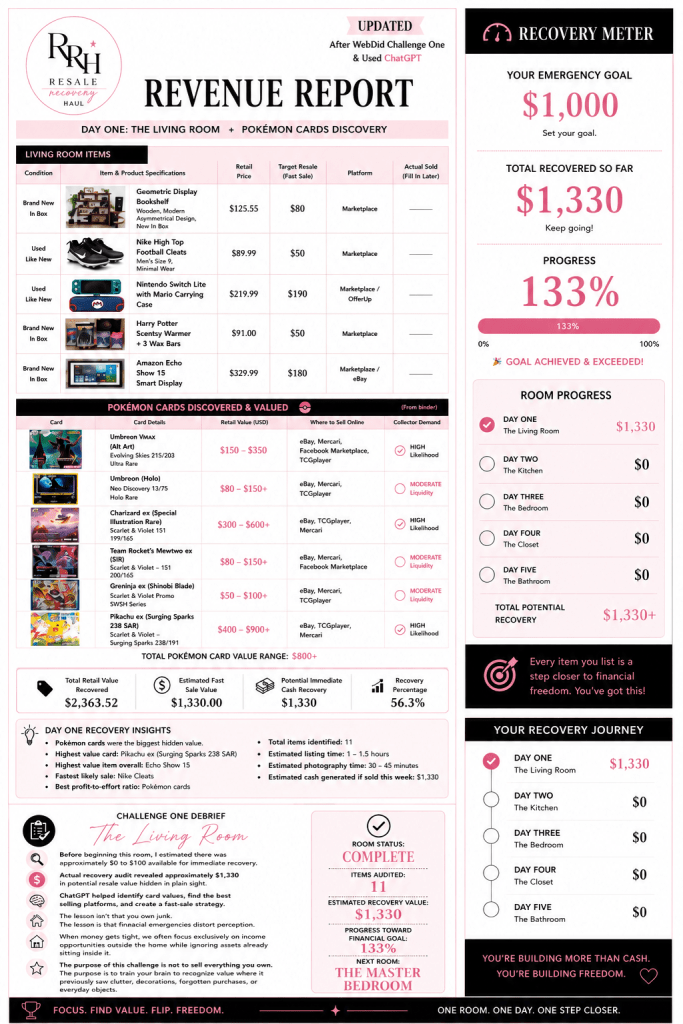
The inventory from the living room wasn’t substantial. But, it was decent. For a single room, at least.
My Living Room Recovery Looks Somewhat Decent!
1.A Scentsy Warmer and Wax Melts
2.A pair of Nike High Top Football Cleats
3. A Nintendo Switch & Carrying Case
4. A Geometric Bookshelf (in box)
5. A Echo Show 15 (In box)

As soon as I started feeling accomplished, a thought crossed my mind.
What if I’m overlooking something?
Not because it isn’t there.
Because I’m so distracted by my own problems that I can’t see it.
That possibility bothered me.
The more I thought about it, the more reasonable it seemed.
After all, I was conducting this entire recovery mission while carrying around enough stress to power a small city. My attention was divided between the room directly in front of me and the financial catastrophe looming overhead.
How many things had I already walked past?
How many opportunities had I unconsciously dismissed?
How many times had I looked directly at something without actually seeing it?
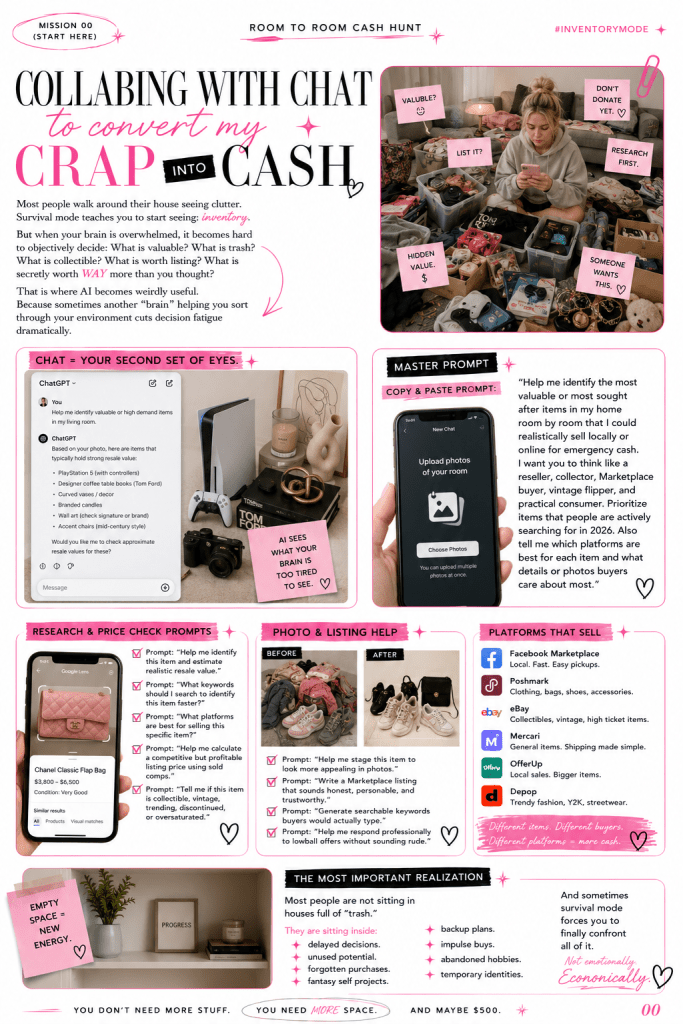
I wished I had an extra pair of eyes.
Unfortunately, I was home alone.
No second opinion.
No resale expert.
No friend to follow behind me, pointing out the obvious things I had missed.
Just me.
Then I got an idea.
Now, before I continue, this next part may not be for everyone.
Some people are going to love it.
Some people are going to hate it.
Some people are immediately going to start arguing about robots replacing humanity, artificial intelligence taking over the world, or whatever terrifying headline is currently circulating this week.
That’s fine.
This portion of the mission is completely optional.
Think of it as extra credit.
A side quest.
A bonus challenge.
If you’re the type of person who still refuses to use self checkout because it’s “taking somebody’s job,” feel free to skip ahead.
You’ll still complete the mission perfectly fine without it.
But if you’re willing to experiment, I’d like to propose an idea that might sound crazy.
Its one of those things that sounds so crazy, it might end up really changing the game and helping out in ways I never thought possible.
The fact Im experiencing a Cash Catastrophe makes it to where I need all the help ai can get.
This only eliminates the uncomfortability that comes with asking someone for help and burdening another person witt yet another one of your many problems that seem to never end.
Let’s save ourselves the embarrassment today. Let’s venture into a sort of Robot Recruitment Phase….
Heres the completely optional First Challenge.
The Extra Set of Eyes Challenge ™.

Whether we like it or not, artificial intelligence is here to stay.
Although this is not the type of thing I typically would rely on AI for, I thought to myself, ” Why not? What do I really have to lose? Not much. What do I have to gain? I can only assume, possibility.”
Why did I even consider this?
Well, it’s obvious I needed help, and it’s already widely known. I have a shortage of people available to me to have a wide open schedule that I can burden with my heavy load.
I also know enough about AI to know what its capable of. My decision to intergrate it in my recovery method began with the obe thought.
AI currently has one major advantage over human beings.
It isn’t emotionally attached to your situation.
AI also, is guaranteed to nor be attached emotionally on your material objects.
It isn’t invested in preserving a future version of you who may one day become a professional scrapbooker, candle maker, woodworker, reseller, crafter, baker, gardener, or whatever other identity your abandoned hobby supplies are still convinced you’re eventually becoming.
It simply evaluates what it sees.
And sometimes that’s exactly what you need.
Not because AI is smarter than you.
Because familiarity creates blindness.
The things we see every day eventually become invisible.
The bookshelf you’ve walked past a thousand times.
The storage bin you’ve moved three different times without opening.The longer something exists in your environment, the less attention your brain gives it.
That’s just how people work.
So, if you’re feeling adventurous, this challenge may be worth exploring.
Worst case scenario?
It finds nothing.
You lose a few minutes and move on with your day.
Best case scenario?
It identifies something valuable you’ve been walking past for years.
Considering the entire objective of this mission is recovery, I figured a second set of eyes couldn’t hurt.
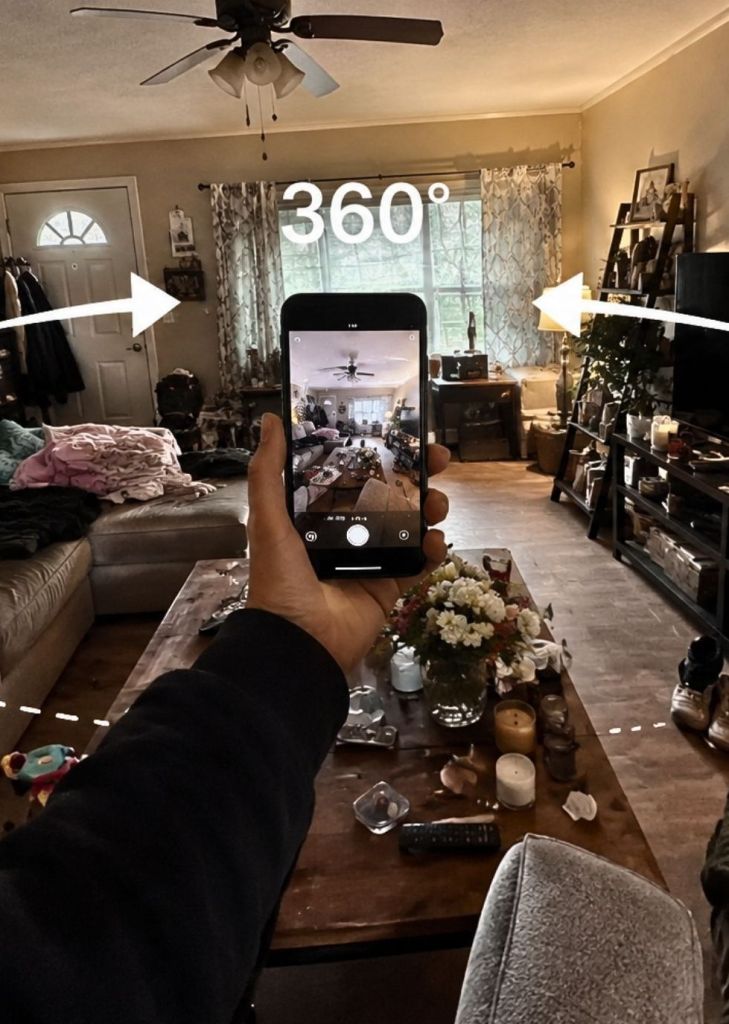
So, I opened up ChatGPT and started snapping photos of my living room.
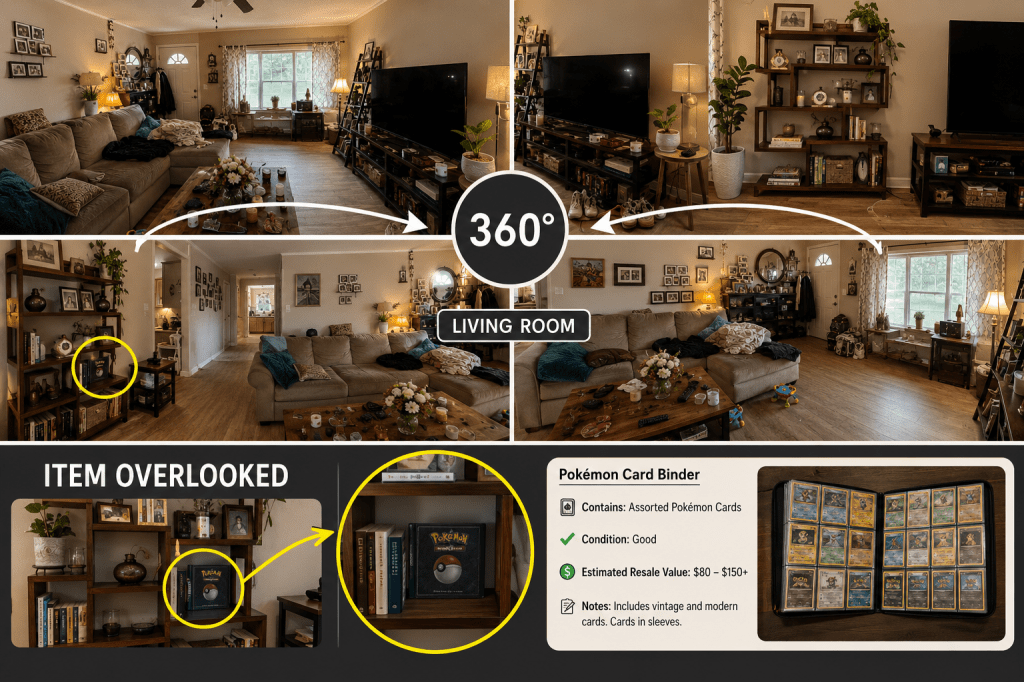
I made a full 360° Turn and took several shots I intended to go through and see the best idea that weren’t blurred and upload those. No more then 10 at a time.
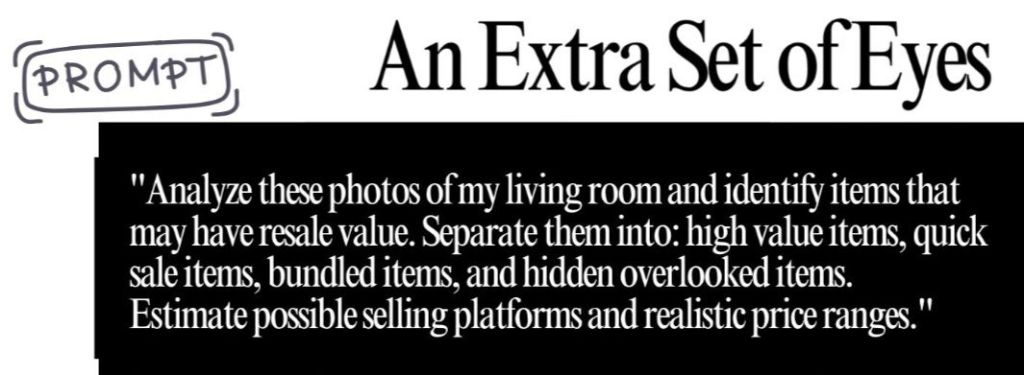
It took about 30 seconds to a minute to get a response. .

Apparently, some Pokémon Binder of my son’s was spotted, and Chat asked me to open it up and take a photo of a few pages inside to see if there were any cards of value.
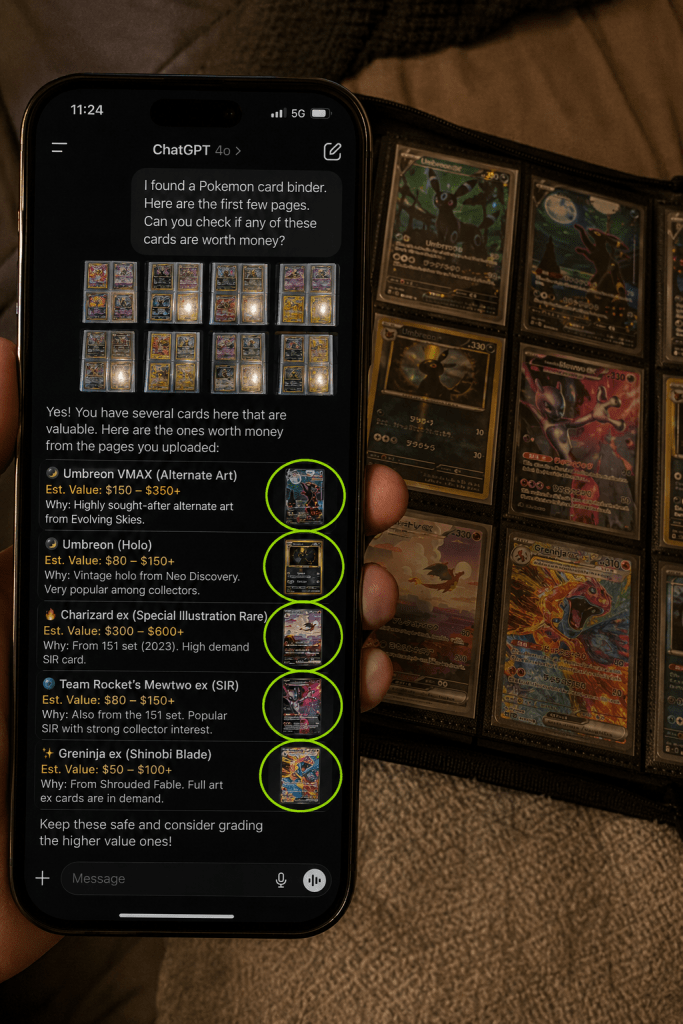
Out of the first several pages I uploaded, multiple cards were immediately flagged as potentially valuable.
Not “worth a couple of bucks” valuable.
Actual collector cards.
The kind of cards that make you pause, sit up a little straighter, and suddenly pay much closer attention to what you’re looking at.
The Umbreon VMAX Alternate Art was identified as one of the stronger finds due to its popularity among collectors and continued demand in the market. The Charizard Special Illustration Rare was immediately recognized as one of the most sought-after cards from its set. Pikachu EX from Surging Sparks surfaced as another card with unusually high collector interest and a reputation for moving quickly when priced appropriately.

Team Rocket’s Mewtwo, Greninja EX, and several Umbreon cards were also identified as cards worth taking a closer look at.
What exactly was sitting inside this binder remained to be seen, but it was becoming increasingly clear that there might be genuine value hiding behind those plastic sleeves.
At the same time, I knew enough about collectibles to understand an important distinction.
Potential value and immediate cash are not the same thing.
These weren’t everyday Facebook Marketplace flips.
They weren’t the type of items where you snap a few photos, post them online, and have somebody knocking on your door thirty minutes later with cash in hand.
Collectibles are a different animal entirely.
The right buyer matters.
Condition matters.
Presentation matters.
Timing matters.
And in some cases, patience matters more than anything.
I could have easily overlooked the binder altogether and never fully understood the value sitting inside it. Had I relied solely on my own observations, I probably would have walked right past it.
But I also wasn’t about to convince myself that one promising discovery in the living room had suddenly solved all my problems.
The mission wasn’t over.
The room had simply revealed its first surprise.
People often make the mistake of assuming that value automatically equals liquidity.
It doesn’t.
Something can be worth hundreds of dollars and still require effort, research, patience, and the right buyer before that value becomes real money.
The Pokémon binder was an unexpected win, but it was still going to require a conversation with my son.
He understands the politics of Pokémon far better than I do.
The grading.
The condition standards.
The collector culture.
The tiny details that can dramatically impact value.
A card might appear flawless to me and still lose a significant percentage of its worth because of a tiny scratch, slight whitening around an edge, a fingerprint smudge, or some microscopic imperfection that only becomes visible once collectors start examining it like forensic investigators.
Before making assumptions, I wanted his input.
Still, even without grading or deeper inspection, the binder had earned a spot on my Living Room Recovery List.
Not as guaranteed money.
As potential.
And that distinction matters.
What originally looked like a random binder shoved onto a bookshelf had quietly transformed into possible inventory.
More importantly, it reinforced the entire purpose behind Challenge One.
Not because every home secretly contains thousands of dollars.
Not because artificial intelligence is magically uncovering treasure.
But because familiarity creates blindness.
The things we walk past every day eventually become part of the background.
And once you train yourself to look differently, something interesting happens.
You stop seeing clutter.
You start seeing assets.
As promising as the Pokémon binder discovery was, I had to remind myself why I started this mission in the first place.
The objective wasn’t to become a professional card grader.
It wasn’t to spend six hours researching market trends.
It wasn’t to disappear into another rabbit hole and convince myself I was being productive while avoiding the larger task at hand.
The objective was recovery.
And recovery requires momentum.
At some point, you have to stop analyzing and keep moving.
The living room had already given me more than I expected.
Several electronics.
A few household items.
Some potential collectibles.
A handful of things that could realistically be converted into cash.
More importantly, it had given me proof.
Proof that I wasn’t surrounded by useless junk.
Proof that value still existed inside my home.
Proof that I wasn’t nearly as trapped as my stress had convinced me I was.
The funny thing about financial pressure is that it narrows your vision.
The heavier the burden becomes, the smaller your world gets.
You stop seeing opportunities.
You stop seeing options.
You stop seeing anything beyond the immediate problem demanding your attention.
For a little while, the living room forced me to look beyond the problem.
Not solve it.
Just look beyond it.
And honestly, that alone felt like progress.
By the time I finished documenting everything, gathering potential inventory, and completing the first mission, the room itself didn’t look dramatically different. Most people probably wouldn’t have noticed much of a change.
But I did.
Because I wasn’t looking at the room anymore.
I was looking at it differently.
The bookshelf wasn’t just a bookshelf.
The storage basket wasn’t just a storage basket.
The forgotten electronics weren’t just clutter.
The Pokémon binder wasn’t just something collecting dust.
Everything had shifted categories.
The room had transformed from a collection of objects into a collection of possibilities.
Some immediate.
Some long term.
Some still require more investigation.
But possibilities nonetheless.
And that was enough.
I wasn’t looking for a miracle.
I was looking for movement.
The living room gave me that.
So, with Mission 001:1 officially complete, I closed my notebook, gathered my recovery list, and resisted the temptation to immediately start posting listings before the rest of the house had been searched.
There would be time for that later.
The mission was never to sell one item.
The mission was to build momentum.
One room wasn’t going to solve everything.
But one room was enough to prove the concept.
Enough to prove that opportunities still exist.
Enough to prove that I wasn’t standing in an empty house hoping for a miracle.
I was standing inside a house filled with resources I had simply stopped noticing.
Tomorrow, another room.
Another sweep.
Another opportunity to uncover value hiding in plain sight.
Because if the living room taught me anything, it was this:
The problem isn’t always that we have nothing.
Sometimes, the problem is that we’ve stopped seeing what we already have.
Mission 001: The Living Room
Status: Complete.
Recovery Value: Better than expected.
Most Valuable Discovery: Perspective and Optimism for Mission 001:2.
Tomorrow, though, I can sleep a little easier now knowing the potential of tomorrow’s recovery might produce.
Stay tuned for the next room!


